Subject: GS 2: Polity & Governance
Context: Recently, the Union Cabinet has approved the Pradhan Mantri Surya Sarovar Yojana (PM-SSY) with an outlay of ₹5,070 crore, enhancing India’s renewable energy capacity while reducing pressure on land resources.
UPSC Coaching Classes
About Pradhan Mantri Surya Sarovar Yojana (PM-SSY)
It is a Central Sector Scheme aimed at accelerating the deployment of Floating Solar Photovoltaic (FSPV) projects on reservoirs and other inland water bodies, integrated with Battery Energy Storage Systems (BESS) to improve grid stability and clean energy generation.
- A Battery Energy Storage System (BESS) stores electricity in rechargeable batteries and supplies it when required, ensuring efficient use of renewable energy.
- Function: It stores excess power generated from solar or wind energy and releases it during peak demand or when renewable generation is low.
- Significance: It enhances grid stability, improves renewable energy integration, and supports reliable, uninterrupted power supply.
|
- Nodal Ministry: Ministry of New and Renewable Energy (MNRE).
- Implementing Agency: The scheme is to be implemented by Solar Energy Corporation of India (SECI) in coordination with State Governments/State Nodal Agencies and other implementing entities for floating solar projects.
 Key Features:
-
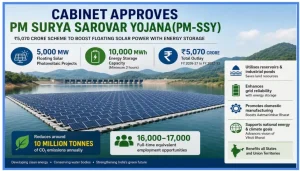
- Implementation Period: Projects will be sanctioned during FY 2026–27 to FY 2030–31, with financial assistance available till FY 2032–33.
- Target Capacity: To develop 5,000 MW of floating solar capacity along with 10,000 MWh of co-located energy storage (minimum 2-hour storage duration).
- Central Financial Assistance (CFA): Provides ₹1 crore per MW for eligible projects after successful commissioning.
- Support for Feasibility Studies: Offers financial assistance up to ₹50 lakh per project for bathymetry, hydrography, environmental assessments, and other preparatory studies.
- Coverage: Applicable to all States and Union Territories.
About Floating Solar Photovoltaic (FSPV)
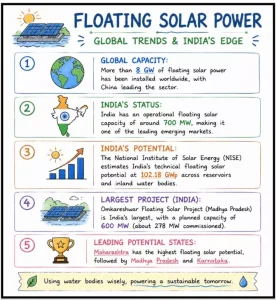
- Meaning: Solar photovoltaic systems installed on floating platforms over reservoirs, lakes, irrigation tanks, industrial ponds, and other inland water bodies.
- Working: Solar panels mounted on floating structures generate electricity, while the water body naturally cools the panels, improving their efficiency.
- Major Components: Floating platforms, photovoltaic modules, anchoring and mooring systems, underwater cables, inverters, and energy storage systems.
Need for the Scheme
- Addressing Land Constraints: Promotes utility-scale solar power without requiring large tracts of land.
- Enhancing Grid Reliability: Integrates Battery Energy Storage Systems (BESS) to ensure reliable and stable renewable power supply.
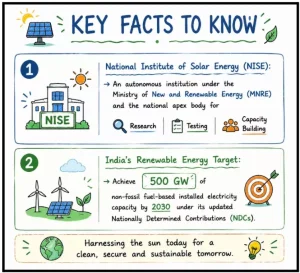
- Harnessing Untapped Potential: Utilises India’s vast reservoir network, with an estimated 102.18 GWp of floating solar potential, as assessed by National Institute of Solar Energy (NISE).
- Advancing Climate Commitments: Supports India’s renewable energy targets and decarbonisation objectives.
Significance
- Expands Renewable Energy Capacity: Enhances India’s floating solar capacity beyond the current ~700 MW.
- Strengthens Energy Security: Increases clean electricity generation through storage-backed renewable energy.
- Promotes Atmanirbhar Bharat: Encourages domestic manufacturing of floating platforms, photovoltaic modules, batteries, and related equipment.
- Generates Employment: Expected to create around 16,000–17,000 Full-Time Equivalent (FTE) jobs.
- Delivers Environmental Benefits: May reduce nearly 10 million tonnes of carbon dioxide emissions annually while enabling efficient utilisation of water bodies.
Click to Know UPSC OnlyIAS Coaching Centres
Conclusion
The Pradhan Mantri Surya Sarovar Yojana (PM-SSY) advances land-efficient, storage-backed renewable energy deployment, strengthening energy security, supporting climate goals, and accelerating India’s transition towards a low-carbon economy.
 1 Aug 2026