Subject: GS 3: Science & Technology
Context: Recently, researchers have developed an indigenous Placenta-on-Chip platform that recreates key functions of the human placenta.
UPSC Online Coaching
About Placenta-on-Chip
- Placenta-on-Chip is a microphysiological (Organ-on-Chip) platform that replicates the maternal–fetal interface and mimics the key physiological functions of the human placenta under controlled laboratory conditions.
- Objective: It provides a human-relevant experimental model to study placental biology, pregnancy-related disorders, drug transport across the placenta and fetal development, without directly studying the placenta during pregnancy.
 Developed By: Jointly developed by ICMR–National Institute for Research on Women’s Health (ICMR-NIRWoH), Mumbai and IIT Bombay.
About the Human Placenta
- The placenta is a temporary organ formed during pregnancy that acts as the vital link between the mother and the developing fetus.
- Major Functions:
-
- Supplies oxygen and nutrients to the fetus.
- Removes carbon dioxide and metabolic waste products.
- Produces pregnancy hormones essential for maintaining pregnancy.
- Acts as a selective biological barrier, regulating the transfer of nutrients, medicines and harmful substances.
- Provides immune protection to support fetal development.
Key Features of Placenta-on-Chip
- Recreates Placental Functions: Replicates hormone production, nutrient transport, waste removal and selective barrier activity.
- Simulates Maternal–Fetal Interface: Mimics the maternal–fetal interface, enabling real-time observation of placental processes.
- Models Pregnancy Disorders: Simulates conditions such as gestational diabetes (hyperglycaemia) to study changes in placental function.
- Studies Drug Transfer: Evaluates how drugs and other molecules cross the placental barrier, supporting safer medicines for pregnant women.
- Laboratory-Friendly Design: Does not require sophisticated microfluidic equipment or continuous perfusion systems, making it simpler, scalable and cost-effective for routine laboratories.
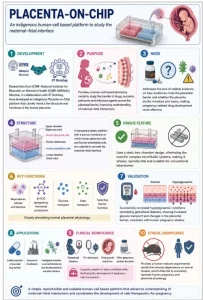
Potential Applications of Placenta-on-Chip:
- Drug Development: Evaluates the safety of medicines intended for pregnant women.
- Disease Modelling: Studies gestational diabetes, pre-eclampsia, fetal growth restriction and placental insufficiency.
- Basic Research: Investigates nutrient exchange, hormone secretion and placental transport mechanisms.
- Regenerative and Reproductive Medicine: Supports advances in maternal healthcare, reproductive biology and future therapeutic research.
|
Click to Know UPSC Offline Courses
About Organ-on-Chip (OoC) Technology
- Organ-on-Chip (OoC) is a microengineered cell-culture platform that recreates the structure and physiological functions of human organs on a miniature chip.
- Working Principle: Combines living human cells, tissue engineering and microfluidics to simulate organ behaviour under controlled laboratory conditions.
- Applications:
- Disease modelling
- Drug discovery and toxicity testing
- Personalised medicine
- Studying human physiology
- Reducing animal experimentation
 9 Jul 2026