Subject: GS 2: Polity & Governance
Context: The Union Ministry of Education has released the All India Survey on Higher Education (AISHE) Reports 2022–23 and 2023–24.
UPSC Coaching Classes
Key Highlights of AISHE 2022–23 & 2023–24
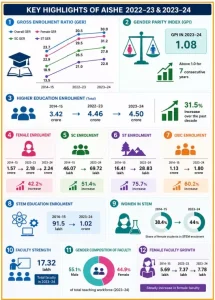
- Gender Parity Index (GPI): The Gender Parity Index (GPI) is calculated as the ratio of female GER to male GER and measures the relative participation of women in higher education.
- Performance: The GPI stood at 1.08 in 2023–24 and has remained above 1.0 for seven consecutive years, indicating consistently higher female participation compared to males.
- Gross Enrolment Ratio (GER): The Gross Enrolment Ratio (GER) is calculated as the ratio of students enrolled in higher education to the total population in the 18–23 years age group based on the 2011 population projections.
- Overall Trend: The GER increased steadily from 23.7 in 2014–15 to 29.5 in 2022–23 and further to 30.0 in 2023–24, indicating sustained expansion in access to higher education.
- Female GER: The female GER increased from 22.9 in 2014–15 to 30.2 in 2022–23 and further to 31.2 in 2023–24, reflecting greater participation of women in higher education.
- SC & ST GER: The GER of Scheduled Castes (SCs) increased from 18.9 in 2014–15 to 27.8 in 2023–24, while the GER of Scheduled Tribes (STs) increased from 13.5 to 22.8 during the same period, indicating improved educational access for disadvantaged communities.
- Higher Education Enrolment: Total enrolment increased from 3.42 crore in 2014–15 to 4.46 crore in 2022–23 and 4.50 crore in 2023–24, representing a 31.5% increase over the past decade.
- Female Enrolment: Female enrolment increased from 1.57 crore in 2014–15 to 2.18 crore in 2022–23 and 2.24 crore in 2023–24, registering a 42.2% increase, which exceeded the overall growth rate.
- SC Enrolment: Enrolment of Scheduled Castes (SCs) increased from 46.07 lakh in 2014–15 to 69.72 lakh in 2023–24, representing a 51.4% increase.
- ST Enrolment: Enrolment of Scheduled Tribes (STs) increased from 16.41 lakh in 2014–15 to 28.83 lakh in 2023–24, representing a 75.7% increase.
- OBC Enrolment: Enrolment of Other Backward Classes (OBCs) increased from 1.13 crore in 2014–15 to 1.80 crore in 2023–24, reflecting a 60.2% increase.
- STEM Education: Enrolment in Science, Technology, Engineering and Mathematics (STEM) increased from 91.5 lakh in 2014–15 to 1.02 crore in 2023–24, reflecting increasing emphasis on science and technology education.
- Women in STEM: The share of female students in STEM enrolment increased from 38.4% in 2014–15 to 44% in 2023–24, indicating improving gender inclusivity in scientific and technical education.
- Faculty Strength: The total number of faculty members increased to 17.32 lakh in 2023–24.
- Gender Composition: Male faculty constituted 55.1%, while female faculty accounted for 44.9% of the total teaching workforce.
- Female Faculty Growth: The number of female faculty members increased from 5.69 lakh in 2014–15 to 7.37 lakh in 2022–23 and further to 7.78 lakh in 2023–24.
About All India Survey on Higher Education (AISHE)
The All India Survey on Higher Education (AISHE), launched in 2011 by the Ministry of Education (then the Ministry of Human Resource Development) is the annual national survey conducted by the Ministry of Education to collect comprehensive data on the higher education sector in India.
- Objective: Serves as the official database on higher education and supports policymaking, planning, monitoring, resource allocation and evidence-based decision-making.
- Coverage: Covers all Higher Education Institutions (HEIs)—Universities, Colleges and Standalone Institutions—across India.
- Data Collection: HEIs upload data on enrolment, faculty, infrastructure, examination results and institutional characteristics through the web-based Data Capture Format (DCF) on the AISHE Portal.
- Participation: Over 90% of registered HEIs participated in both years—56,180 of 60,380 HEIs in 2022–23 and 59,533 of 64,756 HEIs in 2023–24.
|
Significance of the Findings
- Expansion of Higher Education: The sustained increase in GER and total enrolment reflects continuous expansion in access to higher education across the country.
- Improved Gender Inclusion: Higher female GER, sustained GPI above 1.0 and increased female enrolment indicate significant progress towards achieving gender equality in higher education.
- Greater Social Inclusion: Rising enrolment and GER among SC, ST and OBC students demonstrate improved educational opportunities for historically disadvantaged communities.
- Strengthening STEM Ecosystem: The growth in STEM enrolment, particularly among women, supports India’s objective of creating a skilled workforce for emerging technologies and a knowledge-based economy.
- Support for NEP 2020: The findings indicate steady progress towards the goals of the National Education Policy (NEP) 2020, particularly in expanding access, promoting equity, improving quality and enhancing participation in multidisciplinary and technical education.
- Evidence-Based Policymaking: AISHE provides a robust database for educational planning, resource allocation, policy evaluation and monitoring of higher education reforms.
Click to Know UPSC OnlyIAS Coaching Centres
Conclusion
The AISHE 2022–23 and 2023–24 reports reflect the continued expansion and increasing inclusiveness of India’s higher education sector. Improvements in GER, gender parity, enrollment of disadvantaged groups, STEM participation and faculty strength demonstrate steady progress towards the objectives of the National Education Policy (NEP) 2020 and strengthen the foundation for building an inclusive, skilled and globally competitive knowledge economy.
 9 Jul 2026