Subject: GS 2: Polity & Governance
Context: Recently, the Union Ministry of Education has released the Performance Grading Index 2.0 for States/UTs (PGI-S) and the Performance Grading Index for Districts (PGI-D) for 2025–26 to assess and benchmark the performance of school education systems across the country.
UPSC Online Preparation
About Performance Grading Index (PGI)
- It is a comprehensive assessment framework developed by the Department of School Education & Literacy, Ministry of Education, to evaluate the performance of States, Union Territories and districts in school education.
- Purpose: It measures educational performance through a grading-based system, enabling governments to monitor progress, identify gaps and undertake evidence-based policy interventions.
- Approach: Unlike a conventional ranking system, the PGI places multiple States/UTs or districts in the same performance grade, thereby encouraging continuous improvement, healthy competition and cooperative learning.
About Performance Grading Index 2.0 for States/UTs (PGI-S)
- Objective: The PGI-S evaluates the overall performance of States and Union Territories across key dimensions of school education and helps identify areas requiring policy and administrative reforms.
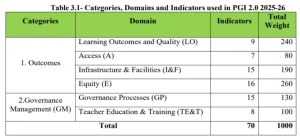
- Framework: The framework carries a total weightage of 1,000 points distributed across 70 performance indicators.
- These indicators are grouped under two broad categories:
- Outcome
- Governance & Management
- Domains: The indicators are organised under six domains:
- Learning Outcomes and Quality: Measures students’ academic performance, foundational learning and overall quality of education.
- Access: Assesses enrolment, retention, transition and participation in school education.
- Infrastructure & Facilities: Evaluates the availability of classrooms, drinking water, toilets, electricity and other essential school facilities.
- Equity: Measures inclusiveness and equitable access to education for disadvantaged and vulnerable groups.
- Governance Processes: Assesses administrative efficiency, institutional management and implementation of educational policies.
- Teacher Education & Training: Evaluates teacher availability, professional development and capacity-building initiatives.
Data Sources: The assessment is based on data collected from:
- Unified District Information System for Education Plus (UDISE+)
- PARAKH Rashtriya Sarvekshan (PRS) 2024
- PM POSHAN Portal
- PRABAND Portal
- Vidyanjali Portal
|
- Key Performance:
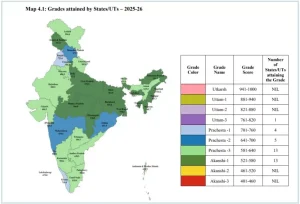
- Top Performer: Chandigarh emerged as the best-performing State/Union Territory in PGI 2.0 (2025–26) and became the only State/UT to secure the ‘Uttam-3’ grade.
- Second Best Performers: Punjab, Kerala, Delhi, and Dadra & Nagar Haveli and Daman & Diu were placed in the second-highest performance band among the States and Union Territories.
- Highest Grades Remain Unattained: No State or Union Territory achieved the ‘Utkarsh’, ‘Uttam-1’ or ‘Uttam-2’ grades, indicating considerable scope for improvement in school education outcomes.
- Lowest Performance Categories: No State or Union Territory was placed in the ‘Akanshi-1’ or ‘Akanshi-2’ categories.
- Grading Approach: The Performance Grading Index (PGI) 2.0 evaluates States and Union Territories through a grading system instead of rankings, enabling multiple States/UTs to be placed within the same performance band and encouraging continuous improvement.
- Grading Structure: The PGI 2.0 grading framework comprises Utkarsh (above 90%), Uttam-1 (81–90%), Uttam-2 (71–80%), Uttam-3 (61–70%), Prachesta-1 (51–60%), Prachesta-2 (41–50%), Prachesta-3 (31–40%), Akanshi-1 (21–30%), Akanshi-2 (11–20%), and Akanshi-3 (up to 10%).
Best Online Coaching for UPSC
About Performance Grading Index for Districts (PGI-D)
- The PGI-D extends the Performance Grading Index to the district level to assess educational performance on a common set of parameters with greater emphasis on measuring the outcomes of education policies at the grassroots level.
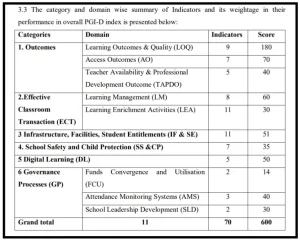
- Framework: The framework carries a total weightage of 600 points distributed across 70 indicators.
- These indicators are grouped under six broad categories:
- Outcomes
- Effective Classroom Transaction
- Infrastructure, Facilities & Student Entitlements
- School Safety & Child Protection
 Digital Learning
- Governance Process
- Domains: The assessment covers eleven domains:
- Learning Outcomes and Quality (LOQ): Assesses students’ learning achievements and overall educational quality.
- Access Outcomes (AO): Measures enrolment, attendance, retention and transition rates.
- Teacher Availability and Professional Development Outcomes (TAPDO): Evaluates teacher adequacy, deployment and professional development.
- Learning Management (LM): Assesses classroom processes, curriculum implementation and academic management.
 Learning Enrichment Activities (LEA): Measures co-curricular activities and initiatives that enhance learning experiences.
- Infrastructure, Facilities & Student Entitlements (IF&SE): Evaluates school infrastructure, student facilities and entitlement delivery.
- School Safety & Child Protection (SS&CP): Assesses measures ensuring safe, inclusive and child-friendly school environments.
- Digital Learning (DL): Evaluates the availability and effective use of digital infrastructure and technology-enabled education.
- Funds Convergence & Utilisation (FCU): Measures the effective convergence, allocation and utilisation of financial resources.
- Attendance Monitoring Systems (AMS): Assesses systems for monitoring the attendance of students and teachers.
- School Leadership Development (SLD): Evaluates leadership capacity, institutional planning and school management practices.
- Data Sources: The assessment is based on information collected through:
- Unified District Information System for Education Plus (UDISE+)
- PARAKH Rashtriya Sarvekshan (PRS) 2024
- PRABANDH Portal
- Key Performance:
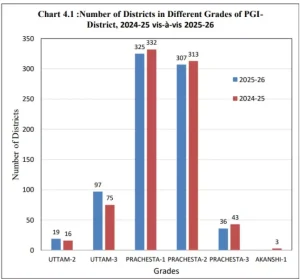
- Highest Grade Performance: No district attained the highest ‘Utkarsh’ grade in 2025–26, indicating that the highest level of educational performance remains to be achieved.
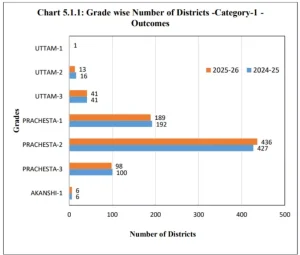
- Uttam-1 Performance: One district secured the ‘Uttam-1’ grade during 2025–26.
- Growth in Uttam-2 Districts: The number of districts achieving the ‘Uttam-2’ grade increased from 16 in 2024–25 to 19 in 2025–26, reflecting gradual improvement in district-level educational performance.
- Improvement in Outcome Scores: A total of 462 districts improved their scores under the Outcome category, of which 50 districts progressed to a higher performance grade.
- Shift Towards Higher Grades: The number of districts in the ‘Uttam-3’ category increased from 75 to 97, while the number of districts in the ‘Prachesta-1’ category declined from 332 to 325, indicating an overall improvement in district performance.
- Top Performing Districts: The 19 districts placed in the ‘Uttam-2’ category include seven districts from Punjab, four from Delhi, three from Kerala, two from Maharashtra, along with Chandigarh, Diu, and Hamirpur (Himachal Pradesh).
- Overall Assessment: The report highlights that the absence of districts in the ‘Utkarsh’ category and the presence of only one district in the ‘Uttam-1’ category indicate significant scope for improving learning outcomes and governance across districts.
Significance
- Outcome-Oriented Assessment: The framework shifts the focus from measuring educational inputs alone to evaluating learning outcomes, governance quality and policy implementation.
- Evidence-Based Policymaking: It enables governments to identify performance gaps and formulate targeted interventions based on reliable educational data.
- Strengthened Accountability: Periodic assessment promotes greater accountability among States, Union Territories and districts in improving school education outcomes.
- Promotion of Cooperative Federalism: The grading approach encourages healthy competition while facilitating the exchange of best practices among States, Union Territories and districts.
- Support for NEP 2020: The framework aligns with the objectives of the National Education Policy (NEP) 2020 by promoting quality education, equity, teacher development, digital learning and governance reforms.
Click to Explore UPSC Offline Coaching
Conclusion
PGI-S and PGI-D provide a robust framework for assessing school education performance. By promoting data-driven governance, accountability and continuous improvement, they contribute significantly to achieving the objectives of NEP 2020 and improving educational outcomes across India.
 9 Jul 2026