Subject: GS 2: Polity & Governance
Context: Recently, the Union Ministry of Education released the Unified District Information System for Education Plus (UDISE+) (UDISE+) Report 2025–26.
IAS coaching
Key Findings of UDISE+ Report 2025–26
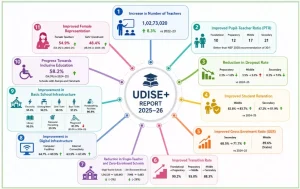
- Increase in Number of Teachers: The total number of teachers increased to 1,02,73,020 in 2025–26, representing an 8.3% increase compared to 2022–23.
- Improved Pupil-Teacher Ratio (PTR): The Pupil-Teacher Ratio (PTR) improved to 10 at the Foundational stage, 12 at the Preparatory stage, 17 at the Middle stage, and 21 at the Secondary stage.
- All these ratios are significantly better than the National Education Policy (NEP) 2020 recommendation of 30:1.
- Reduction in Dropout Rate: The dropout rate at the Preparatory stage declined from 2.3% in 2024–25 to 1.8% in 2025–26, while the Secondary stage witnessed a decline from 8.2% to 7.0%.
- The Middle stage recorded a marginal increase from 3.5% to 3.6%, but overall dropout levels remain significantly lower than in previous years.
- Improved Student Retention: The student retention rate increased from 82.8% to 83.7% at the Middle stage and from 47.2% to 51.9% at the Secondary stage.
- Improved Gross Enrolment Ratio (GER): The Gross Enrolment Ratio (GER) at the Secondary stage increased from 68.5% to 71.7%, indicating improved access to secondary education.
- The Middle-level GER remained broadly stable at 89.6%, reflecting sustained participation.
- Improved Transition Rate: The transition rate from Foundational to Preparatory increased to 99.2%, from Preparatory to Middle to 93.8%, and from Middle to Secondary to 88.3%.
- Reduction in Single-Teacher and Zero-Enrolment Schools: The number of single-teacher schools declined by around 3%, from 1,04,125 to 1,00,843.
- The number of zero-enrolment schools declined by nearly 29%, from 7,993 to 5,663.
- Improvement in Digital Infrastructure: The proportion of schools with computer facilities increased from 64.7% to 69.9%.
- The proportion of schools with internet connectivity increased from 63.5% to 67.4%.
- Improvement in Basic School Infrastructure: 95.0% of schools have electricity, 99.5% have safe drinking water, 98.5% have girls’ toilets, 97.2% have boys’ toilets, and 96.9% have handwashing facilities.
- The availability of libraries increased to 90.5%, while rainwater harvesting facilities increased to 29.9%.
- The proportion of schools with playgrounds declined marginally from 83.0% to 81.9%.
- Progress Towards Inclusive Education: The proportion of schools equipped with ramps and handrails increased from 54.9% to 58.2%.
- Improved Female Representation: Female teachers constituted 54.9% of the teaching workforce, compared to 54.2% in the previous year.
- Girls’ enrolment increased from 48.3% to 48.4%, indicating gradual progress towards gender parity in education.
About Unified District Information System for Education Plus (UDISE+)
- It is India’s integrated Education Management Information System (EMIS) developed by the Department of School Education & Literacy, Ministry of Education.
 It serves as the official national database for school education. It serves as the official national database for school education.
- Launch & Coverage: Launched in 2018–19 as an upgraded version of UDISE, it collects annual data from all recognised schools across India, covering Pre-Primary to Class XII.
- Every school is assigned a unique 11-digit UDISE Code for identification and tracking.
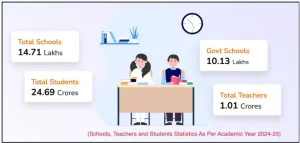
- It covers more than 14.8 lakh schools, 1.02 crore teachers, and over 26 crore students
- Data Collection: It collects comprehensive information on school profile, student enrolment, teachers, learning indicators, and school infrastructure, including classrooms, electricity, drinking water, toilets, libraries, ICT facilities, internet connectivity, playgrounds, and accessibility features.
- Key Educational Indicators: UDISE+ generates important indicators such as Gross Enrolment Ratio (GER), Net Enrolment Ratio (NER), Pupil-Teacher Ratio (PTR), dropout rate, retention rate, transition rate, Gender Parity Index (GPI), and infrastructure indicators to assess the performance of the school education system.
About Unified District Information System for Education (UDISE)
- UDISE (Unified District Information System for Education) is India’s official, massive digital platform managed by the Ministry of Education to collect and manage data from over 1.4 million schools.
- Comprehensive Data Tracking: Now upgraded to UDISE+, the platform acts as a central tracker for critical metrics including student enrollment, teacher profiles, and physical school infrastructure (like classrooms, computers, and toilets).
|
Challenges Faced by the Education System in India
- Learning Outcomes: Persistent gaps in foundational literacy and numeracy (FLN) and uneven learning outcomes continue to affect educational quality across States.
- Regional and Social Disparities Significant disparities persist between urban and rural areas, across States, and among socially disadvantaged groups, particularly in access to quality education.
- Secondary Education: Despite improvements, the Gross Enrolment Ratio (71.7%), Retention Rate (51.9%), and Transition Rate (88.3%) at the secondary level indicate that many students still discontinue education before completing school.
- Digital Divide: Nearly 30% of schools lack computer facilities, while around one-third do not have internet connectivity, limiting equitable access to digital education.
- Inclusive Education: Only 58.2% of schools have ramps with handrails, highlighting the need for greater accessibility for Children with Disabilities (CwDs).
- Infrastructure Gaps: Many schools continue to lack adequate libraries, playgrounds, laboratories, smart classrooms, and rainwater harvesting facilities, affecting the overall learning environment.
- Teacher Availability: Despite improvements, shortages of trained subject teachers, particularly in rural and remote areas, remain a concern.
UPSC Online Preparation
Government Initiatives
- National Means-cum-Merit Scholarship Scheme (NMMSS) (2008): Provides financial assistance to reduce dropout among economically weaker students.
- Samagra Shiksha (2018): An integrated school education scheme supporting equity, quality, infrastructure development, teacher training, digital education, and inclusive education from pre-primary to Class XII.
- National Education Policy (NEP) 2020 (2020): Introduced the 5+3+3+4 curricular structure, universal access to education, Foundational Literacy and Numeracy (FLN), multidisciplinary learning, and competency-based education.
- PM eVIDYA (2020): Promotes digital learning through DIKSHA, SWAYAM Prabha TV channels, radio, and online resources.
- NIPUN Bharat Mission (2021): Aims to ensure Foundational Literacy and Numeracy (FLN) for all children by the end of Grade III.
- Vidyanjali Programme (2021): Encourages community participation and voluntary contributions to strengthen school education.
- PM POSHAN (2021) (formerly Mid-Day Meal Scheme, 1995): Provides nutritious meals to improve enrolment, attendance, retention, and nutritional outcomes.
- PM SHRI Schools (2022): Develops selected schools as model institutions implementing the vision of NEP 2020 through modern infrastructure and innovative pedagogy.
Legal & Constitutional Provisions related to Education in India:
- Article 15(3), 15(4), and 15(5): Enable the State to make special provisions for women, children, socially and educationally backward classes, SCs, and STs in educational institutions.
- Article 21A: Guarantees the Right to Free and Compulsory Education for children between 6 and 14 years.
- Right of Children to Free and Compulsory Education (RTE) Act, 2009: Operationalises Article 21A by prescribing norms relating to free education, neighbourhood schools, pupil-teacher ratio, teacher qualifications, school infrastructure, and inclusive admission policies.
- Article 29 & Article 30: Protect the educational and cultural rights of minorities, including the right to establish and administer educational institutions.
- Article 41: Directs the State to provide education within its economic capacity.
- Article 45: Directs the State to provide early childhood care and education for children below six years of age.
- Article 46: Directs the State to promote the educational and economic interests of Scheduled Castes (SCs), Scheduled Tribes (STs), and other weaker sections.
- Article 51A(k): Makes it a Fundamental Duty of parents or guardians to provide educational opportunities to children between 6 and 14 years.
|
Click to Know UPSC OnlyIAS Coaching Centres
Conclusion
The UDISE+ Report 2025–26 shows progress in access, retention, digital infrastructure, and gender inclusion, but gaps in learning outcomes, equity, and secondary education persist. Achieving NEP 2020 and Sustainable Development Goal (SDG) 4 requires sustained investment in inclusive, quality education.
 8 Jul 2026