SpaceX Starship Recovery
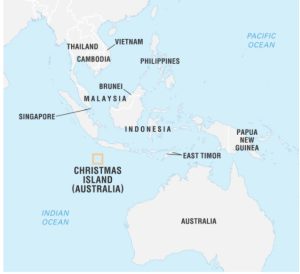
Context: SpaceX’s Starship was towed to waters near Christmas Island after floating in the Indian Ocean for nearly 24 days following a controlled splashdown.
About Starship
Starship is a fully reusable spacecraft and launch system developed by SpaceX to transport crew and cargo to Earth orbit and, eventually, the Moon and Mars.
- Two-Stage Architecture
- Super Heavy: Reusable first-stage booster that provides the initial thrust.
- Starship: Reusable upper-stage spacecraft designed to carry crew and cargo.
- Key Feature: Reusability
- Starship is designed for rapid and repeated reuse of its major components.
- This can potentially reduce launch costs and turnaround time.
UPSC Online Courses
About Christmas Island
Christmas Island is an Australian external territory located in the eastern Indian Ocean.
- Position: Located south of Java and west of the Cocos (Keeling) Islands.
- Distance: About 350 km south of Java, Indonesia.
- Capital: Flying Fish Cove.
- Species Endemism: Christmas Island’s geographic isolation and history of minimal human disturbance have led to high endemism in its flora and fauna, which is of interest to scientists and naturalists.
Terrier Cyber Quest 2026 (TCQ 3.0)
Context: The Indian Army’s Territorial Army has launched the third edition of Terrier Cyber Quest (TCQ 3.0) in collaboration with CyberPeace.
About TCQ 3.0

- TCQ 3.0 is a Territorial Army-led national hackathon to harness AI, cybersecurity, and digital innovation to address emerging national security threats.
- Aim: Promote indigenous solutions for emerging national-security challenges by bringing together talent from academia, industry, research institutions, government, and the Armed Forces.
- Three Competition Tracks:
- Bug Hunting: Identifying vulnerabilities in simulated critical infrastructure through a Capture-the-Flag (CTF) qualifier and live sandbox finale.
- AI Kavach: AI/ML solutions for predictive threat intelligence, automated defense and anomaly detection.
- Creators Challenge: Digital awareness campaigns against deepfakes, phishing, online scams and misinformation.
Foreign Direct Investment (FDI) Rules For Land-Bordering Countries
Context: India has received ₹4,895 crore ($511.5 million) through 29 FDI proposals following the easing of rules for investors from countries sharing a land border with India.
About Foreign Direct Investment (FDI)

- FDI refers to investment by a foreign entity in an Indian company or business with the objective of establishing a lasting interest and significant influence
- Routes Of FDI In India:
- Automatic Route: No prior government approval; subject to sectoral caps, entry conditions and other regulations.
- Government Route: Prior government approval is required through the prescribed mechanism.
- Old FDI Framework in India: Foreign investors with any beneficial ownership linked to a country sharing a land border with India generally needed prior government approval.
New FDI Framework
- Automatic Route: These rules allow investors from countries that share a land border with India to invest through the automatic route if their ownership is non-controlling and does not exceed 10%.
- Focus: The revised framework now provides greater flexibility for investors with limited and non-controlling stakes.
Asian Development Bank (ADB)
Context: India and the Asian Development Bank (ADB) signed a $230 million loan agreement to modernise and expand water supply and sanitation infrastructure in Chennai.
About Asian Development Bank (ADB)
- Established in 1966, ADB is a regional development bank working for inclusive, resilient and sustainable development in Asia and the Pacific, including poverty reduction.
- It has observer status at the United Nations.
- Functions:
- Provides loans, grants, technical assistance and equity investments to member countries for economic and social development.
- It also finances private-sector projects, financial institutions and private equity funds.
- Membership: ADB has 69 members — 50 from Asia-Pacific and 19 from outside the region.
- Headquarter: Manila, Philippines,
- Largest shareholders: Japan (15.6%), USA (15.6%), China (6.4%), India (6.3%) and Australia (5.8%).
ADB & India: India is a founding member and the 4th-largest shareholder of ADB.
UPSC Online Classes
Antelope Reef, South China Sea
Context: China has completed first-phase construction of an artificial island at Antelope Reef, part of the Paracel Islands in the South China Sea.
Background
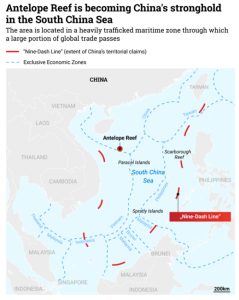
- China has occupied the entire Paracels since 1974, when it expelled the South Vietnamese navy from the islands.
- Vietnam claims the whole Paracel grouping as its own and has separately been expanding its own bases in the Spratly Islands.
- The South China Sea remains one of the world’s most contested maritime zones, with overlapping claims from China, Vietnam, Philippines, Malaysia, Brunei, and Taiwan.
Antelope Reef & Paracel Islands
- Antelope Reef: A coral reef in the Paracel Islands of the South China Sea.
- Paracel Islands: A group of around 130 small islands, reefs and islets in the South China Sea, located roughly between Vietnam and China’s Hainan Island.
- China controls the islands and calls them Xisha Islands.
- Vietnam claims sovereignty over the entire group and calls them Hoàng Sa.
- Taiwan also claims the Paracels.
- The islands are strategically important due to their location near major shipping routes, fishing grounds and potentially energy resources.
Mobile Phone Manufacturing Scheme (MPMS), 2026
Context: Recently, the Ministry of Electronics and Information Technology notified the ₹62,500 crore MPMS to sustain mobile manufacturing growth, deepen domestic value addition, strengthen component supply chains and promote Indian-owned brands, design and intellectual property.
- The ₹62,500 crore MPMS, approved by the Union Cabinet on July 15, 2026, succeeds the PLI Scheme for Large Scale Electronics Manufacturing (PLI-LSEM), which operated from 2020 to FY 2025–26.
About Mobile Phone Manufacturing Scheme (MPMS), 2026

- MPMS is a five-year scheme covering FY 2026–27 to FY 2030–31, succeeding the PLI Scheme for Large Scale Electronics Manufacturing, which ended in March 2026.
- Two Segments: Target Segment 1 (TS1) supports mobile phone manufacturing with 2.25–5% incentives, while Target Segment 2 (TS2) supports Indian brands with 5% incentive plus 3% for domestic design and R&D.
- Localisation Incentive: Additional up to 1.5% incentive for domestic sourcing of key components and sub-assemblies, subject to localisation covering at least 25% of units manufactured.
- Indian Brands: Require more than 51% Indian ownership, Indian-owned IP and trademarks, Indian management control and domestic design/R&D capabilities.
- Targets: Around ₹39 lakh crore cumulative production and 60,000 direct jobs during the scheme period.
Click to Know UPSC Coaching Centres in India
India’s Key Status
- Manufacturing: India is the world’s second-largest mobile phone manufacturer by volume.
- Domestic Production: 99.2% of mobile phones used in India are now manufactured domestically.
- Exports: Smartphones became India’s largest export product category in 2025.
- Value Addition: Domestic value addition has risen to around 23%, with a target of 35–40%.
- PLI Impact: Electronics manufacturing has grown seven-fold and electronics exports eleven-fold since FY 2014–15.
Global Status
- Top Manufacturer: China remains the world’s largest mobile phone manufacturing hub, accounting for the largest share of global smartphone production.
- Global Value Chains: China and India are major manufacturing hubs, while countries such as Vietnam are also important export and assembly centres.
- India’s domestic value addition of around 23% remains below leading manufacturing hubs, particularly China, where it is estimated at around 35–40%.
 22 Aug 2026