NITI Aayog Report on School Education System in India: Challenges, Reforms & Policy Roadmap

8 May 2026

NITI Aayog Report on School Education System in India: Challenges, Reforms & Policy Roadmap

Recently,  NITI Aayog has released a policy report titled School Education System in India: Temporal Analysis and Policy Roadmap for Quality Enhancement’. 
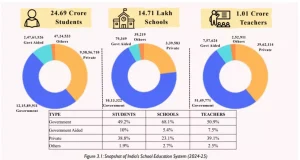
  • India’s school education system today spans 14.71 lakh schools, serving over 24.69 crore students, making it the largest system in the world. 

School Education System in India

About ‘School Education System in India – Policy Roadmap for Quality Enhancement’: NITI Aayog Report 

  • It is a policy document that presents a comprehensive, decade-long analysis of India’s School Education System across key parameters such as:
    • access and enrolment, infrastructure, equity and inclusion, and learning outcomes  for all  States and UTs. 
  • It draws on secondary data from UDISE+ 2024-25, PARAKH Rashtriya Sarvekshan 2024, NAS 2017 and 2021, and ASER 2024. 

Best Online Coaching for UPSC

Key Highlights of Report

  • Improvement in School Infrastructure: The report highlights major advancements in electricity, functional sanitation facilities, and inclusive infrastructure across schools.
  • Expansion of Digital Learning Ecosystem: The study notes improved access to computers, internet connectivity, and smart classrooms across educational institutions.
  • Progress in Equity and Inclusion: The report records encouraging gains in girls’ participation and improved enrolment of SC and ST students across educational stages.
  • Recovery in Learning Outcomes: The report observes improvement in foundational literacy and numeracy across grades following the pandemic.
  • Role of Policy Initiatives: The recovery in learning outcomes has been supported by:
    • National Education Policy
    • NIPUN Bharat Mission
    • Samagra Shiksha
  • Need for Continued Reforms: The report emphasises the need for sustained efforts to strengthen quality and equitable learning outcomes.

Challenges

  • Lack of Functioning Labs for STEM Education:  Secondary schools across the country lack access to functional science labs despite the policy push towards systemic STEM education. 
    • According to UDISE+ 2024-25, 51.7% of government secondary schools are equipped with science laboratories, thereby limiting opportunities for practical, inquiry-based learning in nearly 50% of schools. 
  • Single-Teacher Schools:  Across many parts of the country, particularly in remote and sparsely populated regions, schools continue to function with only a single teacher managing the entire institution. 
    • According to the latest UDISE+ 2024-25 data, more than 1 lakh schools in India operate with just 1 teacher, accounting for over 7% of all schools.
    •  This results in little to no value addition for the students studying in those schools. 
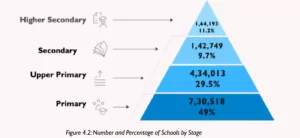
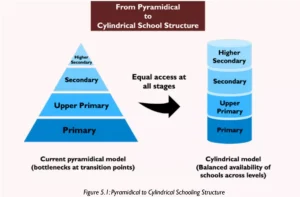
  • Discontinuity in School Structures and the Pyramidal Model:India’s schooling system is pyramid-shaped, with 7.3 lakh primary schools declining sharply to 4.34 lakh upper primary, 1.42 lakh secondary, and 1.64 lakh higher secondary schools (UDISE+ 2024-25).
    • This steep reduction in schools at higher levels limits access to continued education for many children.

School Education System in India

  • Inadequate Access to basic facilities:
    •  Electricity availability:  Electricity availability has grown by nearly 1.6 times from 55.96% in 2014 to 91.9%, marking a substantial expansion in access across the country. According to UDISE+ 2024-25, 1.19 lakh schools lack access to functional electricity.
    • Access to water and hygiene facilities:  Access to water and hygiene facilities is also inconsistent. 
      • The share of schools with drinking water facilities has increased from 96.5% in 2014 to 99% in 2025. 14,505 schools still lack functional water sources.
  • Gaps in Equity and Inclusion: Despite notable gains in access, marginalised students, particularly from Socio-Economically Disadvantaged Groups (SEDGs), girls, and migrant communities continue to face overlapping and structural barriers to participation, retention, and learning. 
  • Fragmented Governance Structure: Education governance in India is fragmented across the Centre, States, districts, blocks and Panchayats, with overlapping jurisdictions and poorly defined roles.
    • State education departments often face organisational overlaps, missing functions, inadequate staffing, and unclear responsibilities, leading to operational and management inefficiencies.
  • Misalignment in Pedagogy, Curriculum, and Learning Outcomes: The lack of alignment between curriculum, pedagogy, and assessment continues to be a foundational challenge in India’s school education system. 
    • Though policy frameworks such as the National Curriculum Framework 2023 set standards for learning competencies and goals, these are not consistently translated into classroom practice 
  • Existence of Small and Under-Enrolled Schools:  A significant proportion of schools in India operate with very low student strength.
    • More than one-third of schools have less than 50 students, with around 5.1% having enrolment below 10, and another 8% in the 11-20 range.

School Education System in India

Way Forward:

  • Reform School System and Ensure Structural Continuity:  NEP 2020 calls for a coherent, developmentally aligned schooling structure that ensures academic continuity, efficient use of resources and equitable access across geographies. 

School Education System in India

  • Strengthen School Infrastructure:
    • Ensure Universal Access to Foundational Infrastructure 
    • Integrate Digital Infrastructure into Teaching, Learning, and School Governance
    • Strengthen Laboratories, Libraries, and Resource Centres for Experiential Learning 
  • Reform Governance and Enhance Administrative Capacity:
    • Rationalise Governance Structures and Enhance Local Autonomy 
    • Strengthen Institutional Capacity and Administrative Cadres 
    • Reform School Supervision and Academic Support Structures 
    • Develop Effective School Leadership through Structured Training and Decentralised Empowerment 
  • Promote Equity and Inclusion:
    • Strengthen Contextualised Support for Socially and Economically Disadvantaged Students 
    • Enhance Gender-Inclusive Systems 
    • Prevent and Address Dropouts through Education Continuity and Re-Entry Pathways 
    • Facilitate Education Continuity for Migrant and Mobile Populations 
  • Strengthen Vocational Education and Skill Integration in Schooling:
    • Mainstream Vocational Education as an Aspirational and Integrated Pathway in Schooling
    • Build Market Linkages and Enhance Regional Relevance of School-based Vocational Education 
  • Ensure Universal Access to Foundational Infrastructure:  To ensure equitable and uninterrupted access to education, every school must be equipped with foundational physical infrastructure that enables a safe, inclusive, and conducive learning environment.
    •  This includes universal access to electricity, drinking water, boundary walls, gender-segregated functional toilets, and hygiene facilities.
  • Integrate Artificial Intelligence for Pedagogical Innovation and System Readiness: AI should be viewed as a supportive tool that enhances classroom instruction, enables differentiated learning, and improves formative assessment rather than as a substitute for the teacher. 

Evolution of Education in India

Phase Time Period Key Features / Developments
Ancient Indian Education Ancient India Education (Vidya) is viewed as sacred and holistic; emphasis on moral discipline, spiritual growth, humility, righteousness, and lifelong learning.
Colonial Reorientation of Education 1823–1947 Elphinstone’s Minutes (1823) and Macaulay’s Minute (1835) promoted English-medium and clerical education, marginalising indigenous knowledge systems and vernacular learning.
Post-Independence Reconstruction Post-1947 Focus on rebuilding educational infrastructure, expanding access, improving teacher quality, and fulfilling constitutional commitments under Article 45.
Early Educational Commissions 1950s Secondary Education Commission (Mudaliar Commission, 1952) promoted science education, mother tongue instruction, vocational guidance, and teacher training reforms.
First Three Five-Year Plans 1951–1966 Expansion of universal primary education, adult literacy, technical education, teacher training, SC/ST and girls’ education, and state-level education planning.
Kothari Commission & First NPE 1964–1968 The Education Commission (Kothari Commission) shaped modern education policy; National Policy on Education (1968) introduced a three-language formula, universal education, and focused on science and teacher training.
Expansion through National Policies 1968–1995 NPE 1986/1992 focused on access, equity, infrastructure, Operation Blackboard, Navodaya Vidyalayas, DIETs, SCERTs, decentralisation, and vocational education.
Rights-based & Inclusive Education Phase 1995–2010 Mid-Day Meal Scheme, Sarva Shiksha Abhiyan (SSA), Education for All (EFA), Millennium Development Goals (MDGs), and Right to Education (RTE) Act, 2009 expanded universal access and inclusion.
Secondary Education & Quality Focus 2009–2020 Rashtriya Madhyamik Shiksha Abhiyan (RMSA), Sustainable Development Goal 4 (SDG 4), and Samagra Shiksha focused on quality, equity, learning outcomes, and integrated school education.
NEP 2020 and Transformational Reforms 2020 onwards The National Education Policy introduced 5+3+3+4 structure, foundational literacy and numeracy, ECCE, competency-based learning, vocational education, technology integration, and holistic development.

Click to Know UPSC Coaching Centres in India

Conclusion

India’s school education system has achieved significant progress in infrastructure, inclusion, and learning recovery, but structural and quality-related challenges persist.

Sustained reforms under National Education Policy are essential to ensure equitable, inclusive, and future-ready education for all.

Check Out UPSC CSE Books

Visit PW Store


online store 1

Explore UPSC Foundation Course

Need help preparing for UPSC or State PSCs?

Connect with our experts to get free counselling & start preparing

Aiming for UPSC?

Download Our App

      
Quick Revise Now !
AVAILABLE FOR DOWNLOAD SOON
UDAAN PRELIMS WALLAH
Comprehensive coverage with a concise format
Integration of PYQ within the booklet
Designed as per recent trends of Prelims questions
हिंदी में भी उपलब्ध
Quick Revise Now !
UDAAN PRELIMS WALLAH
Comprehensive coverage with a concise format
Integration of PYQ within the booklet
Designed as per recent trends of Prelims questions
हिंदी में भी उपलब्ध

<div class="new-fform">


    </div>

    Subscribe our Newsletter
    Sign up now for our exclusive newsletter and be the first to know about our latest Initiatives, Quality Content, and much more.
    *Promise! We won't spam you.
    Yes! I want to Subscribe.