Recently, the debate on Indian federalism has expanded beyond Centre–State relations to include the role of the third tier of government — urban and rural local bodies.
- Arvind Subramaniam, Former Chief Economic Advisor, in an article described the third tier of local governance as the “stepchild of Indian federalism”, controlled excessively by state governments.
Best Online Coaching for UPSC
About Third Tier of Government
- The third tier of government refers to local self-government institutions functioning below the Union and State governments.
- Rural governance is carried out through the Panchayati Raj System at village, block, and district levels.
- Urban governance functions through Municipal Corporations, Municipal Councils, and Nagar Panchayats.
- Constitutional Status: It was given constitutional recognition through the 73rd and 74th Constitutional Amendments (1992).
- Functions: They deliver essential services such as sanitation, water supply, roads, public health, and local planning.
Why Have Local Bodies Been Excluded from the Federalism Debate?
- Union–State Centric Federalism: Indian federalism has historically focused on Centre–State relations such as GST disputes, Governor’s role, and fiscal devolution, sidelining local bodies.
- Dominance of State Governments: States control appointments of municipal commissioners; for example, officials in cities like Delhi and Bengaluru remain largely accountable to state governments.
- Weak Fiscal Capacity: Urban Local Bodies generate very low own revenues, with many municipalities depending heavily on state transfers for basic services.
- Administrative Dependence: Even after functional devolution, municipal staff often remain under state cadres, limiting autonomy of city governments.
- Incomplete Implementation of 73rd and 74th Amendments: Several states have not fully transferred the 18 functions under the 74th Amendment to Urban Local Bodies.
- Perception as Implementing Agencies: Schemes such as Atal Mission for Rejuvenation and Urban Transformation and Jawaharlal Nehru National Urban Renewal Mission are often implemented through top-down administrative structures.
- Urban Governance Failures: Severe pollution in Delhi and traffic congestion in Bengaluru reflect weak and fragmented urban governance systems.
- Low Institutional and Political Capacity: Many smaller municipalities lack professional urban planners, financial experts, and technical staff, reducing their governance effectiveness.
E-Governance in Local Bodies
- e-Gram Swaraj Portal: Promotes digital governance in Panchayats through online planning, budgeting, and accounting systems.
- Smart Cities Mission: Encourages technology-based urban governance through integrated command centres and smart service delivery systems.
- SVAMITVA Scheme: Uses drone technology for property mapping and ownership records in rural areas.
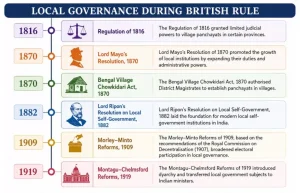
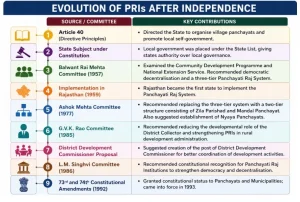
Challenges
- Historical Continuity of Weak Local Governance: In 1925, Jawaharlal Nehru observed that local bodies lacked efficiency and success, and the authors argue that this condition continues even today.
- Despite constitutional recognition through the 73rd and 74th Constitutional Amendments (1993), local governments remain institutionally weak.
- Weak Administrative Capacity: Indian local governments have very limited control over appointments, promotions, and disciplinary powers of municipal staff.
- Municipal commissioners and senior officials remain accountable primarily to state governments, weakening urban autonomy.
- Low Share in Government Employment: In countries like the United States and China, nearly two-thirds of government employees work under local governments.
- In India, only a little above 10% of government employees work for local bodies, reducing their service delivery capacity.
- Stagnant Revenue Generation: Urban local bodies have failed to increase their own tax revenues, which remain around 0.3% of GDP for decades.
- In contrast, the Centre and states significantly expanded their own revenue generation capacities over time.
- Low Public Expenditure: Expenditure by the third tier remains below 1% of GDP, while the Centre and states spend many times more.
- Dependence on external grants reduces the financial autonomy and agency of local governments.
- Performs like Subordinate Arm of States: The debate on federalism in India mainly focuses on the Union and States, while the third tier remains ignored.
- Local governments are treated as a subordinate administrative arm of states rather than autonomous democratic institutions.
- High Dependence, Low Autonomy: Higher tiers of government use financial devolution as a tool of administrative and political control over cities.
- Local bodies remain unwilling or unable to tax citizens adequately, resulting in chronic fiscal weakness.
- Managerial Weakness: State governments dominate urban administration, reducing managerial professionalism and accountability within cities.
- Even when functions are formally devolved, operational control remains with states.
Way Forward
- Urbanisation and Political Representation: Future census and intra-state delimitation may increase the political importance of urban voters, potentially strengthening city governance demands.
- Independent Local Cadre: Municipal governments should have greater control over appointments, promotions, and disciplinary actions of staff.
- Reducing Excessive State Control: State governments should act as facilitators rather than controlling authorities in urban governance and planning.
- Promoting Competitive Sub-Federalism: Encouraging competition among cities such as Indore, Surat, and Bhubaneswar can improve innovation, service delivery, and urban governance standards.
- Complete Devolution of Functions: States should fully transfer the 18 functions under the 74th Amendment and relevant powers under the 73rd Amendment to local bodies.
- Strengthening Fiscal Autonomy: Urban Local Bodies must be empowered to improve property tax collection, user charges, and local revenue mobilisation.
- Participatory Urban Governance: Greater citizen participation through ward committees, public consultations, and local accountability mechanisms should be promoted.
- Capacity Building of Local Bodies: Municipalities require trained urban planners, financial experts, engineers, and technical professionals for efficient governance.
- Reforming Urban Development Schemes: Schemes like Atal Mission for Rejuvenation and Urban Transformation and Jawaharlal Nehru National Urban Renewal Mission should focus on institutional strengthening alongside infrastructure creation.
- Integrating Cities into Federalism Debate: Federalism discussions must include urban governance and decentralisation alongside Centre–State relations.
- Empowering local governments requires greater financial autonomy, administrative control, and accountability mechanisms.
Conclusion
- India’s federal structure remains incomplete without a strong and empowered third tier of governance.
- Weak urban governance has resulted in poor service delivery, fiscal dependence, pollution, congestion, and reduced competitiveness.
- Strengthening cities through genuine decentralisation is essential for improving governance, sustaining urbanisation, and accelerating India’s economic growth.
Click to Know UPSC Coaching Centres in India
2nd ARC Recommendations for Rural Governance
- Implementation of PESA Act, 1996: The Panchayats (Extension to Scheduled Areas) Act, 1996 should be implemented effectively to strengthen self-governance in tribal and Scheduled Areas.
- Appropriate Size of Gram Panchayats: Gram Panchayats should be constituted with a suitable population and territorial size to ensure efficient administration and better public participation.
- Power to Recruit Staff: Panchayats should be empowered to appoint personnel and manage their service conditions independently for improving administrative efficiency.
- Autonomy in Budget Approval: State laws requiring approval of Panchayat budgets by higher authorities should be removed to enhance financial autonomy of local bodies.
- Limiting State Government Interference: State governments should not possess arbitrary powers to suspend Panchayat resolutions or take excessive action against elected representatives.
- Comprehensive Activity Mapping: States should clearly assign functions and responsibilities to Panchayats for all subjects listed in the Eleventh Schedule.
- Strengthening Revenue Base: A comprehensive strategy should be adopted to expand and strengthen the revenue sources of local governments.
|
 25 May 2026