Recently, the Supreme Court of India has clarified that lower courts can continue trials under Section 124A (Sedition) of the repealed Indian Penal Code (IPC) if the accused consent, even though the law’s constitutional validity remains under challenge.
UPSC Coaching Classes
Historical & Legal Background
- Colonial Origin: Section 124A was drafted by Thomas Babington Macaulay and introduced into the IPC in 1870.
- It was heavily used by the British colonial regime to suppress freedom fighters, including Mahatma Gandhi and Bal Gangadhar Tilak.
- The IPC was drafted under Macaulay’s chairmanship, but Section 124A was not part of the IPC as enacted in 1860. It was inserted in 1870 through an amendment associated with James Fitzjames Stephen.
- The 2022 Freeze: In May 2022, in S.G. Vombatkere v. Union of India, a three-judge bench of the Supreme Court temporarily put Section 124A (Sedition) on hold.
- The court directed central and state governments to refrain from registering any FIRs, continuing investigations, or taking coercive measures under the provision due to its widespread misuse and colonial-era nature.
- The 2026 Shift: In Kamran v. State of Madhya Pradesh, the court unlatched the 2022 freeze exclusively for “consenting accused” who seek the progression or closure of their trials, prioritizing their Right to a Speedy Trial.
Key Supreme Court Judgments on Sedition
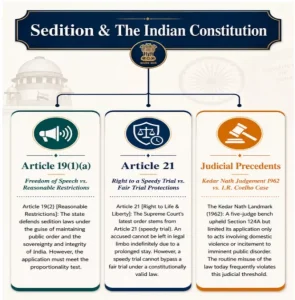
- Romesh Thappar v. State of Madras (1950): The Supreme Court held that the Constitution’s framers intentionally deleted the word “Sedition” from Article 19(2) (Reasonable Restrictions).
- It ruled that free speech cannot be restricted just for criticizing the government, forcing the government to pass the First Constitutional Amendment (1951) to insert the term “Public Order” as a shield to retain Section 124A.
- Kedar Nath Singh v. State of Bihar (1962): A five-judge Constitution Bench upheld the validity of Section 124A but severely limited its scope.
- It ruled that sedition is applicable only when there is an incitement to violence or an intention to create public disorder. Strong words against public measures or government actions do not amount to sedition.
- Balwant Singh v. State of Punjab (1995): The Supreme Court dropped sedition charges against two individuals who shouted pro-Khalistan slogans on the day of Prime Minister Indira Gandhi’s assassination.
- The Court ruled that casual slogan-shouting, which does not evoke any public response or lead to actual violence, is not sedition.
- Shreya Singhal v. Union of India (2015): While striking down Section 66A of the Information Technology Act, the Court drew a line that directly applies to sedition.
- It divided speech into three tiers- Discussion, Advocacy, and Incitement. It ruled that a citizen has the right to advocate even radical causes; the state can only step in when speech directly reaches the level of incitement to violence.
- S.G. Vombatkere v. Union of India (2022): A three-judge bench passed an extraordinary interim order putting the 152-year-old colonial law in abeyance (on hold).
- The Court ordered central and state governments to stop registering fresh First Information Reports (FIRs) under Section 124A and froze all pending trials and appeals across the country.
- Kamran v. State of Madhya Pradesh (2026): The Supreme Court unlatched the 2022 freeze exclusively for “consenting accused” individuals who have spent long periods in jail.
- It ruled that lower courts can proceed with trials and pass judgments if the accused gives voluntary consent, prioritizing their Right to a Speedy Trial (Article 21) while the main constitutional challenge remains pending.
|
The Legal Shift- From IPC Section 124A to BNS Section 152
The BNS explicitly claims to have abolished the offense of “Sedition.” However, it has introduced Section 152, which penalizes “Acts endangering sovereignty, unity, and integrity of India.” The table below outlines how the old colonial provision compares with the modern statutory framework:
| Feature |
Section 124A of IPC (Old) |
Section 152 of BNS (Current) |
| Nomenclature |
- Explicitly termed “Sedition”.
|
- Termed “Acts endangering sovereignty, unity, and integrity of India”.
|
| The Core Offense |
- Bringing hatred or contempt or exciting disaffection toward the Government.
|
- Endangering sovereignty, unity, and integrity through subversive activities or separatist acts.
|
| Modes of Communication |
- Words (spoken/written), signs, or visible representation.
|
- Words, signs, electronic communication, or use of financial means.
|
| Quantum of Punishment |
- Imprisonment for life or up to 3 years, with a fine.
|
- Imprisonment for life or up to 7 years, with a fine.
|
Key Constitutional and Legal Concerns
- The Dilemma of Adjudicating Unconstitutional Provisions: The fundamental constitutional validity of Section 124A remains pending and under challenge before a larger bench of the Supreme Court.
- The Paradox: Allowing trial courts to pronounce judgments of guilt or innocence based on a law whose very constitutionality is suspect creates severe legal asymmetry.
 If the Supreme Court eventually strikes down Section 124A as unconstitutional, any convictions handed down by trial courts in the interim would become inherently flawed.
- Procedural Chaos in Joint Trials: The clarification states that proceedings can resume for “consenting accused.” However, criminal cases often involve multiple co-accused individuals.
- If Accused ‘A’ consents to the trial for a quick closure, but Accused ‘B’ and ‘C’ refuse (invoking the 2022 stay), it creates a procedural deadlock.
- Splitting trials for the same offense can lead to conflicting judgments, judicial inefficiency, and a violation of the principle of joint liability.
- Compromising the “Chilling Effect” Doctrine: Sedition has historically had a “chilling effect” on the Fundamental Right to Freedom of Speech and Expression (Article 19(1)(a)).
- By breathing life back into the provision, critics argue that the institutional threat of an oppressive colonial law returns to the socio-political milieu, contradicting the executive’s stated goal of shedding “colonial baggage.”
Click to Explore UPSC Offline Coaching
Way Forward
- Early Constitutional Review: The Supreme Court should quickly decide the validity of Section 124A and review Section 152 of the Bharatiya Nyaya Sanhita (BNS) to prevent misuse against legitimate dissent.
- Strong Safeguards: Sedition-like provisions under the Bharatiya Nyaya Sanhita (BNS) and Bharatiya Nagarik Suraksha Sanhita (BNSS) must include strict safeguards, including prior approval by senior police officers before filing such cases.
- Balance Rights and Security: The judiciary must balance national security and speedy justice with the protection of fundamental rights and free speech.
 25 May 2026