Recently, the Union Ministry of Health and Family Welfare released the National Family Health Survey–6 (NFHS-6) for 2023–24.
UPSC Coaching Classes
Key Findings of National Family Health Survey – 6
Based on 6.79 lakh households across 715 districts, the data shows significant improvement in maternal care, child immunisation, nutrition, and financial safety.
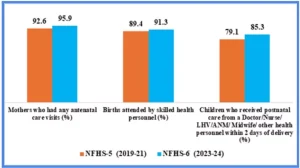
- Maternal and Newborn Care: Deliveries in hospitals rose from 88.6% to 90.6%.
- Overall Antenatal Care (ANC)—health checkups during pregnancy—reached 95.9%. Early checkups in the first three months grew from 70.0% to 76.2%.
- Newborn checkups within two days of birth improved to 85.3%.
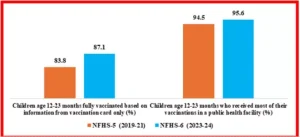
- Child Immunisation: Full vaccination for children aged 12–23 months increased from 83.8% to 87.1%.
 Rotavirus vaccine coverage more than doubled, jumping from 36.4% to 85.4%.
- Rotavirus vaccine is an oral live-attenuated vaccine that protects infants against severe diarrhoea and dehydration caused by rotavirus. Administered under the Universal Immunisation Programme at 6, 10, and 14 weeks, it reduces child mortality and hospitalisation.
- Improvement in Child Nutrition Indicators: Long-term malnutrition numbers dropped significantly.
- Stunting (children who are too short for their age) fell by 17%, dropping from 35.5% to 29.3%.
 Severe wasting (children who are dangerously thin for their height) fell by 32%, dropping from 7.7% to 5.2%.
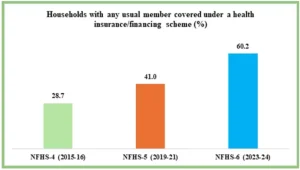
- Health Insurance: Families with health insurance or government health schemes grew from 41.0% to 60.2%, drastically lowering out-of-pocket medical bills.
- Women’s Independence: Women who have ever used the internet nearly doubled from 33.3% to 64.3%.
- Women managing their own bank accounts grew to 89.0%, and mobile phone ownership among women hit 63.6%.
- Population Growth: India’s Total Fertility Rate (TFR)—the average number of children born per woman—stabilized at 2.0. This is just below the replacement level of 2.1, meaning the population growth is stabilizing.
About the National Family Health Survey (NFHS)
The NFHS is a large-scale national survey that collects high-quality data on population, health, and nutrition across India.
- Conducted by: The Ministry of Health and Family Welfare (MoHFW) leads the survey.
- It appoints the International Institute for Population Sciences (IIPS) in Mumbai to coordinate and guide the process.
- What It Tracks: It tracks key areas like fertility, child mortality, family planning, maternal health, nutrition, anemia, and the quality of government health services.
- How It Evolved:
- NFHS-1 (1992–93)- The Baseline:
- Core Focus: Set the first scientific baseline for fertility, family planning, and infant mortality.
- Key Feature: Shifted the national focus toward institutional data collection for maternal and child health.
- NFHS-2 (1998–99)- Expanding Quality & Nutrition:
- Core Focus: Added deeper metrics on maternal nutrition, anemia, and the quality of health services.
- Key Feature: Covered 26 states and introduced the tracking of institutional care standards.
- NFHS-3 (2005–06)- Inclusion & New Health Risks:
- Core Focus: Targeted adult health, sexual behavior, and gender dynamics.
- Key Feature: First time the survey tracked HIV/AIDS awareness and high-risk health behaviors across broader demographics.
- NFHS-4 (2014–15)- The District-Level Revolution:
- Core Focus: Moved from state-level data to highly localized district-level mapping for about 640 districts.
- Key Feature: First time all Union Territories were included. It introduced initial tracking for Non-Communicable Diseases (NCDs) like hypertension and diabetes, alongside domestic violence.
- NFHS-5 (2019–21)- Global Goals & Digital Literacy:
- Core Focus: Tied health tracking directly to 30 Sustainable Development Goals (SDGs).
- Key Feature: First time the survey tracked internet usage among men and women. It also added markers for death registration, preschool education, and expanded age brackets for lifestyle diseases.
- Funding: Supported by the Indian Government alongside global groups like USAID, the Bill & Melinda Gates Foundation, UNICEF, and UNFPA.
Key Terms
- Total Fertility Rate (TFR) represents the average number of children a woman is expected to have during her reproductive years, generally considered to be from 15 to 49 years, if the existing age-specific fertility pattern continues.
- Replacement Level Fertility refers to the fertility level at which one generation replaces itself with the next. It is generally taken as around 2.1 children per woman, as it accounts for mortality, sex ratio at birth, and the possibility that not all children will survive to reproductive age.
- If fertility remains below this level for a prolonged period, population growth may slow and eventually decline, unless factors such as migration or population momentum offset the fall.
- Contraceptive Prevalence Rate (CPR) refers to the percentage of women, or their partners, who are using any method of contraception at a given point in time.
- It is usually measured for a defined population group, such as married or in-union women in the reproductive age group of 15–49 years.
- Sex Ratio at Birth (SRB) denotes the number of girls born for every 1,000 boys.
- It is an important demographic indicator used to assess gender imbalance and the extent of son preference in society.
- Stunting refers to poor linear growth among children due to long-term nutritional deprivation, repeated infections, and inadequate care during early childhood.
- It reflects chronic undernutrition and is often linked to poverty, poor maternal nutrition, frequent illness, and unsuitable feeding practices.
- Wasting refers to a condition in which a child has low weight in relation to height.
- It usually reflects acute undernutrition or recent severe weight loss, although it may also continue for a prolonged period.
- Children affected by wasting face a higher risk of death if timely treatment and nutritional support are not provided.
- Infant Mortality Rate (IMR) refers to the number of deaths of infants below one year of age per 1,000 live births in a given year.
- As per the Sample Registration System Bulletin 2024, India’s IMR declined to 24 per 1,000 live births, with a rural IMR of 27 and an urban IMR of 17, reflecting improvement in child survival along with a continuing rural–urban gap.
|
Significance of the Survey
- Smart Decision Making: Gives district-level data so local governments can address region-specific health deficits in their exact regions.
- Report Card for Schemes: Acts as an official, independent check to see if government welfare programs are actually working on the ground.
- Global Target Tracker: Helps India see how close it is to hitting the United Nations Sustainable Development Goals (SDGs) by 2030.
- High Public Trust: Since 95.6% of children received shots at state centers, it proves that people deeply trust government hospitals and clinics.
UPSC Online Classes
Challenges to Overcome
- The Double Burden of Malnutrition: While child undernutrition is going down, adult obesity and overweight rates are going up.
- This creates a double problem of both coexistence of undernutrition and overnutrition.
- As per the survey, the percentage of women who were overweight or obese increased to 30.7 per cent in 2023-24 from 24 per cent in 2019-21.
- The obesity was higher in urban areas than rural areas. In urban areas, 42.8 per cent women were reported overweight or obese, while the figure was 25.5 per cent in rural areas.
- Rise in Lifestyle Diseases: Non-communicable issues like high blood pressure, heart risks, and diabetes are climbing among younger populations.
- Skewed Sex Ratio at Birth: Even though adult numbers look stable, past survey rounds show that the Sex Ratio at Birth (SRB) still heavily favors boys over girls due to cultural preferences, especially in states like Uttar Pradesh, Punjab, and Bihar.
- Persistent Anaemia Burden: Past data highlights that anemia (lack of healthy red blood cells) remains a tough problem among women and young children, showing that micronutrient gaps still need a lot of work.
Related India’s Initiatives
The improvements seen in NFHS-6 are driven by strong domestic programs:
- Maternal Care: Schemes like Janani Suraksha Yojana (JSY) and Pradhan Mantri Matru Vandana Yojana (PMMVY) provide cash support and medical safety for pregnant women.
- Vaccines for All: The Universal Immunization Programme and the digital U-WIN portal helped expand Child Immunisation coverage.
- Nutrition Drives: POSHAN Abhiyaan and Saksham Anganwadi work across different ministries to distribute healthy food and track child growth.
- Financial Protection: Ayushman Bharat (PM-JAY) provides free hospital care up to ₹5 lakh per year for poor families, pushing total insurance coverage to 60.2%.
- Hygiene and Dignity: The Menstrual Hygiene Scheme and cheap sanitary pads at Janaushadhi centers helped raise safe menstrual hygiene adoption to 79.2%.
Associated Global Actions & Initiatives
- UN Sustainable Development Goal 3 (SDG 3): A global plan to ensure healthy lives and well-being for all, specifically aiming to lower maternal deaths and end preventable newborn deaths.
- WHO’s Triple Billion Targets: A global drive by the World Health Organization to give one billion more people health insurance, protect one billion from emergencies, and provide better health outcomes.
- Every Woman Every Child Movement: A United Nations effort that rallies global funding to help women and children living in vulnerable conditions.
|
Way Forward
- Shift Towards Preventive Healthcare: Public health policy should give greater emphasis to prevention, early screening and behavioural change communication to address obesity, diabetes and hypertension.
- Improve Dietary Diversity: Anganwadi meals and school meals should be strengthened with diverse micronutrient-rich foods to tackle anaemia, undernutrition and emerging obesity risks.
- Target Underperforming Districts: NFHS-6 district-level data should be used to direct additional financial, human-resource and infrastructure support to lagging regions.
- Expand Financial Protection: The scope of health insurance and public health financing should be widened to cover outpatient care, diagnostics and routine treatment costs.
Click to Know UPSC OnlyIAS Coaching Centres
Conclusion
The NFHS-6 highlights major gains in maternal health, child immunisation, and nutrition through improved last-mile healthcare delivery. However, rising obesity and lifestyle diseases require adaptive health strategies combining government schemes with community-level action to achieve long-term health and development goals.
 30 May 2026