The National Institution for Transforming India (NITI Aayog) has convened the first meeting of the high-powered ‘Education to Employment and Enterprise’ (EEE) Standing Committee.
- This specialized committee was originally proposed in Para-51 of the Union Budget 2026–27 to realize the economic and social aspirations of India’s massive youth population.
- It forms a core component of India’s long-term strategy to reach Viksit Bharat (Developed India) status by 2047.
UPSC Online Preparation
Core Mandate and Objectives of the EEE Committee
The committee bridges three vital economic pillars—Education, Skilling, and Entrepreneurship—with the following distinct targets:
- Capture Global Markets: Help India achieve a 10% share of the global services market by 2047.
- Address Disruptive Technology: Evaluate the structural impact of frontier technologies, including Artificial Intelligence, on current employment models and future skill requirements.
- Optimize Growth Engines: Prioritize high-potential niches within the services sector to simultaneously maximize economic output, job creation, and export capabilities.
- Structural Transition: Facilitate the smooth and productive shift of rural and informal labor into non-farm sectors.
Institutional Structure- Inter-Sectoral Convergence
The constitution of the EEE Committee reflects NITI Aayog’s unique capacity to foster collaborative networks across administrative, political, and economic boundaries:
- Chairpersonship: Led directly by the Chief Executive Officer of NITI Aayog.
- Inter-Ministerial Convergence: Includes senior officials from the Ministry of Labour and Employment, Ministry of Skill Development and Entrepreneurship, Ministry of Electronics and Information Technology, and the Department of Higher Education.
- Federal Representation: Balances regional skilling demands by drawing representation from diverse state administrations.
- Industry Integration: Driven by commercial networks including NASSCOM, FICCI, CII, FISME, and the Services Export Promotion Council.
The Strategic Importance of the Services Sector
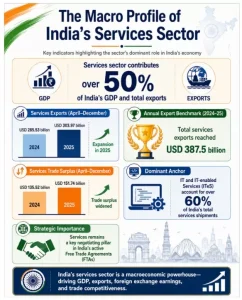
During its initial deliberations, the committee emphasized that the Services Sector remains the cornerstone of India’s macroeconomic resilience:
- The Demographic Pivot: Transforming India’s demographic dividend into a tangible growth dividend relies on creating high-quality, productive employment options rather than disguised unemployment in agriculture.
- Export Competitiveness: Diversifying from traditional Information Technology services into advanced legal, financial, healthcare, and engineering consultation to firmly embed India into Global Value Chains.
- Formalizing the Economy: Aligning industry-relevant skilling pathways helps lift workers out of low-wage, informal jobs and integrates them into secure, formal wage structures.
Key Legal, Institutional, and Structural Concerns
While the creation of the committee is a progressive step, its real-world success faces several structural hurdles:
- The Education-Industry Mismatch: India’s formal academic curriculum has historically remained isolated from market realities.
- Bridging the deep gap between university degrees and modern, industry-relevant application remains a persistent challenge for the Department of Higher Education.
- The Threat of Technological Displacement: The rapid adoption of Artificial Intelligence creates a double-edged sword.
- While it introduces advanced tech roles, it actively threatens traditional, entry-level service sector jobs like back-office operations, data entry, and customer support lines.
- Challenges in Federal Execution: Because NITI Aayog is an advisory body, it lacks enforcement powers.
- Executing centralized skilling frameworks effectively requires absolute harmony at the ground level across diverse states.
- Varying industrial capacities between states like Maharashtra (highly industrialized) and Bihar (largely agrarian) mean that a single, unified skilling policy will not work everywhere.
Way Forward
To move beyond administrative meetings and generate real economic value, the EEE Standing Committee should prioritize the following strategies:
- Adopt Flexible, Dynamic Curricula: Establish continuous feedback loops between industry bodies like NASSCOM and educational boards to update skilling pathways dynamically, keeping pace with Artificial Intelligence breakthroughs.
- Strengthen the Apprenticeship Ecosystem: Embed mandatory, localized apprenticeship programs within higher education frameworks to ensure hands-on, practical training.
- Decentralize State-Specific Skills: Leverage NITI Aayog’s platform to empower states to design regional sub-policies tailored to their specific needs—such as prioritizing agro-processing services in Bihar while expanding advanced digital services in Maharashtra.
- Incentivize Service Sector Entrepreneurship: Offer targeted credit structures, financial assistance, and simplified regulatory compliance pathways to encourage youth to build service-oriented startups, shifting their focus from being job seekers to job creators.
Click to Explore UPSC Offline Coaching
Conclusion
The Education to Employment and Enterprise (EEE) Committee reflects India’s shift towards a skills-driven and employment-oriented growth model. By aligning education, skilling, and entrepreneurship with future economic needs, it can help transform India’s demographic dividend into a sustainable engine for achieving Viksit Bharat 2047.
 25 May 2026