Union Education Minister launched the School Management Committee (SMC) Guidelines 2026 to strengthen participatory and outcome-oriented school governance.
UPSC Online Preparation
About School Management Committee (SMC)
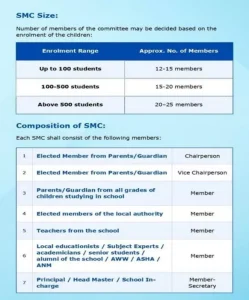
- The School Management Committee (SMC) is a statutory body under the Right to Education (RTE) Act, 2009, established to decentralize school governance, enhance accountability, and increase community participation.
- Legal Basis: Based on the provisions of the National Council for Educational Research and Training-aligned framework under the Right to Education Act 2009.
- Released by: Ministry of Education under the Department of School Education and Literacy (DoSEL).
- Policy Alignment: Aligns school governance with National Education Policy 2020 and Samagra Shiksha Abhiyan.
- Coverage: Applicable for schools from Balvatika to Grade 12 through a unified SMC framework.
About School Management Committee (SMC) Guidelines 2026
- The SMC Guidelines 2026 provide a comprehensive national framework that clearly defines the functions, powers, and responsibilities of School Management Committees (SMCs).
- The guidelines act as a common reference for States and Union Territories to align their respective rules and practices with the broader national objective of ensuring inclusive, participatory, transparent, and accountable school governance
Need for New Guidelines
- Expanding Governance Scope: Earlier SMCs focused mainly on grants, infrastructure and administrative supervision.
- Learning Outcome Focus: New challenges include FLN, student well-being, inclusivity, mental health and digital transparency.
- Community Participation: Seeks stronger involvement of parents, alumni, senior citizens and local communities in education governance.
- NEP 2020 Implementation: Acts as an institutional mechanism for translating NEP 2020 goals into grassroots action.
Key Provisions of SMC Guidelines 2026
- Unified SMC Structure: Single School Management Committee for all grades from Balvatika to Grade 12.
- Representative Membership Structure: Parents and guardians constitute 75% of the total membership, ensuring strong community participation.
- The remaining 25% comprises teachers, local authority representatives, educationists, and frontline workers such as ASHA and Anganwadi workers.
- Ensuring Inclusive Representation: At least 50% of the members in School Management Committees (SMCs) must be women to ensure gender balance.
- Adequate representation is also provided to parents from Socio-Economically Disadvantaged Groups (SEDGs) and parents of Children with Special Needs (CwSN).
- Defined Responsibilities: Clearly specifies duties of SMC members and Member Secretary for accountability.
- Preparation of School Development Plan: School Management Committees (SMCs) are entrusted with drafting a three-year School Development Plan (SDP).
- The plan includes three annual sub-plans aimed at improving school infrastructure and academic performance.
- Support through Specialized Committees: School Management Committees (SMCs) can be supported by specialised sub-committees for focused functioning.
- These include bodies such as a School Building Committee for infrastructure development and an Academic Committee for tracking learning outcomes.
- Financial Monitoring and Administrative Authority: School Management Committees (SMCs) oversee the utilisation of government grants allocated to schools.
- They are also empowered to undertake civil works projects up to a cost of ₹30 lakh
- Learning Outcome Monitoring: Encourages monitoring of attendance, teacher engagement and student learning achievements.
- Transparency and Social Audit: Strengthens financial oversight, school development planning and community-led social audits.
- Whole-of-Government Approach: Integrates initiatives like Vidyanjali, Eco-clubs, ULLAS, PRASHAST App and disaster preparedness.
Significance of the Guidelines
- Strengthening Grassroots Governance: Converts SMCs into community-based educational governance institutions.
- Enhancing Foundational Learning: Supports Foundational Literacy and Numeracy (FLN) and improved classroom outcomes.
- Promoting Participatory Democracy: Encourages local ownership and decentralised decision-making in school administration.
- Advancing Inclusive Education: Focuses on equity, child safety, mental health and inclusion of vulnerable students.
- Supporting Viksit Bharat 2047: Links quality education reforms with India’s long-term human capital development goals.
Click to Know UPSC OnlyIAS Coaching Centres
Conclusion
The SMC Guidelines 2026 aim to transform schools into community-driven institutions supporting inclusive, accountable and outcome-oriented education aligned with NEP 2020.
 8 May 2026