Recently, India and Canada launched the Canada–India Trade and Investment Forum to deepen economic cooperation and support negotiations for a Comprehensive Economic Partnership Agreement.
- India and Canada aim to increase bilateral trade to around USD 50 billion by 2030.
UPSC Coaching Classes
Key Highlights of the Forum
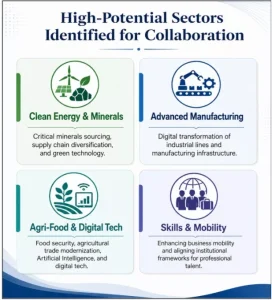
- CEPA Fast-Track: Both nations have set a strict timeline to conclude an “ambitious and mutually beneficial” CEPA by the end of 2026. The pact aims to significantly improve market access, institutionalize two-way economic growth, and build resilient supply chains.
- The New Trade Forum: The newly launched Canada-India Trade and Investment Forum will serve as a permanent institutional platform to bridge business leaders, innovators, and institutional investors from both countries.
- Sensitive Sectors Approach: India and Canada are likely to avoid contentious sectors and focus on mutually beneficial areas such as critical minerals, clean energy, advanced manufacturing, agri-food, digital technology, and mobility.
About CEPA (Comprehensive Economic Partnership Agreement)
- Refers: A Comprehensive Economic Partnership Agreement (CEPA) is an overarching and deeply integrated bilateral or multilateral treaty.
- It is far more holistic than a traditional Free Trade Agreement (FTA).
- Scope: It encompasses a wide array of economic pillars rather than just dropping duties on physical products.
- Core Components Covered:
- Trade in Goods: Removal or reduction of customs duties (tariffs) on manufactured and agricultural products.
- Trade in Services: Easing regulatory barriers for sectors like IT, banking, hospitality, and healthcare.
- Investment: Protecting bilateral investments and creating secure, institutional frameworks for capital flow.
- Other Regulatory Pillars: Includes Intellectual Property Rights (IPR), Competition Policy, Customs Procedures, Dispute Settlement, and Mutual Recognition Agreements (MRAs) for professional qualifications.
India–Canada Economic Cooperation
- Resumption of CEPA Talks: India and Canada resumed negotiations on a Comprehensive Economic Partnership Agreement (CEPA) at the G20 Leaders’ Summit.
- Trade Targets
- India targets bilateral trade of $50 billion by 2030, while Canada targets $70 billion.
- In 2024, the India-Canada bilateral trade in goods and services was around $22.6 billion.
- Scope of CEPA: The agreement will cover:
- Goods & services
- Investment
- Agriculture
- Digital trade
- Mobility & sustainable development
- Diplomatic Reset: Trade talks suspended in 2023 over the Hardeep Singh Nijjar issue have restarted amid improving ties, restoration of High Commissioners, and renewed cooperation in civil nuclear energy and uranium supply.
| Area |
Fact |
| Critical Minerals |
- Canada is important for critical minerals needed in batteries, EVs, clean energy, semiconductors and advanced manufacturing.
|
| Energy |
- Cooperation includes LNG, oil, clean energy, uranium, hydrogen, biofuels and renewable energy value chains.
|
| Diaspora & Mobility |
- Canada has a large Indian-origin population; student mobility and professional mobility strengthen people-to-people ties.
|
| Investment |
- Canadian pension funds and institutional investors are important sources of long-term capital for India.
|
| Indo-Pacific |
- Canada’s Indo-Pacific Strategy sees India as a key partner for trade diversification and supply-chain resilience.
|
Strategic Importance for India
- Critical minerals security: Canada is resource-rich and can support India’s clean-energy transition, battery manufacturing and EV ecosystem.
- Supply-chain diversification: Helps India reduce overdependence on single-country sources for minerals, energy inputs and technology.
- Investment inflows: Canadian pension funds and institutional investors are major global investors; India can attract long-term capital into infrastructure, renewables, logistics and manufacturing.
- Services and mobility: India can push for easier movement of professionals, students and skilled workers.
- Indo-Pacific convergence: Canada’s Indo-Pacific Strategy and India’s Act East/Indo-Pacific outlook create space for economic and strategic cooperation.
India’s Concluded CEPAs
| Partner Country / Region |
Key Insights |
| South Korea (Effective 2010) |
- India’s first major CEPA with an Organisation for Economic Co-operation and Development (OECD) nation.
- Covers goods, services, and investments.
- Currently undergoing modernization reviews.
|
| Japan (Effective 2011) |
- Eliminated tariffs on over 90% of trade items.
- Highly strategic for boosting Japanese FDI into Indian infrastructure and manufacturing.
- Includes a dedicated chapter on IPR protection.
|
| United Arab Emirates (UAE) (Effective 2022) |
- First CEPA signed by India in over a decade.
- Highly significant for Indian gems & jewelry, textiles, and engineering goods.
- Features a dedicated ‘Digital Trade’ chapter and a strict Rules of Origin clause to prevent third-party routing.
|
| Oman (Signed 2025) |
- India’s second major comprehensive economic breakthrough in the West Asian/GCC region.
- Aims to secure strategic supply chains in fertilizers, energy, and petrochemicals.
|
Click to Know UPSC OnlyIAS Coaching Centres
CEPA vs. Other Comprehensive Agreements
| Agreement Type |
Definition & Depth |
Indian Examples |
| Free Trade Agreement (FTA) |
- A Free Trade Agreement primarily focuses on reducing or eliminating tariffs and trade barriers between member countries.
- It has a narrower scope compared to comprehensive pacts.
|
- India-ASEAN FTA
- India-Sri Lanka FTA
|
| Comprehensive Economic Cooperation Agreement (CECA) |
- A comprehensive trade pact, but its foundational emphasis is heavily skewed toward tariff reduction/elimination on goods and services.
- It generally treats investment and deep regulatory alignment as secondary elements.
|
- India-Singapore CECA
- India-Malaysia CECA
|
| Comprehensive Economic Partnership Agreement (CEPA) |
- The most structurally mature of the three.
- It places equal, deep emphasis on Goods, Services, Investments, and Regulatory Compliance (such as IPR, labor standard discussions, and competition laws).
|
- India-Japan CEPA
- India-UAE CEPA
|
| Comprehensive Economic Cooperation & Partnership Agreement (CECPA) |
- A hybrid structural title used specifically for tailored economic partnership terms.
|
|
| Trade & Economic Partnership Agreement (TEPA) |
- A specialized framework structured to fit trade with unique economic blocks.
|
- India-EFTA (European Free Trade Association)
|
| Economic Cooperation & Trade Agreement (ECTA) |
- Typically acts as an interim or early-harvest comprehensive trade deal, paving the pathway toward a full-scale CEPA later.
|
|
 29 May 2026