Subject: GS 2: International Relations
Context: At the 3rd Annual India–Australia Summit (2026) held in Melbourne, Australia, the two countries signed several landmark agreements.
- The landmark agreements cover defence, maritime security, civil nuclear cooperation, trade, critical minerals, cyber security, education, skilling and clean energy, reflecting the growing Comprehensive Strategic Partnership.
- Australia has officially commissioned a temporary space tracking terminal on the Cocos (Keeling) Islands to support India’s Gaganyaan Human Space Flight Programme.
UPSC Course Fees Online
About the India–Australia Annual Summit
- It is the highest-level bilateral institutional dialogue between the Prime Ministers of India and Australia.
- It was established following the elevation of bilateral ties to a Comprehensive Strategic Partnership (CSP) in 2020, to provide strategic direction for cooperation in defence, trade, technology, energy, education, and the Indo-Pacific.
Key Outcomes of Summit
- Strategic & Geopolitical Cooperation
- Indo-Pacific Cooperation
- Reaffirmed commitment to a free, open, inclusive, and rules-based Indo-Pacific, adherence to UNCLOS, and opposition to unilateral attempts to alter the status quo.
- Counter-Terrorism
- Reiterated a shared commitment to combat terrorism through stronger bilateral cooperation and intelligence coordination.
- Regional & Global Issues
- Emphasised peaceful resolution of global conflicts through dialogue and diplomacy and reaffirmed support for regional peace, stability, and freedom of navigation.
- Defence and Security Innovation:
- Defence Innovation
- Launched the India–Australia Defence Innovation Corridor to connect defence industries, start-ups, and innovation ecosystems of both countries.
- Maritime Security
- Adopted the Maritime Security Collaboration Roadmap to strengthen maritime domain awareness, promote freedom of navigation, and enhance cooperation in shipbuilding, ship repair, and maintenance.
- Cyber & Emerging Technologies
- Launched the Australia–India Partnership on Cyber, Critical Technologies and Supply Chains (PACTS) focusing on cybersecurity, semiconductor research, digital resilience, and trusted supply chains.
- Trade and Investment:
- Trade & Investment
- Agreed to fast-track negotiations on the Comprehensive Economic Cooperation Agreement (CECA) and accelerate progress on the Bilateral Investment Treaty (BIT).
- Reaffirmed commitment to expand gains under the ECTA by reducing non-tariff barriers and promoting private investment.
- Energy & Critical Resource Security
- Civil Nuclear Cooperation
- Finalised the administrative arrangement to operationalise the 2014 Civil Nuclear Agreement, enabling Australian uranium exports to India for peaceful nuclear energy and strengthening India’s clean energy transition.
- Energy Security
- Agreed to establish a Rooftop Solar Training Academy in Gujarat under the PM Surya Ghar Yojana to build technical skills among women and youth and support renewable energy deployment.
- Critical Minerals
- Expanded cooperation in critical minerals to secure resilient supply chains and support clean energy technologies and strategic industries.
- Trilateral Technology Partnership
- Signed a trilateral Australia–Canada–India Technology and Innovation (ACITI) MoU to strengthen collaboration in advanced technologies and innovation.
- Education, Skills & Cultural Exchange
- Education
- UGC issued a Letter of Intent to Flinders University to establish a campus in Bengaluru and a Letter of Approval to Victoria University to establish a campus in Gurugram, deepening higher education cooperation.
- Skill Development
- Signed an agreement to establish a National Centre of Excellence for Skilling in Mining at the National Skill Training Institute (NSTI), Bhubaneswar, Odisha in collaboration with the Government of Western Australia.
- Cultural Cooperation
- Australia agreed to repatriate three ancient Indian artefacts—the sacred Nandi, Trident with Auspicious Kali, and Six-headed Skanda—strengthening cultural heritage cooperation.
- Australia announced a $10 million allocation for the Centre for Australia-India Relations’ Maitri Grants to deepen people-to-people links
India–Australia Sports Collaboration Roadmap (2026)
Recently, both Prime Ministers launched the India–Australia Sports Collaboration Roadmap at the Melbourne Cricket Ground.
Key Features
- Cooperation in sports science and technology
- Capacity building and coach development
- Sports industry and investment
- India–Australia Youth Sports Festival
- Greater collaboration ahead of major international sporting events
- Support for India’s ambition to host the 2036 Olympics
|
Strategic Importance of Australia for India
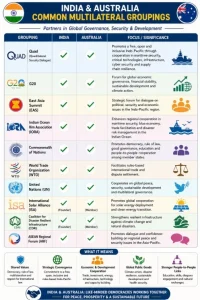
- Trusted Quad Partner: Australia is a key member of the Quad (India, Australia, Japan, and the US), working with India to promote a free, open, inclusive, and rules-based Indo-Pacific, maritime security, and resilient regional governance.
- Major Indo-Pacific Maritime Power: Located at the junction of the Indian and Pacific Oceans, Australia is a crucial partner in safeguarding Sea Lines of Communication (SLOCs), enhancing maritime domain awareness, and ensuring freedom of navigation.
- Source of Critical Minerals: Australia possesses abundant reserves of lithium, cobalt, nickel, and rare earth elements, which are essential for electric vehicles, semiconductors, batteries, and clean energy technologies, supporting India’s energy transition.
- Reliable Uranium Supplier: Australia is one of the world’s largest uranium producers. The operationalisation of the India–Australia Civil Nuclear Agreement strengthens India’s long-term energy security and supports its non-fossil fuel power generation.
- Important Education Partner: Australia is among the top destinations for Indian students, fostering collaboration in higher education, research, innovation, and skill development, while strengthening people-to-people ties.
- Growing Defence Partner: Defence cooperation has expanded through joint military exercises (AUSINDEX, Malabar), logistics cooperation, defence innovation, maritime security, and interoperability, enhancing strategic convergence.
- Large Indian Diaspora: A vibrant Indian diaspora serves as a bridge between the two countries by strengthening economic, cultural, educational, and political linkages.
- Key Partner in Resilient Supply Chains: Australia collaborates with India to build trusted and diversified supply chains in critical minerals, semiconductors, clean energy, and emerging technologies, reducing overdependence on single-country sources.
Challenges
- Slow Progress in Trade Negotiations: Despite the successful implementation of the Economic Cooperation and Trade Agreement (ECTA), negotiations on the Comprehensive Economic Cooperation Agreement (CECA) remain prolonged due to differences over market access, services and agricultural products.
- During 2024–25, total bilateral trade stood at USD 24.1 billion, while India’s exports to Australia recorded an 8% growth over the previous year. In FY 2025–26 (up to February), India’s total trade with Australia stood at USD 19.3 billion.
- Trade Barriers and Regulatory Issues: Non-tariff barriers, complex regulatory standards, sanitary and phytosanitary (SPS) measures, and differing certification requirements continue to impede the growth of bilateral trade.
- High Logistics and Connectivity Costs: The geographical distance between the two countries increases transportation costs, supply chain complexities and shipping time, reducing trade competitiveness.
- Limited Defence Industrial Cooperation: Although defence ties have expanded, cooperation in joint research, co-development, co-production and defence manufacturing remains limited, with scope for greater industrial integration.
- China Factor and Regional Security: China’s growing military presence and assertive behaviour in the Indo-Pacific create strategic uncertainties, requiring both countries to carefully balance deterrence, diplomacy and regional stability.
- Supply Chain Vulnerabilities: Global disruptions caused by geopolitical conflicts and economic uncertainties have exposed vulnerabilities in critical mineral, semiconductor and manufacturing supply chains.
- Differences in Economic Priorities: India seeks greater mobility for skilled professionals and improved services access, while Australia prioritises greater market access for agricultural products, creating negotiation challenges.
- Competition in Export Sectors: Both countries compete in sectors such as minerals, agricultural commodities and education services, occasionally limiting the scope for deeper economic integration.
Click to Know UPSC OnlyIAS Coaching Centres
Way Forward
- Conclude the Comprehensive Economic Cooperation Agreement (CECA): Expedite negotiations to establish a comprehensive trade framework that enhances market access, reduces non-tariff barriers and boosts bilateral investment.
- Finalise the Bilateral Investment Treaty (BIT), encourage private-sector participation and strengthen institutional financing mechanisms for infrastructure and technology projects.
- Strengthen Defence Industrial Partnership: Expand co-development, co-production and technology transfer in defence manufacturing while promoting collaboration between defence industries and startups.
- Deepen Maritime Security Cooperation: Enhance cooperation in Maritime Domain Awareness (MDA), joint naval exercises, shipbuilding, ship repair and logistics support to maintain a free and open Indo-Pacific.
- Expand Cooperation in Emerging Technologies: Promote joint research and innovation in Artificial Intelligence (AI), semiconductors, quantum technologies, cybersecurity and critical digital infrastructure.
- Build secure supply chains for lithium, cobalt, rare earth elements and other critical minerals essential for clean energy technologies, batteries and semiconductors.
- Strengthen Energy Security and Resilient Supply Chains:
- Enhance collaboration in civil nuclear energy, renewable energy, green hydrogen and critical energy infrastructure to support India’s clean energy transition.
- Leverage frameworks such as the Quad, the Supply Chain Resilience Initiative (SCRI) and other trusted partnerships to reduce dependence on concentrated global supply chains.
- Enhance Education, Innovation and Skill Development: Expand university collaborations, research partnerships, vocational training and mining skill development to build a future-ready workforce.
- Deepen People-to-People and Diaspora Engagement: Strengthen cultural exchanges, academic mobility, tourism and diaspora-led business partnerships to reinforce the long-term foundation of India–Australia relations.
 11 Jul 2026