Subject: GS 2: Polity & Governance
Context: The Central Government is considering amending the Information Technology (IT) Act, 2000 and the rules framed under it to make Central Board of Film Certification (CBFC) certification mandatory for all films released, including those released directly on Over-the-Top (OTT) platforms.
IAS coaching
Recent Development
- Trigger for the Proposal: The proposal has gained momentum following the controversy surrounding the OTT release and subsequent removal of Satluj (earlier titled Punjab ’95), a biographical film on Jaswant Singh Khalra.
- Background of the Controversy: The CBFC had recommended 127 cuts to the film, which the filmmakers declined to implement. Consequently, the film was denied certification for theatrical release.
- It was later released directly on OTT without certification before being removed from the platform shortly after its release.
About the Proposed Amendment
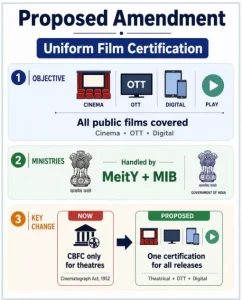
- The proposed amendment seeks to extend the existing film certification regime to all films made available for public viewing, irrespective of whether they are released in cinema halls, OTT platforms, or any other digital medium.
- Implementing Ministries: The proposed amendment is expected to be jointly handled by the Ministry of Electronics and Information Technology (MeitY) and the Ministry of Information and Broadcasting (MIB).
- Key Change: At present, mandatory CBFC certification applies only to theatrical releases under the Cinematograph Act, 1952. The proposal seeks to remove the distinction between theatrical and digital releases by introducing a uniform certification mechanism.
Need for the Proposed Amendment
- Changing Media Consumption: The rapid expansion of OTT platforms such as Netflix, Amazon Prime Video, JioHotstar, Sony LIV, and ZEE5 has transformed film consumption, with an increasing number of films opting for direct digital releases.
- Ensuring Regulatory Parity: At present, the same film may be subject to different regulatory standards solely because of its mode of release. While a theatrical release requires CBFC certification, a direct OTT release does not.
- Protecting National Security: The Government has argued that films dealing with terrorism, separatism, insurgency, or communal violence may influence public opinion and could potentially be exploited by hostile foreign actors or extremist organisations. The controversy surrounding Satluj has been cited as one such instance.
- Ensuring Uniform Oversight: Mandatory certification would ensure that every film intended for public viewing is examined under a common statutory framework, irrespective of the platform on which it is released.
Present Legal Framework
- Central Board of Film Certification (CBFC): The CBFC is a statutory body constituted under the Cinematograph Act, 1952 and functions under the Ministry of Information and Broadcasting (MIB).
- It is responsible for regulating films intended for public exhibition in theatres.
- Functions: The Board examines films before their theatrical release to ensure compliance with the provisions of the Cinematograph Act. It may require filmmakers to modify, delete, or alter scenes before granting certification.
- Categories of Certification:
- U (Universal): Suitable for viewers of all age groups.
- UA: Suitable for children under parental guidance. The Cinematograph (Amendment) Act, 2023 introduced UA 7+, UA 13+, and UA 16+ categories.
- A (Adults Only): Restricted to persons aged 18 years and above.
- S (Special): Restricted to members of a specified profession or class.
About IT Act, 2000
- India’s principal legislation governing digital activities and cyber operations.
- Amended in 2008 and 2015 to address evolving cyber threats and technological developments.
Key Provisions
- Section 69A:
- Empowers the Central Government to block online content on digital platforms if necessary to protect interests listed under Article 19(2) — such as sovereignty, integrity, national security, public order, or morality.
- Safeguards under Section 69A:
- Blocking orders must fall strictly within Article 19(2) grounds.
- The Government must record reasons in writing for blocking content.
- Section 79:
- Section 79 offers “safe-harbour” immunity to intermediaries (social media platforms, ISPs, e-commerce entities) for third-party content, provided they act as neutral platforms and comply with due-diligence norms.
- Section 79(3)(b): It limits this protection, Intermediaries lose immunity if, after receiving actual knowledge (via court order or government notification), they fail to remove unlawful content promptly.
- In Shreya Singhal v. Union of India (2015), the Court narrowed the interpretation of Section 79(3)(b):
- “Actual knowledge” arises only upon a valid court order or official government directive, not mere user complaints.
|
Regulation of OTT Platforms
OTT platforms are regulated under the Information Technology Act, 2000 and the Information Technology (Intermediary Guidelines and Digital Media Ethics Code) Rules, 2021. Unlike theatrical films, they currently operate under a framework based primarily on self-regulation.
- Present System: Films released directly on OTT platforms do not require prior CBFC certification. Instead, publishers are responsible for classifying and regulating their own content.
- Obligations of OTT Platforms: Under the Digital Media Ethics Code, publishers are required to:
- Self-classify content according to age ratings.
- Display appropriate content descriptors and parental guidance.
- Follow the prescribed Code of Ethics.
- Comply with the three-tier grievance redressal mechanism, comprising self-regulation, self-regulatory bodies, and Government oversight.
UPSC Online Courses
Constitutional Provisions
- Article 19(1)(a): Guarantees the Fundamental Right to Freedom of Speech and Expression, which includes artistic, literary, cinematic, and digital expression.
- Article 19(2): Permits the State to impose reasonable restrictions on this right in the interests of:
- Sovereignty and Integrity of India
- Security of the State
- Friendly Relations with Foreign States
- Public Order
- Decency or Morality
- Contempt of Court
- Defamation
- Incitement to an Offence
- Thus, any regulation of films or OTT content must satisfy the test of reasonableness under Article 19(2).
Important Supreme Court Judgments
- K. A. Abbas v. Union of India (1970): The Supreme Court upheld the constitutional validity of pre-censorship of films, observing that cinema possesses a greater emotional and audio-visual impact than other forms of expression and therefore may require prior scrutiny.
-
- Principle Laid Down: The Court held that film certification is constitutionally valid, provided that the restrictions are reasonable, non-arbitrary, and fall within the grounds specified under Article 19(2).
- Significance: This judgment forms the constitutional basis for the CBFC’s pre-certification mechanism.
- S. Rangarajan v. P. Jagjivan Ram (1989): The Supreme Court held that Freedom of Speech and Expression cannot be suppressed merely because a section of society disagrees with the content or threatens protests.
- Principle Laid Down: Restrictions are justified only when there exists a clear, direct, and proximate nexus between the expression and a threat to public order. Mere apprehension of public disorder is not sufficient.
- Significance: The judgment emphasises that restrictions on films must satisfy the constitutional test of necessity and proportionality.
Challenges to be Addressed
- Concerns over Freedom of Expression: Mandatory pre-certification may expand State regulation over digital content, raising concerns regarding creative freedom, artistic autonomy, and the scope of Article 19(1)(a).
- Increased Compliance Burden: Additional certification requirements may increase costs, procedural delays, and administrative burdens, particularly for independent filmmakers and smaller production houses.
- Institutional Overlap: The proposal may create overlapping jurisdiction among the CBFC, MIB, and MeitY, resulting in regulatory uncertainty and duplication of functions.
- Implementation in a Global Digital Ecosystem: Since OTT platforms release content simultaneously across multiple countries, enforcing a country-specific certification regime may pose significant operational and legal challenges.
Way Forward
- Adopt a Balanced Regulatory Framework: The proposed framework should strike an appropriate balance between national security, public order, and the constitutional guarantee of Freedom of Speech and Expression.
- Ensure Transparent and Time-bound Certification: The certification process should be objective, transparent, predictable, and time-bound, with clearly defined statutory standards to minimise arbitrariness.
- Strengthen Age-based Classification: Greater emphasis should be placed on age ratings, parental controls, and content descriptors, rather than excessive censorship or content modification.
- Promote Co-regulation: A co-regulatory model, combining industry self-regulation with statutory oversight, would provide greater flexibility while ensuring accountability in the rapidly evolving digital media ecosystem.
Click to Know UPSC Offline Courses
Conclusion
The proposed amendment seeks to modernise India’s film certification framework in line with the growth of OTT platforms. Its success will depend on achieving a balanced framework that safeguards national security and public interest while upholding the constitutional guarantee of Freedom of Speech and Expression and creative freedom.
 11 Jul 2026