Subject: GS 2: IR
Context: Recently, at the National Security Chiefs’ meeting in New Delhi, member states of BIMSTEC adopted guiding principles for maritime law enforcement and disaster relief, underscoring the BIMSTEC’s growing security role.
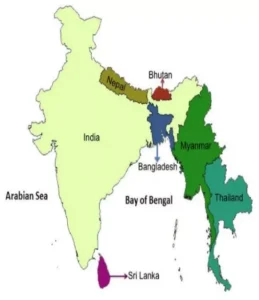
- Ahead of its 30th anniversary in 2027, BIMSTEC is enhancing cooperation to tackle emerging security challenges such as terrorism, cybercrime, and maritime security.
IAS coaching
Key Outcomes of the BIMSTEC National Security Chiefs’ Meeting
- Counter-Terrorism Cooperation: Agreed to strengthen collaboration against terrorism, organised crime, and violent extremism through greater intelligence sharing and coordinated action.
Cyber Security: Enhanced cooperation to tackle cyber threats, cybercrime, and emerging digital security challenges affecting the region.
- Maritime Security: Endorsed guiding principles for interactions between maritime law enforcement agencies to improve coordination, predictability, and safety in the Bay of Bengal.
- Humanitarian Assistance & Disaster Relief (HADR): Approved guidelines for maritime HADR operations to enable faster and more coordinated responses during natural disasters and emergencies.
- Energy Security: Committed to closer cooperation in addressing energy security risks and strengthening regional resilience against supply disruptions.
- Improved Regional Coordination: Agreed to deepen cooperation on transnational security challenges through regular consultations and capacity-building initiatives.
What is BIMSTEC?
- BIMSTEC is a regional organisation comprising seven countries located around the Bay of Bengal.
- It serves as a bridge between South Asia and Southeast Asia, promoting regional cooperation, connectivity, economic integration, and security.
- It represents around 1.7 billion people (22% of the world’s population) with a combined GDP of nearly US$5 trillion.
Evolution
| Year |
Development |
| 1997 |
Established as BIST-EC (Bangladesh, India, Sri Lanka, Thailand Economic Cooperation). |
| 1997 |
Myanmar joined; renamed BIMST-EC. |
| 2004 |
Nepal and Bhutan joined; became BIMSTEC. |
Why was BIMSTEC Formed?
- Bridge Between South & Southeast Asia: BIMSTEC is the only regional organisation linking South Asia and Southeast Asia, promoting economic, technical and strategic cooperation across the Bay of Bengal while complementing India’s Act East and Neighbourhood First policies.
- For Example: India is implementing the India–Myanmar–Thailand Trilateral Highway and the Kaladan Multi-Modal Transit Transport Project to strengthen regional integration (Ministry of External Affairs).
- Alternative to SAARC: SAARC has remained largely inactive due to India–Pakistan tensions, making BIMSTEC a more effective platform for regional cooperation free from bilateral political deadlocks.
- For Example: Following the Uri terrorist attack (2016), India intensified engagement with BIMSTEC by inviting its leaders to the BRICS Goa Summit, signalling a strategic shift.
- Promote Regional Connectivity: BIMSTEC seeks to enhance transport, digital, energy and people-to-people connectivity, enabling seamless movement of goods, services and people while integrating regional value chains.
- The BIMSTEC Master Plan for Transport Connectivity (2022) identifies 267 projects requiring investments of over US$126 billion (ADB & BIMSTEC Secretariat).
- Accelerate Economic Integration: The grouping promotes trade liberalisation, investment, resilient supply chains and sustainable development to unlock the Bay of Bengal’s economic potential and improve regional prosperity.
- BIMSTEC countries together account for 1.7 billion people (22% of the global population) and a combined GDP of nearly US$5 trillion (BIMSTEC Secretariat).
- Strengthen Maritime Security: The Bay of Bengal is a critical maritime corridor, making cooperation essential for maritime safety, anti-piracy efforts, disaster response and protection of Sea Lines of Communication (SLOCs).
- For Example: BIMSTEC has adopted Maritime HADR Guidelines and Guiding Principles for Maritime Law Enforcement Agencies to improve coordination.
- Counter-Terrorism and Transnational Crime: BIMSTEC was created to strengthen regional cooperation against terrorism, organised crime, human trafficking, narcotics smuggling and cybercrime through coordinated security mechanisms.
- For Example: The BIMSTEC Convention on Cooperation in Combating International Terrorism, Transnational Organised Crime and Illicit Drug Trafficking (2009) provides the legal framework for such cooperation.
- Balance China’s Expanding Influence: BIMSTEC provides member countries with a platform to strengthen regional cooperation and connectivity while offering an alternative to China’s expanding strategic and infrastructure footprint under the Belt and Road Initiative (BRI).
- For Example: India promotes BIMSTEC as part of its Indo-Pacific Vision and MAHASAGAR (Mutual and Holistic Advancement for Security and Growth Across Regions) initiative (Government of India).
- Promote Inclusive Regional Development: The grouping seeks to reduce regional disparities by supporting the development of India’s North-East and improving market access for landlocked Nepal and Bhutan through enhanced connectivity and trade.
- For Example: Sagarmala, BBIN connectivity initiatives, and BIMSTEC transport projects are expected to improve logistics, tourism and cross-border commerce across the Bay of Bengal region
Importance of BIMSTEC for India
- Neighbourhood First Policy: BIMSTEC strengthens India’s Neighbourhood First Policy by enhancing political, economic, and security cooperation with its immediate neighbours while fostering regional trust, stability, and collective development across the Bay of Bengal.
- Act East Policy: BIMSTEC serves as a crucial bridge between South and Southeast Asia, advancing India’s Act East Policy by improving connectivity, trade, investment, and strategic engagement with ASEAN countries through the Bay of Bengal region.
- Maritime Security: BIMSTEC enhances cooperation in maritime security through joint efforts in maritime domain awareness, anti-piracy operations, humanitarian assistance and disaster relief (HADR), search and rescue, and maritime law enforcement, ensuring a secure and resilient Bay of Bengal.
- Countering China’s Influence: BIMSTEC offers India a strategic regional platform independent of China’s Belt and Road Initiative (BRI), enabling rules-based cooperation, strengthening regional partnerships, and supporting a free, open, inclusive, and secure Indo-Pacific.
- North-East Development: BIMSTEC promotes multimodal connectivity, cross-border trade, and infrastructure development, transforming India’s Northeastern states into a gateway to Southeast Asia while creating new opportunities for investment, tourism, employment, and regional economic integration.
UPSC Course Fees Online
Major Challenges Facing BIMSTEC
- Political Instability: Internal conflicts, particularly in Myanmar, and frequent political changes in member states disrupt regional cooperation, delay collective initiatives, and weaken BIMSTEC’s ability to pursue long-term strategic objectives.
- Bilateral Disputes: Border disagreements, political differences, and unresolved bilateral issues among member countries reduce mutual trust, slow consensus-building, and hinder the effective implementation of regional cooperation initiatives.
- Teesta River Water Sharing: India and Bangladesh have not finalized the Teesta water-sharing agreement due to differences over water allocation and concerns raised by West Bengal. The issue remains a major bilateral irritant despite continued diplomatic negotiations.
- Connectivity Gaps: Inadequate road, rail, port, air, and digital infrastructure continues to restrict seamless movement of goods, services, and people, limiting trade integration and regional economic growth.
- Slow Project Implementation: Procedural delays, funding constraints, and weak coordination among member states have slowed the execution of key connectivity, energy, and economic projects, reducing BIMSTEC’s overall effectiveness.
- Limited Institutional Capacity: Compared to ASEAN, BIMSTEC has a relatively small Secretariat, limited financial resources, and weaker institutional mechanisms, restricting its ability to monitor, coordinate, and implement regional programmes efficiently.
- China Factor: China’s expanding economic, strategic, and maritime presence through the Belt and Road Initiative (BRI) and other investments has intensified geopolitical competition, posing strategic challenges to BIMSTEC’s regional cohesion and India’s interests.
BIMSTEC Regional Centres Across Member States (UPSC Prelims 2026)
| Regional Centre |
Host Country |
Focus Area |
| BIMSTEC Energy Centre (BEC) |
India (Bengaluru) |
Energy cooperation, power grid connectivity, renewable energy, energy security |
| BIMSTEC Centre for Weather and Climate |
India (Noida) |
Weather forecasting, climate research, disaster early warning |
| BIMSTEC Cultural Industries Commission (BCIC) |
Bhutan (Thimphu) |
Cultural heritage, creative industries, people-to-people exchanges |
| BIMSTEC Centre for Bay of Bengal Studies (BCBS) |
Bangladesh (Dhaka) |
Policy research, maritime studies, blue economy, regional cooperation |
| BIMSTEC Technology Transfer Facility (TTF) |
Sri Lanka (Colombo) |
Technology transfer, innovation, MSME development, capacity building |
| BIMSTEC Centre of Excellence on Tropical Medicine (Proposed) |
Thailand |
Public health, tropical diseases, medical research and training |
| BIMSTEC Centre on Disaster Management (Proposed) |
Myanmar |
Disaster risk reduction, emergency response and resilience |
Way Forward
- Expedite the BIMSTEC Free Trade Agreement (FTA): Early conclusion and implementation of the BIMSTEC FTA will boost intra-regional trade, attract investment, reduce trade barriers, and deepen economic integration among member countries.
- Strengthen Physical and Digital Connectivity: Accelerating cross-border transport corridors, ports, multimodal infrastructure, and digital networks will improve regional connectivity, facilitate commerce, and enhance people-to-people exchanges across the Bay of Bengal.
- Enhance Maritime Security Cooperation: Expanding maritime domain awareness, joint naval exercises, information sharing, humanitarian assistance and disaster relief (HADR), and coordinated law enforcement will strengthen security and stability in the Bay of Bengal.
- Improve Institutional Capacity and Funding: Empowering the BIMSTEC Secretariat with greater financial resources, technical expertise, and decision-making capacity will ensure effective coordination, monitoring, and timely implementation of regional initiatives.
- Promote Resilient Supply Chains and Energy Cooperation: Strengthening regional value chains, cross-border energy trade, renewable energy partnerships, and power-grid connectivity will improve economic resilience and support sustainable regional development.
- Align with India’s Strategic Vision: India should leverage BIMSTEC as a key pillar of its Neighbourhood First, Act East, MAHASAGAR (Mutual and Holistic Advancement for Security and Growth Across Regions), and Indo-Pacific vision to promote a secure, connected, prosperous, and rules-based Bay of Bengal region.
Click to Know UPSC Offline Courses
SAARC- BIMSTEC-ASEAN: At Glance
| Parameter |
SAARC |
BIMSTEC |
ASEAN |
| Full Form |
South Asian Association for Regional Cooperation |
Bay of Bengal Initiative for Multi-Sectoral Technical and Economic Cooperation |
Association of Southeast Asian Nations |
| Established |
1985 |
1997 |
1967 |
| Headquarters |
Kathmandu, Nepal |
Dhaka, Bangladesh |
Jakarta, Indonesia |
| Members |
(8) Afghanistan, Bangladesh, Bhutan, India, Maldives, Nepal, Pakistan, Sri Lanka |
(7) Bangladesh, Bhutan, India, Myanmar, Nepal, Sri Lanka, Thailand |
(10) Brunei, Cambodia, Indonesia, Laos, Malaysia, Myanmar, Philippines, Singapore, Thailand, Vietnam |
| Objective |
Regional cooperation for peace, development and economic integration |
Promote connectivity, economic cooperation and security across the Bay of Bengal |
Economic integration, political cooperation, regional peace and stability |