Subject: GS 2: Polity & Governance
Context: The Madhya Pradesh Cabinet has approved a draft Uniform Civil Code (UCC) Bill, 2026. The Bill proposes a common civil law applicable to residents across religions, covering marriage, divorce, live-in relationships, and inheritance.
- The draft Bill has been prepared by a committee headed by Justice (Retd.) Ranjana Desai, former Judge of the Supreme Court of India.
Best Online Coaching for UPSC
Key Highlights
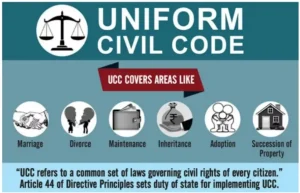
- Common Civil Code: The Bill seeks to establish a uniform civil law governing marriage, divorce, maintenance, succession, inheritance, adoption and live-in relationships irrespective of religion.
- On Marriage and Divorce:
-
- Monogamy is made mandatory across all communities — a person may have only one living spouse at a time
- Minimum marriage age: 21 for men, 18 for women
- Marriages involving invalid consent or prohibited relationships (unless customary exceptions apply) are barred
- Oral divorce and rulings by informal panchayats are declared entirely illegal; divorce can only proceed on statutory grounds defined in law
- Practices like nikah halala for remarriage to the same spouse are criminalized
- Regulation of Live-in Relationships: Couples must file a “declaration of live-in relationship” with the registrar within one month of cohabiting.
- If either partner is under 21, details of the relationship’s start and end must be shared with their parents/guardians, and the registrar must inform the local police station.
- Protection of Women and Children: The Bill provides that a woman deserted by her live-in partner may claim maintenance through a competent court.
- It also grants children born from live-in relationships equal legal status and inheritance rights, abolishes the concept of an “illegitimate child,” and ensures equal inheritance and succession rights for sons, daughters, widows and widowers.
- Exemption: The Bill does not apply to Scheduled Tribes notified under Articles 342 and 366(25) of the Constitution, thereby preserving their customary practices.
What is Uniform Civil Code?

- Definition: A UCC refers to a unitary framework of personal laws that applies uniformly to all citizens regardless of their religious affiliation.
- It standardizes civil matters such as marriage, divorce, maintenance, inheritance, adoption, and succession.
- Constitutional Backing: Article 44 under the Directive Principles of State Policy (DPSP) explicitly mandates that the State shall strive to secure a UCC for all citizens throughout the territory of India.
- Federal Structure: Marriage, divorce, adoption, succession and family law fall under the Concurrent List (Entry 5, List III).
Constitutional Provisions Related to UCC
- Personal law falls under the Concurrent List (List III)
- Article 44: Directs the State to endeavour to secure a Uniform Civil Code for all citizens.
- Article 14: Guarantees equality before law and equal protection of laws.
- Article 15: Prohibits discrimination on the grounds of religion, race, caste, sex or place of birth.
- Article 21: Guarantees the right to life and personal liberty, including dignity, privacy and individual autonomy.
- Article 25: Guarantees freedom of conscience and the freedom to profess, practise and propagate religion, subject to public order, morality, health and other Fundamental Rights.
- Article 342: Empowers the President to specify Scheduled Tribes.
- Article 366(25): Defines Scheduled Tribes for constitutional purposes.
Major Supreme Court Judgements
- Mohd. Ahmed Khan v. Shah Bano Begum (1985): The Supreme Court observed that a Uniform Civil Code would promote national integration and gender justice.
- Sarla Mudgal v. Union of India (1995): The Court held that conversion solely to contract a second marriage amounts to misuse of personal laws and reiterated the need for a Uniform Civil Code.
- John Vallamattom v. Union of India (2003): The Court observed that the absence of a Uniform Civil Code creates inequalities in civil matters and hinders national integration.
- Shayara Bano v. Union of India (2017): The Court declared instant triple talaq (Talaq-e-Biddat) unconstitutional.
- Joseph Shine v. Union of India (2018): The Court reaffirmed the constitutional principles of equality, dignity and individual autonomy within marital relationships.
Click to Know UPSC Coaching Centres in India
States Implementing Uniform Civil Code

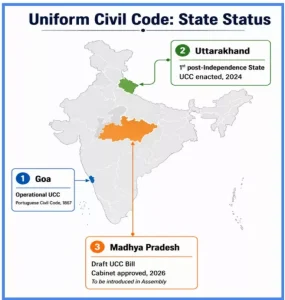
- Goa: Continues to follow the Portuguese Civil Code, 1867, regarded as India’s only operational Uniform Civil Code.
- Uttarakhand: Became the first State after Independence to enact a Uniform Civil Code in 2024.
- Gujarat: The State Government has constituted a committee to examine the implementation of a Uniform Civil Code.
- Assam: The State has not enacted a UCC, but has undertaken legal reforms such as banning polygamy (through administrative measures) and repealing the Assam Muslim Marriages and Divorces Registration Act, 1935, as steps towards greater uniformity in personal laws.
- Madhya Pradesh: The draft Uniform Civil Code Bill, 2026 has been approved by the State Cabinet and is proposed to be introduced in the State Legislative Assembly.