UPSC PYQs

Prelims, Mains & Optional PYQs

UPSC Notes

Comprehensive & Short Notes

Taj Mahal Survey Petition: History, ASI Stand & Tejo Mahalaya Debate

20 Jul 2026

Taj Mahal Survey Petition: History, ASI Stand & Tejo Mahalaya Debate

Subject: GS 1: Art & Culture

Context: Recently, the Allahabad High Court has sought responses from the Union Government and the Archaeological Survey of India (ASI) on a petition challenging an Agra trial court’s refusal to order a survey of the Taj Mahal

UPSC Online Preparation

Key Highlights

  • Petition: The plea seeks a declaration that the Taj Mahal is the ‘Tejo Mahalaya’ temple and requests a court-monitored survey, including photography and videography.
  • High Court Proceedings: The Allahabad High Court has issued notices to the Centre and the ASI, seeking their response on the maintainability and merits of the petition.
  • ASI’s Stand: The ASI has consistently maintained that the Taj Mahal is a 17th-century Mughal mausoleum, citing historical records, inscriptions, architectural evidence and construction techniques such as pietra dura, which were unavailable in pre-medieval India.

Historical & Archaeological Position

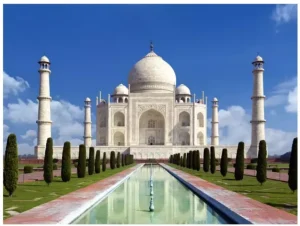
Taj Mahal

  • Construction: Built by Mughal Emperor Shah Jahan between 1632 and 1653 as a mausoleum for his wife Mumtaz Mahal (Arjumand Banu Begum).
  • Architect: Traditionally attributed to Ustad Ahmad Lahori.

History of Contested Authorship

  • Early Alternative Claims: During the 17th–19th centuries, some European writers incorrectly attributed the Taj Mahal’s design to architects such as Geronimo Veroneo, Muhammad Effendi, and Austin de Bordeaux; these claims were later disproved by historians.
  • P.N. Oak’s Theory: In 1965, P.N. Oak claimed the Taj Mahal was originally a Rajput palace, later revising his claim in 1989 to describe it as the “Tejo Mahalaya” Shiva temple. 
    • His assertions lacked credible historical or archaeological evidence.
  • Judicial Rejection: The Supreme Court (2000) dismissed P.N. Oak’s petition, terming the allegations as baseless. 
    • Similar claims were also rejected by the Allahabad High Court (2005) and Agra Trial Court (2015).

About Taj Mahal

  • Location: Situated on the right bank of the Yamuna River in Agra, Uttar Pradesh.
  • UNESCO Recognition: Declared a UNESCO World Heritage Site (1983) as an outstanding masterpiece of Mughal architecture and a monument of exceptional universal value.
  • Protection Status: Declared a Monument of National Importance under the Ancient Monuments and Archaeological Sites and Remains (AMASR) Act, 1958.
    • Conserved and maintained by the Archaeological Survey of India (ASI).

Key Features of the Taj Mahal

  • Architectural Style: Finest example of Mughal architecture, blending Persian, Timurid, Islamic and Indian architectural traditions.
  • Building Material: Constructed primarily from white Makrana marble.
  • Charbagh Layout: Designed around a Persian-style Charbagh (four-part) garden, symbolising paradise.
  • Central Dome: Features a prominent double dome surrounded by four smaller domed structures.
  • Minarets: Four slightly outward-leaning minarets at the corners enhance symmetry and provide structural safety during earthquakes.
  • Pietra Dura: Decorated with intricate pietra dura (stone inlay) work using semi-precious stones.
  • Calligraphy: Contains elegant Quranic calligraphy, primarily executed by Amanat Khan Shirazi.
  • Symmetry: Renowned for its near-perfect geometrical symmetry in design and layout.
  • Complex: Includes the main mausoleum, mosque, jawab (guest building), gateway, gardens and reflecting pools.

Click to Explore UPSC Offline Coaching

About Pietra Dura

  • An ornamental stone inlay technique in which semi-precious stones are precisely cut and embedded into marble to create decorative floral and geometric patterns.
  • Origin: Developed during the Italian Renaissance and later perfected in Mughal architecture.

Check Out UPSC CSE Books

Visit PW Store

online store 1

Taj Mahal Survey Petition: History, ASI Stand & Tejo Mahalaya Debate

Explore UPSC Foundation Batches

Need help preparing for UPSC or State PSCs?

Connect with our experts to get free counselling & start preparing

Free Counselling for UPSC Aspirants

Connect with our experts and take the right next step.

Expert Guidance
Personalized Strategy
100% Free

Book Your Free Session

NEED ASSISTANCE?

Request a Callback

Our counsellor will connect with you and help you choose the right course and centre.

  • Expert Guidance
  • Course & Fee Information
  • Quick Callback Support

Request a Callback

Books
UPSC PYQs
UPSC Notes
Current Affairs
Quick Revise Now !
AVAILABLE FOR DOWNLOAD SOON
UDAAN PRELIMS WALLAH
Comprehensive coverage with a concise format
Integration of PYQ within the booklet
Designed as per recent trends of Prelims questions
हिंदी में भी उपलब्ध
Quick Revise Now !
UDAAN PRELIMS WALLAH
Comprehensive coverage with a concise format
Integration of PYQ within the booklet
Designed as per recent trends of Prelims questions
हिंदी में भी उपलब्ध

<div class="new-fform">


    </div>

    Subscribe our Newsletter
    Sign up now for our exclusive newsletter and be the first to know about our latest Initiatives, Quality Content, and much more.
    *Promise! We won't spam you.
    Yes! I want to Subscribe.