Subject: GS 01: Art and Culture
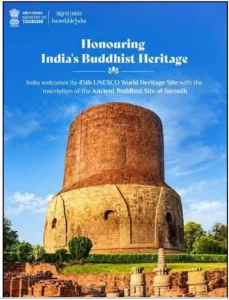
Context: Sarnath was inscribed on the UNESCO World Heritage List during the 48th World Heritage Committee session held in Busan, South Korea in July 2026.
UPSC Coaching Classes
About the Sarnath Site
- The Ancient Buddhist Site of Sarnath, located near Varanasi in Uttar Pradesh, is India’s latest UNESCO World Heritage Site and its 45th World Heritage Sites.
It is Uttar Pradesh’s fourth World Heritage Site after Taj Mahal, Agra Fort and Fatehpur Sikri.
- It is one of Buddhism’s most important pilgrimage centres, as Gautama Buddha delivered his first sermon, known as the Dhammacakkappavattana Sutta, here after attaining enlightenment, thereby setting the Wheel of Dharma in motion.
- Discovery of the Sarnath Site
- Accidental Discovery (1794): Jagat Singh, Dewan of Varanasi, dismantled the Dharmarajika Stupa for building materials. The discovery of a relic casket containing human bones and gold ornaments attracted scholarly attention to Sarnath.
- First Systematic Excavation (1835–1836): Alexander Cunningham, later the first Director-General of the Archaeological Survey of India (ASI), excavated the area around the Dhamek Stupa and uncovered Buddhist sculptures and monastery remains.
- Major Archaeological Breakthrough (1904–1905): F.O. Oertel conducted extensive excavations around the main shrine and discovered the Ashokan Lion Capital, which later became India’s National Emblem.
- Further Discoveries: Oertel also unearthed the monolithic Ashoka Pillar and more than 475 pieces of ancient Buddhist sculptures, establishing Sarnath’s significance as a major centre of Buddhist heritage.
- Key Structures
- Dhamek Stupa: The massive cylindrical stupa traditionally associated with the site of Buddha’s first sermon and decorated with intricate floral and geometric carvings.
- Chaukhandi Stupa: The stupa marks the place where Buddha is believed to have met his first disciples on his arrival at Sarnath.
- Ashokan Pillar: Erected during Emperor Ashoka’s reign, its Lion Capital became the National Emblem of India and symbolises India’s Buddhist heritage.
- Monastic Ruins: The archaeological remains of ancient monasteries reflect Sarnath’s importance as a major centre of Buddhist learning and monastic life.
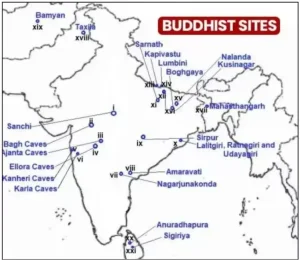
Other Key Buddhist Sites (Life of Buddha)
| Site |
Location |
Significance |
Key Facts |
| Lumbini |
Rupandehi district, Nepal |
Birthplace of Buddha (623 BC) |
It was made a UNESCO World Heritage site in 1997. |
| Mahabodhi Temple |
Bodh Gaya, Bihar |
Site of Buddha’s enlightenment (Nirvana) |
Original shrine by Ashoka (3rd century BCE); only the Vajrasana (Diamond Throne) survives from that period; current structure dates to Gupta period (6th century CE); already a UNESCO WHS |
| Kushinagar |
Uttar Pradesh |
Site of Buddha’s Mahaparinirvana |
Houses Mahaparinirvana Temple (reclining Buddha statue) and Ramabhar Stupa (cremation site); first excavated by Cunningham and Carlleyle in 1876; historically capital of the Malla mahajanapada |
About UNESCO World Heritage Sites
- A UNESCO World Heritage Site is a cultural, natural or mixed property recognised for possessing Outstanding Universal Value (OUV) and considered important for humanity as a whole.
- Origin: The World Heritage Convention was adopted by UNESCO in 1972 to establish an international framework for identifying, protecting and conserving cultural and natural heritage of exceptional value.
Categories
-
- Cultural Sites: These include monuments, archaeological sites, historic cities and architectural ensembles that demonstrate exceptional human creativity or historical significance.
- Natural Sites: These comprise areas of outstanding natural beauty, geological importance, ecological processes or habitats essential for biodiversity conservation.
- Mixed Sites: These possess both significant cultural and natural values that satisfy the relevant UNESCO criteria.
- Selection Criteria: A property must demonstrate Outstanding Universal Value and satisfy at least one of UNESCO’s ten selection criteria, covering cultural and natural values such as human creative genius, civilisational traditions, important historical stages, exceptional natural phenomena, geological processes and biodiversity conservation.
- India’s Last 5 UNESCO World Heritage Site Inscriptions (Total 45 as of July 2026)(UPSC Prelims 2026)
- Ancient Buddhist Site of Sarnath, Uttar Pradesh (2026)
- Maratha Military Landscapes of India, Maharashtra and Tamil Nadu (2025)
- Moidams – the Mound-Burial System of the Ahom Dynasty, Assam (2024)
- Sacred Ensembles of the Hoysalas, Karnataka (2023)
- Santiniketan, West Bengal (2023)
Click to Know UPSC OnlyIAS Coaching Centres
World Heritage inscription enhances international recognition, encourages conservation and promotes sustainable tourism, while highlighting the cultural and natural heritage of the country concerned.