UPSC PYQs

Prelims, Mains & Optional PYQs

UPSC Notes

Comprehensive & Short Notes

India–U.S. Relations: Unilateralism, Challenges and the Way Forward

14 Oct 2026

India–U.S. Relations: Unilateralism, Challenges and the Way Forward

Subject: GS 02: International Relations

Context: Recent U.S. restrictions on immigration-related labour certification, alongside persistent trade and strategic disagreements, have raised concerns about American unilateralism, mutual trust, and the future trajectory of India–U.S. relations.
  • Suspension of PERM Programme: Recently, the United States announced the suspension of the Permanent Labour Certification (PERM) programme for eight major information technology companies, including Indian firms such as Infosys, Tata Consultancy Services (TCS), Wipro, and HCL, citing alleged misuse of immigration and labour-certification systems.
  • Growing Bilateral Frictions: Differences over tariffs, market access, India’s imports of Russian oil, defence technology transfers, and U.S. engagement with Pakistan have complicated bilateral ties despite expanding economic and strategic cooperation.

Best Online Coaching for UPSC

About Unilateralism

India–U.S. Relations

  • Unilateralism refers to a state’s tendency to make and implement foreign policy decisions independently, without adequate consultation with affected countries or coordination through multilateral institutions.
  • Policy Instruments: It may involve unilateral tariffs, immigration restrictions, economic sanctions, export controls, and changes in trade or security commitments.
  • Strategic Rationale: Major powers may adopt unilateral measures to protect domestic industries, strengthen national security, gain negotiating leverage, or advance geopolitical interests.
  • Distinction from Multilateralism: While unilateralism prioritises independent national decisions, multilateralism emphasises cooperation, consultation, and shared rules among multiple countries.

About India–U.S. Relations

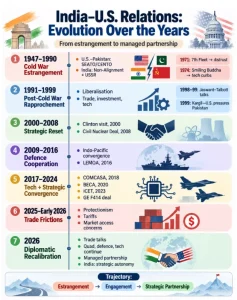
  • Historical Evolution: Relations improved significantly after the end of the Cold War and gained momentum following the 2005 Civil Nuclear Agreement, which helped transform bilateral engagement.
  • Strategic Partnership: India and the United States cooperate through platforms such as the Quad, the India–U.S. 2+2 Ministerial Dialogue, and the Initiative on Critical and Emerging Technology (iCET).
  • Economic Engagement: The two countries maintain substantial trade and investment ties across information technology, services, pharmaceuticals, energy, manufacturing, and digital technologies.
  • Defence Cooperation: Joint military exercises, defence agreements, maritime cooperation, and efforts towards co-production have strengthened their security partnership.
  • Areas of Divergence: Differences persist over trade barriers, immigration policies, India’s strategic autonomy, relations with Russia, agricultural market access, and approaches towards Pakistan.

Significance of India–U.S. Relations

  • Indo-Pacific Stability: Cooperation supports a free, open, and inclusive Indo-Pacific, maritime security, and a rules-based regional order.
  • Economic Growth and Investment: Bilateral trade, investment, and technology partnerships can strengthen India’s manufacturing capacity, exports, employment, and integration into global value chains.
  • Defence Modernisation: Access to advanced defence technologies, joint research, and co-production can enhance India’s military capabilities while supporting domestic defence manufacturing.
  • Critical and Emerging Technologies: Collaboration in semiconductors, artificial intelligence, quantum technologies, telecommunications, and clean energy can strengthen India’s technological capabilities.
  • Energy and Supply-Chain Security: Cooperation in civil nuclear energy, renewables, and diversified supply chains can reduce vulnerabilities arising from excessive dependence on individual countries.
  • People-to-People Ties: The Indian diaspora, educational exchanges, research partnerships, and skilled professionals provide a strong foundation for bilateral relations.
  • Global Governance: Cooperation between the world’s largest democracy and a leading global power can contribute to addressing climate change, terrorism, public health, and emerging technological challenges.

UPSC Online Preparation

Major Challenges in India–U.S. Relations

  • Trade and Market Access: Disagreements over tariffs, agricultural and dairy imports, intellectual property rights, and regulatory barriers continue to obstruct a comprehensive trade agreement.
    • Trade Imbalance: India recorded a surplus of $33.8 billion in bilateral trade exceeding $140 billion in FY 2025-26.
  • Immigration Uncertainty: Restrictions affecting skilled Indian professionals and changes to labour-certification or visa policies create uncertainty for Indian technology companies and workers.
  • Strategic Autonomy: India’s independent foreign policy, including its defence and energy ties with Russia, sometimes conflicts with Washington’s geopolitical priorities.
  • Pakistan and Regional Security: U.S. engagement with Pakistan and differences over the interpretation of developments following Operation Sindoor can generate mistrust between New Delhi and Washington.
  • Defence Technology Gaps: Delays in equipment delivery, limited technology transfer, and concerns about dependence on foreign suppliers constrain the full potential of defence cooperation.
    • India has acquired over $22 billion of American military hardware since 2002.
  • Unilateral Policy Shifts: Abrupt changes in tariffs, immigration rules, and diplomatic positions can weaken investor confidence and make long-term strategic planning difficult.
    • Example: Prolonged delays in supplying GE F404 engines for the Tejas fighter aircraft.
    • Also, Lindsey O. Graham Act, 2026 highlights how secondary sanctions and tariffs on Russia’s trading partners can create uncertainty for India’s energy security and strategic planning.
  • Unequal Expectations: Differences in economic priorities, domestic political pressures, and expectations regarding strategic alignment can complicate negotiations.

Way Forward

  • Institutionalise Economic Dialogue: Establish predictable mechanisms for resolving tariff disputes, improving market access, and addressing regulatory barriers through mutually negotiated arrangements.
  • Protect Skilled Mobility: Maintain regular consultations on immigration and labour-certification policies to ensure transparency, due process, and greater certainty for businesses and professionals.
  • Deepen Defence Co-production: Move beyond buyer–seller arrangements towards joint research, technology transfer, and domestic manufacturing under initiatives such as Make in India.
  • Respect Strategic Autonomy: Recognise that India–U.S. cooperation can deepen without requiring complete alignment on every international issue.
  • Strengthen Institutional Engagement: Use the 2+2 Dialogue, trade forums, and technology partnerships to resolve disagreements before they escalate into broader diplomatic disputes.
  • Diversify Strategic Dependencies: India should strengthen domestic capabilities and diversify trade, energy, and technology partnerships while continuing to leverage cooperation with the United States.
  • Prioritise Mutual Respect: Both countries should avoid abrupt policy changes that undermine trust and instead pursue transparent, reciprocal, and rules-based solutions.

Click to Know UPSC Offline Courses

Conclusion

India–U.S. relations can withstand differences if strategic autonomy, mutual respect, and predictable cooperation guide bilateral engagement, allowing both countries to advance shared economic and security interests.

News Source: The Hindu

Check Out UPSC CSE Books

Visit PW Store

online store 1

India–U.S. Relations: Unilateralism, Challenges and the Way Forward

Need help preparing for UPSC or State PSCs?

Connect with our experts to get free counselling & start preparing

Free Counselling for UPSC Aspirants

Connect with our experts and take the right next step.

Expert Guidance
Personalized Strategy
100% Free

Book Your Free Session

NEED ASSISTANCE?

Request a Callback

Our counsellor will connect with you and help you choose the right course and centre.

  • Expert Guidance
  • Course & Fee Information
  • Quick Callback Support

Request a Callback

Books
UPSC PYQs
UPSC Notes
Current Affairs
Quick Revise Now !
AVAILABLE FOR DOWNLOAD SOON
UDAAN PRELIMS WALLAH
Comprehensive coverage with a concise format
Integration of PYQ within the booklet
Designed as per recent trends of Prelims questions
हिंदी में भी उपलब्ध
Quick Revise Now !
UDAAN PRELIMS WALLAH
Comprehensive coverage with a concise format
Integration of PYQ within the booklet
Designed as per recent trends of Prelims questions
हिंदी में भी उपलब्ध

<div class="new-fform">


    </div>

    Subscribe our Newsletter
    Sign up now for our exclusive newsletter and be the first to know about our latest Initiatives, Quality Content, and much more.
    *Promise! We won't spam you.
    Yes! I want to Subscribe.