UPSC PYQs

Prelims, Mains & Optional PYQs

UPSC Notes

Comprehensive & Short Notes

18th BRICS Summit: New Delhi Declaration & Global South

14 Sep 2026

18th BRICS Summit: New Delhi Declaration & Global South

Subject: GS 2: International Relations

Context: The 18th BRICS Summit, held in New Delhi under India’s chairship on 12–13 September 2026, adopted the 140-point New Delhi Declaration.

  • The theme is “Building for Resilience, Innovation, Cooperation and Sustainability”, covering global governance, trade and finance, technology, security, health, climate and development.
  • India conducted around 350 meetings in cities across the country, including 22 at the ministerial level.

IAS coaching

BRICS- Evolution & Institutional Framework

  • Emerging-Economy Forum: BRICS is an informal, consensus-based intergovernmental grouping of major emerging economies and developing countries, seeking a greater voice for the Global South in global governance.
  • Evolution from BRIC To BRICS+: The term BRIC was coined by Goldman Sachs economist Jim O’Neill in 2001; Brazil, Russia, India and China began summit-level cooperation in 2009, while South Africa joined in 2011. Egypt, Ethiopia, Iran, Saudi Arabia and UAE joined in 2024, followed by Indonesia in 2025.
    • Saudi Arabia’s membership status remains formally unconfirmed, despite being listed among the BRICS members on the grouping’s official platform.
  • India’s Chairship: India assumed the chairship on 1 January 2026, adopting a people-centric and development-oriented approach and organising over 400 ministerial, official and technical meetings across 30 Indian cities.

Key Outcomes of the New Delhi Declaration

  • Global Governance and Multilateral Reform:
    • Governance Reform Roadmap: India proposed developing 10 governance-reform proposals into a BRICS Reform Roadmap, centred on Representation, Responsiveness and Rule-making, to shift the Global South from rule-takers to rule-shapers.
    • UN Security Council Reform: BRICS reiterated support for comprehensive UN reform and greater developing-country representation in the UNSC; China and Russia supported the aspirations of India and Brazil for a greater role in the UN.
    • African Representation: BRICS endorsed greater African representation in global governance, consistent with the Ezulwini Consensusseeking permanent and non-permanent African seats, including veto rights for permanent seats—and the Sirte Declaration, which specifically envisages two permanent African seats and additional non-permanent seats.
    • Decolonisation and Global South Solidarity: The declaration recognised historical racial injustice, decolonisation and Asian-African solidarity, while acknowledging Africa’s continuing under-representation in global institutions.
    • India–Africa Engagement: India used the BRICS platform to deepen engagement with Ethiopia, South Africa, Burundi, Uganda and Nigeria, with emphasis on healthcare, agriculture, digital technologies, capacity building, investment and defence, and renewed discussions on the India–Africa Forum Summit.
    • Inclusive Multilateralism: BRICS called for greater gender and geographical representation in international institutions, while supporting IMF quota reform and restoration of the WTO’s two-tier dispute-settlement mechanism, alongside opposition to unilateral protectionism and trade-distorting barriers.
  • Economic, Financial and Trade Cooperation:
    • Financial Integration: The BRICS Payment Task Force is promoting faster, cheaper and interoperable cross-border payments through local-currency settlements; the BRICS Insurance Resilience Centre (BIRC) and India’s BRICS Risk Lab at GIFT City IFSC aim to strengthen financial-risk management.
    • Trade and Protectionism: BRICS opposed unilateral tariffs and non-tariff barriers and raised concerns over the potential trade-distorting effects of the EU’s Carbon Border Adjustment Mechanism (CBAM).
    • Market Diversification: Expanded BRICS membership can support export diversification and wider market access, but deeper economic integration must account for differences in industrial competitiveness and trade structures among members.
  • Food, Agriculture and Supply-Chain Resilience:
    • Food Security and Grain Cooperation: Discussions on a BRICS Grain Exchange seek to improve food-market stability and cushion members against supply disruptions, price volatility and geopolitical shocks.
    • Agricultural Innovation and Farmers’ Rights: The  BRICS AGRIN (Agro-Inputs, Genetic Resources, and Information Network) network promotes cooperation on agro-inputs, genetic resources and agricultural information, while the Global Forum on Farmers’ Rights in Seed Systems links innovation with farmers’ access to seeds and genetic resources.
    • Resilient Critical Supply Chains: BRICS emphasised diversified, sustainable and resilient supply chains for strategic commodities and critical minerals, while recognising sovereign rights over domestic mineral resources and promoting cooperation in their exploration, processing and supply.
  • Technology, AI And Space Cooperation:
    • Digital Public Infrastructure: The BRICS Digital Public Infrastructure Repository can facilitate exchange of scalable solutions such as India’s Aadhaar, UPI, CoWIN and India Stack, supporting inclusive digital transformation across developing economies.
    • Space Cooperation: Amendments to the BRICS Remote Sensing Satellite Constellation (RSSC) will accommodate new members, while the proposed BRICS Space Council can expand cooperation in satellite applications and space technology.
    • Innovation Ecosystem: The Incubator Network, Startup Innovation Fund proposal and Young Scientists Forum aim to connect research, entrepreneurship and technology diffusion across member countries.
  • Climate, Energy and Critical Resources:
    • Climate Equity and CBDR-RC: BRICS reaffirmed the UNFCCC and Paris Agreement while emphasising developed countries’ responsibilities for climate finance and technology transfer, with Common but Differentiated Responsibilities and Respective Capabilities (CBDR-RC) remaining central to equitable climate action.
    • Just and Technology-Neutral Energy Transition: BRICS supported technological neutrality, recognising the continuing role of fossil fuels in developing economies while expanding renewables; the Digital Centre of Excellence for Smart Grids and Energy Storage can improve grid resilience, efficiency and renewable integration.
    • Nature and Ecosystem Resilience: Cooperation through the Tropical Forest Forever Facility (TFFF), India-led International Big Cats Alliance (IBCA) and landscape-based approaches for forests, wetlands, mangroves, peatlands and arid ecosystems strengthens the nature–climate–development nexus.
  • Health, Social Development and Human Security:
    • Preventive and Mental Healthcare: The BRICS Mission for Healthy Lifestyle (2026–2029) promotes preventive health, while the BRICS Network of Centres of Excellence on Mental Well-Being, coordinated by NIMHANS Bengaluru, strengthens research and institutional cooperation.
    • Traditional Medicine and Pandemic Preparedness: The proposed Traditional, Complementary and Integrative Medicine (TCIM) Expert Working Group can facilitate evidence-based knowledge sharing, while the Integrated Early Warning System for Mass Infectious Diseases seeks faster detection and coordinated responses to health emergencies.
    • Future of Work and Social Protection: BRICS CONNECT (Cooperation Network for Capacity Building, Employability, and New Skills and Technologies) focuses on employability and new skills amid digitalisation, green transitions and gig/platform work, complemented by efforts towards portable social-security arrangements for cross-border workers.
  • Peace, Security and Regional Issues:
    • Counter-Terrorism and Counter-Narcotics: BRICS reaffirmed zero tolerance towards terrorism and no double standards, supported progress on the Comprehensive Convention on International Terrorism (CCIT) and condemned the 22 April 2025 J&K terrorist attack.
    • Palestine and Regional Conflicts: BRICS reiterated support for a viable Palestinian state within the 1967 borders with East Jerusalem as its capital and a two-state solution, while addressing conflicts and instability in Lebanon, Syria and Sudan and supporting African-led solutions to African conflicts.
    • Nuclear and Maritime Security: BRICS condemned attacks on peaceful civilian nuclear facilities under IAEA safeguards, while India’s proposed Seafarers Emergency Support Network seeks to protect seafarers, commercial shipping and critical maritime supply lines during regional crises.
    • Security–Development Nexus: The grouping criticised the diversion of resources towards escalating global military expenditure when substantial financing is required for the SDGs, linking international security with development priorities.
    • Sovereignty and International Law: Opposition to unilateral acts of war and coercive measures, alongside emphasis on sovereignty, territorial integrity and international law, reflects BRICS’ broader effort to promote a multipolar and rules-based international order.

UPSC Coaching Classes

Significance for India

  • Strategic Autonomy: BRICS complements India’s multi-alignment strategy, enabling simultaneous engagement with the US, EU, Quad, SCO and G20 while avoiding alignment with any rigid geopolitical bloc.
  • Global South Leadership: BRICS strengthens India’s role as a Global South bridge and rule-shaper, allowing it to advance concerns of developing countries on climate justice, development finance, technology access and global governance reform.
  • Global Governance Reform: The proposed BRICS Reform Roadmap supports India’s efforts for greater representation of developing countries in the UN, IMF, World Bank and WTO, including its UNSC aspirations.
  • Africa Outreach: The platform strengthens India’s engagement with African countries and the African Union through cooperation in healthcare, agriculture, digital technologies, capacity building, investment and defence, while supporting revival of the India–Africa Forum Summit.
  • Development Finance: The NDB provides India an additional source of infrastructure finance, with nearly $10 billion committed across 32 projects, including metro systems and the Delhi–Ghaziabad–Meerut RRTS, reducing dependence on traditional lenders.
  • Trade, Energy and Resources: Expanded BRICS membership creates opportunities for export diversification and cooperation in energy, hydrocarbons, critical minerals and strategic commodities, strengthening India’s supply-chain resilience.
  • Digital and Maritime Leadership: India can leverage its DPI and digital-payment experience to shape BRICS cooperation on AI and digital governance, while the proposed Seafarers Emergency Support Network complements India’s interest in safe sea lanes and resilient supply chains.

Challenges that need to be Tackled

  • Geopolitical Divergence: BRICS brings together democracies, monarchies and one-party systems with divergent interests; while Russia, China and Iran may favour a more anti-Western orientation, India, Brazil and South Africa prefer a non-Western but inclusive platform
    • This limits consensus on major security issues.
  • China-Centric Asymmetry: China’s dominance in manufacturing, trade, technology and critical-mineral processing, combined with India-China strategic tensions and the bilateral trade imbalance, creates an internal asymmetry that may constrain India’s strategic autonomy.
  • US Tariff Threats And Economic Coercion: Tariffs, sanctions and other economic measures by the US can pressure BRICS members, test their economic resilience and complicate efforts towards greater trade and financial autonomy.
  • 18th BRICS SummitIndia–China Strategic Rivalry: Persistent border tensions and strategic distrust between India and China can limit deeper cooperation within BRICS and create challenges for India’s strategic autonomy.
  • Weak Institutionalisation: BRICS remains an informal grouping without a permanent secretariat or centralised decision-making framework, which can limit policy coordination, continuity and implementation of summit-level commitments.
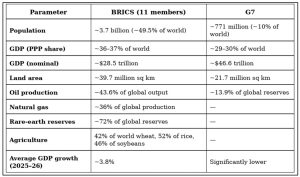
  • Representation–Influence Gap: Despite accounting for nearly 40% of global GDP and 55% of the world’s population, BRICS continues to have disproportionately limited voting influence in institutions such as the IMF, exposing the gap between its economic weight and institutional power.
  • De-Dollarisation Constraints: Expanding local-currency settlements requires convertibility, liquidity, deeper financial markets and regulatory interoperability. Moreover, excessive de-dollarisation could increase dependence on the Renminbi, creating a dilemma for India.
  • Global Polarisation: Excessive positioning against Western institutions could reinforce the perception of BRICS as an anti-Western bloc, limiting cooperation with advanced economies and undermining its stated objective of building a more inclusive and representative multilateral order.

Way Forward

  • Implementation Architecture: Convert the New Delhi Declaration into a time-bound implementation matrix with designated agencies, financing mechanisms, measurable targets and periodic progress reviews to bridge the declaration–delivery gap.
  • Institutional and Financial Reform: Strengthen the NDB through greater capitalisation, wider membership and faster disbursement, while promoting local-currency financing, payment interoperability and the rupee bond rather than pursuing an abrupt common currency or de-dollarisation.
  • Economic Integration: Prioritise customs simplification, mutual recognition, payment connectivity and sector-specific market access to deepen intra-BRICS trade without prematurely creating a comprehensive free-trade area.
  • Critical-Mineral and Supply-Chain Security: Promote joint exploration, processing, recycling, strategic reserves and technology-sharing to build diversified and resilient critical-mineral value chains.
  • Digital and Technological Cooperation: Leverage India’s DPI experience for interoperable digital systems while ensuring cybersecurity, privacy, data sovereignty and responsible AI.
  • Issue-Based Cooperation: Build flexible coalitions around areas of common interest such as climate finance, health security, food resilience, maritime safety and development finance, rather than forcing consensus on contentious geopolitical issues.
  • India as a Bridge: Use BRICS to advance Global South agency and multipolar reform while maintaining constructive engagement with the US, EU, G20, Quad and SCO, ensuring strategic autonomy without strategic dependence on China.

Click to Know UPSC Coaching Centres in India

Conclusion

BRICS is evolving from an emerging-economy forum into a significant platform for Global South agency and multipolar governance. Its credibility will ultimately depend on converting consensus into implementation, diversity into cooperation and interdependence into mutual resilience.

News Source: The Indian Express

Check Out UPSC CSE Books

Visit PW Store

online store 1

18th BRICS Summit: New Delhi Declaration & Global South

Need help preparing for UPSC or State PSCs?

Connect with our experts to get free counselling & start preparing

Free Counselling for UPSC Aspirants

Connect with our experts and take the right next step.

Expert Guidance
Personalized Strategy
100% Free

Book Your Free Session

NEED ASSISTANCE?

Request a Callback

Our counsellor will connect with you and help you choose the right course and centre.

  • Expert Guidance
  • Course & Fee Information
  • Quick Callback Support

Request a Callback

Books
UPSC PYQs
UPSC Notes
Current Affairs
Quick Revise Now !
AVAILABLE FOR DOWNLOAD SOON
UDAAN PRELIMS WALLAH
Comprehensive coverage with a concise format
Integration of PYQ within the booklet
Designed as per recent trends of Prelims questions
हिंदी में भी उपलब्ध
Quick Revise Now !
UDAAN PRELIMS WALLAH
Comprehensive coverage with a concise format
Integration of PYQ within the booklet
Designed as per recent trends of Prelims questions
हिंदी में भी उपलब्ध

<div class="new-fform">


    </div>

    Subscribe our Newsletter
    Sign up now for our exclusive newsletter and be the first to know about our latest Initiatives, Quality Content, and much more.
    *Promise! We won't spam you.
    Yes! I want to Subscribe.