The Sample Registration System (SRS) Statistical Report, 2024 highlights India’s transition from a phase of population explosion to demographic stabilisation, marked by a declining fertility rate, falling birth rate, and improving life expectancy.
- India is on its way from population ‘explosion’ to one of aging population and shrinking workforce expansion.
Best Online Coaching for UPSC
About Demography
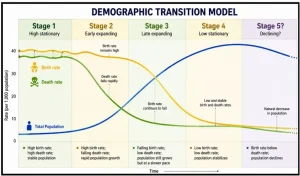
- Core Definition: Demography is the statistical and mathematical study of human populations, primarily focusing on how size, structure, and spatial distribution change over time due to vital events like births, deaths, and migration.
- The Demographic Transition Model (DTM): A conceptual framework explaining how societies shift from high birth and death rates to low birth and death rates during economic development.
- India is in late Stage 3 and moving toward Stage 4, though states are at different points of transition.
- Replacement Level Fertility: This refers to the Total Fertility Rate (TFR) at which a population replaces itself from one generation to the next without migration, commonly estimated at around 2.1 children per woman in developing economies.
- Population Momentum: A demographic phenomenon where a population continues to expand despite achieving sub-replacement fertility, driven by a high concentration of individuals moving through their prime reproductive years.
Key Demographic Trends in India (SRS 2024 Data)
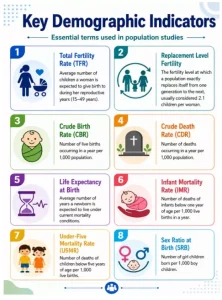
- Sub-Replacement Fertility: India’s national Total Fertility Rate (TFR) remained steady at 1.9, staying below the replacement level of 2.1 for the fifth consecutive year.
- Declining Birth Rate: The national Crude Birth Rate (CBR) continued its long-term drop, falling from 21 per 1,000 population in 2014 to 18.3 in 2024.
- Stable Mortality Baselines: The national Crude Death Rate (CDR) stood at 6.4 per 1,000 population, remaining slightly above pre-pandemic baselines.
- Rising Longevity: Rising longevity, with life expectancy at birth around 72 years, reflects improvements in survival outcomes, though rural-urban and gender gaps persist.
- Child Survival Gains: The national Infant Mortality Rate (IMR) declined to 24 deaths per 1,000 live births, while the Under-Five Mortality Rate (U5MR) fell to 28.
- Sex Ratio at Birth (SRB): The report registered a minor, three-year averaged improvement in the national SRB, reaching 918 girls per 1,000 boys.
About Sample Registration System (SRS) Statistical Report
- Nodal Agency: Conducted by the Office of the Registrar General & Census Commissioner, India under the Ministry of Home Affairs.
- Purpose: India’s largest demographic survey system for estimating:
- Birth Rate (BR)
- Death Rate (DR)
- Infant Mortality Rate (IMR)
- Total Fertility Rate (TFR)
- Historical Background: Launched on a pilot basis in 1964–65 and made fully operational in 1969–70.
- Methodology: Based on a dual-record system involving:
- Continuous enumeration by a resident enumerator.
- Independent half-yearly retrospective surveys by supervisors.
- Matching and verification of records.
- Significance: Provides reliable annual demographic estimates between two Census periods.
- Supports policymaking in public health, family welfare, and population stabilisation.
- Policy Relevance: Helps monitor India’s progress in:
- Reducing infant mortality
- Lowering fertility rates
- Achieving Sustainable Development Goals (SDGs)
- Recent Trend: The latest report reflects India’s ongoing demographic transition, marked by declining fertility and improving mortality indicators.
|
Factors Driving the Demographic Transition
- Female Literacy and Education: Expansion of female literacy and secondary education has played a major role in reducing fertility rates by delaying marriage, increasing awareness about reproductive health, and encouraging smaller family norms.
- The SRS 2024 data highlights this relationship clearly- illiterate mothers record a TFR of 3.2, while literate mothers have a significantly lower TFR of 1.8, below the replacement level fertility.
- Modern Family Planning and Government Interventions: Improved access to family planning services, contraceptives, and reproductive healthcare has enabled couples to make informed decisions regarding family size.
- Government initiatives such as Mission Parivar Vikas (MPV), the Antara Programme (injectable contraceptives), and Chhaya (non-hormonal contraceptive pills) have strengthened family planning outreach, especially in high-fertility districts.
- The Family Planning Logistics Management Information System (FP-LMIS) has further improved contraceptive availability by reducing supply shortages at healthcare centres.
- Urbanisation and Rising Economic Costs: Rapid urbanisation and migration to cities have contributed to smaller family preferences due to rising costs of education, healthcare, housing, and child upbringing.
- The gradual shift from joint family systems to nuclear families has also reduced the economic and social preference for larger households.
- Declining Child Mortality: Sustained improvements in maternal healthcare, nutrition, and child immunisation programmes such as Mission Indradhanush have significantly improved child survival rates.
- As confidence in child survival has increased, the traditional tendency to have larger families as protection against infant mortality has gradually declined.
UPSC Online Coaching
Significance of India’s Demographic Dividend
- Present Young Cohort Advantage: India remains one of the youngest large economies globally, with a median age of 29.2 years, compared to China’s 40.2 years and older Western societies.
- This young cohort includes 370–380 million people in the 15–29 age bracket, constituting nearly 27% of the total population.
- Time-Bound Demographic Dividend: With over 65% of its population under 35 years of age, India possesses a valuable working-age window.
- However, this demographic dividend is not permanent. It must be actively converted into human capital through targeted investments in education, skilling, healthcare, and employment generation.
- Defining the Timeline and Urgency: Demographic projections indicate that India’s population will likely peak between 2050 and 2060 before beginning a gradual decline.
- The dividend window is projected to peak between 2030 and 2041 and close by 2055, creating an urgent need for forward-looking policy planning.
- Consumption and Market Advantage: A large young population can expand domestic demand, savings and entrepreneurship, supporting India’s long-term growth trajectory.
Challenges That Need to be Tackled
- Ageing Transition and Social Security Stress: India’s demographic challenge is shifting from controlling population growth to managing ageing, regional imbalance, and future workforce constraints.
- As sustained low fertility shrinks the future active labor supply, an increasing senior dependency ratio will place immense fiscal stress on pension systems and social safety nets.
- Skewed Sex Ratio and Marriage Squeeze: A skewed SRB of 918 reflects persistent son preference and may create long-term social concerns.
- These include a regional marriage squeeze (bride shortages), human trafficking risks, and heightened gender-based vulnerabilities in severely affected states.
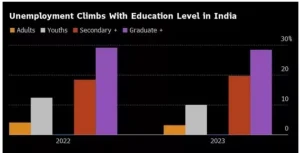 Youth Unemployment and Skills Mismatch: The youth bulge presents a structural vulnerability- high rates of unemployment among educated youth paired with a widening gap between industry requirements and training outcomes.
 -
- Without scaled-up job generation, this dividend risks turning into a source of socio-economic friction.
- The International Labour Organization highlighted rising educated youth unemployment in India, pointing to a major skills mismatch between educational qualifications and available jobs.
- The graduate unemployment rate stood at 29.1%, compared to 3.4% among illiterate persons, while youth with secondary or higher education recorded 18.4% unemployment.
- The share of educated unemployed youth increased from 54.2% in 2000 to 65.7% in 2022, with women accounting for a disproportionately high 76.7% share.
- The report also noted rising dependence on gig and informal employment due to inadequate quality job creation.
- The North-South Divergence and Federal Implications:
- The Regional Divide: Southern states achieved replacement fertility decades ago and are transitioning into older societies, while high-burden Northern states (such as Bihar at a TFR of 2.9 and Uttar Pradesh at 2.6) continue to drive population growth.
- Federal Implications: Uneven fertility decline may sharpen debates around delimitation, fiscal transfers by the Finance Commission, and political representation, especially for states that achieved population stabilisation earlier.
- North-South Migration Pressures and Political Economy: As a direct consequence of this demographic divide, large-scale internal migration flows are moving young workers from high-fertility northern states to ageing southern economic hubs.
- While this generates vital financial remittances for the North, it places structural strains on urban infrastructure in the South and can elevate local social tensions.
- Chronic Diseases and Healthcare Disparities: The ageing transition will increase the burden of non-communicable diseases (NCDs) such as diabetes, cardiovascular diseases, and cancer, requiring stronger preventive and geriatric care.
- Furthermore, a stark rural-urban divide persists; the SRS data shows that 48.9% of rural deaths occur without formal medical attention, exposing severe gaps in end-of-life and palliative care networks.
- Data Gap and Delayed Census: While SRS provides useful annual indicators, the absence of an updated Census limits granular planning for migration, ageing, urbanisation, welfare delivery and constituency-level representation.
Initiatives Taken by India
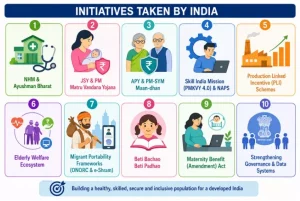
- National Health Mission (NHM) & Ayushman Bharat: Overhauls primary healthcare through the institutional network of Ayushman Arogya Mandirs (HWCs), expanding local clinical capabilities from maternal-neonatal tracking to universal screening for Non-Communicable Diseases (NCDs) and early geriatric care.
- Janani Suraksha Yojana (JSY) & PM Matru Vandana Yojana (PMMVY): Deploys conditional cash transfers to systematically drive down maternal and infant mortality by incentivizing institutional deliveries and providing partial wage compensation to support nutritional well-being.
- Atal Pension Yojana (APY) & PM Shram Yogi Maan-dhan (PM-SYM): Strengthens the national financial safety net by establishing voluntary, co-contributory pension architecture to guarantee old-age livelihood security for vulnerable workers within the unorganized sector.
- Skill India Mission (PMKVY 4.0) & NAPS: Targets the structural youth bulge by synchronizing institutional vocational training with Industry 4.0 competencies and expanding industrial apprenticeships to mitigate the industry-academia skills gap.
- Production Linked Incentive (PLI) Schemes: Drives macroeconomic interventions across 14 strategic sectors to stimulate labor-intensive manufacturing hubs, explicitly designed to absorb the expanding domestic working-age cohort.
- Elderly Welfare Ecosystem: India’s elderly welfare framework combines healthcare support, economic participation, and technology-driven solutions for senior citizens.
- The National Programme for Health Care of the Elderly (NPHCE) strengthens geriatric healthcare services through dedicated elderly care facilities at primary, district, and tertiary healthcare levels.
- The Senior Able Citizens for Re-Employment in Dignity (SACRED) Portal helps senior citizens find employment opportunities and remain economically active after retirement.
- The Seniorcare Ageing Growth Engine (SAGE) Initiative promotes a technology-driven Silver Economy by supporting startups and innovations focused on elderly care, assistive technologies, and age-friendly services.
- Migrant Portability Frameworks (ONORC & e-Shram): Leverages digital governance to establish a national database of unorganized labor and ensure food security portability, shielding internal migrant populations moving across regional demographic fault lines.
- Beti Bachao Beti Padhao (BBBP): Deploys multi-sectoral behavior-change communication and enforcement mechanisms to counter gender-biased sex selection, safeguard the girl child, and close secondary education gender gaps.
- Maternity Benefit (Amendment) Act: Institutionalizes structural workplace reforms, including mandating 26 weeks of paid leave and localized crèche facilities, to enhance Female Labor Force Participation (FLFP) during demographic transitions.
Global Actions & Initiatives
- UN Sustainable Development Goal 3 (SDG 3): Aims to ensure healthy lives and promote well-being for all ages, with focus on reducing maternal and child mortality, combating diseases, and achieving Universal Health Coverage (UHC).
- UN Decade of Healthy Ageing (2021–2030): A global initiative led by the World Health Organization to improve the lives of older persons through age-friendly environments, integrated care, and long-term support systems.
- Madrid International Plan of Action on Ageing (2002): Provides a global policy framework for addressing population ageing through social protection, healthcare access, income security, and active ageing.
- WHO Global Strategy and Action Plan on Ageing and Health: Focuses on promoting healthy ageing, strengthening health systems, and developing age-responsive public policies.
- Universal Health Coverage (UHC): Promoted by the World Health Organization and the United Nations to ensure access to essential healthcare services without financial hardship.
- 2030 Agenda for Sustainable Development: Integrates demographic concerns such as ageing, health equity, gender inclusion, and social security into the broader Sustainable Development Goals (SDGs) framework.
- UNFPA Initiatives: The United Nations Population Fund supports countries in demographic planning, reproductive health services, ageing policies, and population data systems.
Way Forward
- Address Skills Mismatch and Generate Quality Jobs at Scale: India must urgently modernize its vocational curricula to match evolving market realities and expand labor-intensive manufacturing hubs via initiatives like Production Linked Incentives (PLI) to productively absorb the youth cohort.
- As per PLFS 2023-24, 4.1 per cent of the person of age 15-59 years have received formal vocational/technical training, while another 30.6 per cent received training through informal sources.
- Boost Female Labor Force Participation (FLFP): To cushion the impact of future workforce constraints, structural reforms must be prioritized to retain women in the economy, including safe public transit, accessible childcare networks, and flexible working frameworks.
- For Example: Female LFPR, in the age group 15 years and above, recorded a sustained increase since June, 2025 and stood at 35.3% in December 2025, marking the highest level observed during the year, however more efforts need to be made for improvement.
- Cultivate a Sustainable Silver Economy: The state needs to build robust, co-contributory pension funds for informal workers while expanding long-term investments in geriatric specialization, specialized medical wings, and accessible public infrastructure for senior citizens.
- Harmonize Federal Realities and Support Migrant Flows: Destination states must implement inclusive urban policies to support incoming migrant workers, while federal institutions must design fiscal sharing formulas that reward demographic management performance without penalizing high-growth regions.
- Strengthen Preventive and Geriatric Healthcare: India must expand screening for NCDs, palliative care, home-based care, mental health support and geriatric services at the primary healthcare level.
- Improve Population Data Systems: India must conduct the delayed Census and strengthen civil registration systems to enable granular planning for migration, ageing, welfare delivery and urbanisation.
Click to Know UPSC Coaching Centres in India
Conclusion
The SRS 2024 report shows that India’s demographic challenge has shifted from merely controlling population growth to managing stabilisation, ageing, and regional divergence. India must use its remaining demographic window to invest in health, education, jobs, women’s workforce participation, and social security, so that demographic change becomes a source of long-term national strength rather than future vulnerability.
 26 May 2026