Subject: GS Paper 2: Polity & Governance
Context: On Independence Day, Prime Minister Narendra Modi announced initiatives to strengthen India’s technological capabilities and reduce the financial burden of competitive-exam preparation.
Best Online Coaching for UPSC
Key Announcements
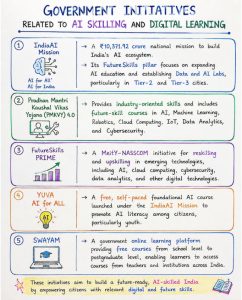
- AI Skilling: The government will provide AI skill training to 1 crore youth over the next year, enabling them to participate in and lead the AI-driven economy.
- Free Online Coaching: The government will provide free online coaching for various competitive examinations to reduce the financial burden of coaching classes on students and their families.
- Digital Public Infrastructure: Existing digital public infrastructure, technology, and teaching talent will be brought together to create a nationwide network for free online coaching.
- Emerging Technologies: The Prime Minister emphasised India’s need to take the lead in artificial intelligence, quantum computing, space technology, robotics, data centers and next-generation communications.
- 6G Technology: India aims to develop Made-in-India 6G technology and ensure its reach across the country.
Why is AI Skilling Important for India?
- Changing nature of employment: AI and automation are transforming jobs across sectors, creating demand for new technological and digital skills.
- Demographic dividend: Skilling India’s large young population can help convert demographic potential into productive human capital.
- Future-readiness: Early exposure to AI can help youth adapt to emerging technologies and changing skill requirements.
- Innovation and entrepreneurship: AI capabilities can enable new products, startups, research, and technology-driven enterprises.
- Technological self-reliance: Building domestic AI capabilities can help strengthen India’s technological capabilities and reduce dependence on external technologies.
Significance of the Initiatives
- Democratization of opportunities: Free online coaching can make competitive-exam preparation more accessible to students, regardless of their economic background or location.
- Reduction in household burden: Free coaching can reduce expenditure on private coaching and ease the financial pressure on families.
- Bridging regional disparities: Online delivery can extend access to quality educational resources beyond major coaching hubs and urban centers.
- Leveraging Digital Public Infrastructure: The initiative demonstrates how India’s digital infrastructure can deliver public services and educational resources at scale.
- Inclusive growth: Combining AI skilling with affordable access to education can promote wider participation in India’s technology-driven growth.
Challenges
- Digital divide: Limited access to smartphones, computers, affordable internet, and reliable digital infrastructure may exclude students from disadvantaged and remote regions.
- Skill–industry mismatch: AI training may become too basic or theoretical, creating a gap between the skills imparted through the program and those demanded by industry.
- Shortage of qualified trainers: India may face a shortage of trainers and mentors with adequate AI expertise to deliver quality training at the scale of 1 crore youth.
- Language and accessibility barriers: Limited availability of high-quality content in Indian languages and accessible formats may restrict participation among diverse learners.
- Low completion and learning outcomes: Large-scale online programs may face low course completion, engagement, and competency levels, making enrolment numbers alone an inadequate measure of success.
- Rapid technological change: Advances in AI can quickly make curricula and skills outdated, requiring frequent course revisions and continuous reskilling.
- Weak employment linkages: Training without adequate links to internships, jobs, and industry opportunities may not translate into improved employability or incomes.
Click to Know UPSC Coaching Centres in India
Way Forward
- Industry–academia collaboration: Involve technology companies, startups, and educational institutions in designing industry-relevant AI curricula and training programs.
- Outcome-based skilling: Focus on measurable competencies, course completion, certification, employability, and employment outcomes, rather than enrolment alone.
 Hybrid learning model: Combine online learning with local learning centers, mentorship and hands-on training to improve learning outcomes and reduce digital exclusion.
- Multilingual and inclusive content: Develop high-quality learning resources in Indian languages and accessible formats to widen participation.
- Strengthen digital access: Improve affordable internet connectivity, access to digital devices, and digital literacy, particularly in underserved regions.
- Continuous reskilling: Establish lifelong learning and periodic curriculum-upgradation mechanisms to keep pace with rapid advances in AI and other emerging technologies.
- Strengthen employment linkages: Integrate skilling programs with internships, apprenticeships, industry projects, and job opportunities to convert training into meaningful employment.
 18 Aug 2026