Subject: GS 2: Polity & Governance
Context: The Supreme Court in August 2026 stressed that reforms in the National Testing Agency (NTA) must ensure institutional continuity, technological resilience and institutional memory.
UPSC Course Fees Online
Supreme Court’s Key Observations
- Institutional Memory: The Court emphasised that reforms must create institutional knowledge and continuity that survives changes in NTA personnel.
| Institutional memory is the organisation’s ability to retain and use its accumulated knowledge, experience and lessons from the past despite changes in personnel and leadership |
- Committee Continuity: The newly constituted Nandan Nilekani Task Force should not result in discarding the recommendations of the earlier K. Radhakrishnan Committee.
 Permanent Mechanism: The Court favoured a permanent institutional mechanism to continuously identify vulnerabilities and implement reforms.
- Beyond Knee-Jerk Reforms: Reforms should be proactive and institutionalised, rather than introduced only after examination-related catastrophes.
- Technological Preparedness: The Court specifically raised concerns regarding cybersecurity, data storage, software systems and technological infrastructure for public examinations.
- Intergenerational Continuity: Reforms should flow from one generation of officers to the next, preventing reversal whenever senior officials are transferred.
- UPSC as Reference: The Court referred to the Union Public Service Commission (UPSC) as an example of an institution that has maintained greater continuity in conducting public examinations.
About National Testing Agency (NTA)
- Establishment: NTA was established in 2017 as an autonomous organisation under the Department of Higher Education, Ministry of Education, and registered as a society under the Societies Registration Act, 1860.
- Purpose: It conducts entrance and eligibility examinations using standardised processes and technology.
- Major Examinations: NTA conducts examinations including NEET-UG, JEE (Main), CUET-UG, UGC-NET and other national-level tests.
- Institutional Objective: NTA was intended to bring standardisation, transparency, efficiency and greater use of technology into examination administration.
- NEET-UG: The National Eligibility-cum-Entrance Test (Undergraduate) is the common entrance examination for undergraduate medical education in India, subject to the applicable statutory framework.
Reform Architecture- Radhakrishnan Committee & Nilekani Task Force
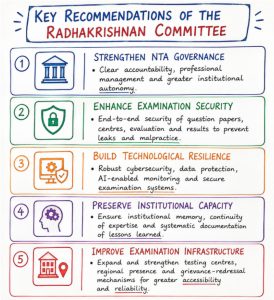
- Radhakrishnan Committee: An earlier committee headed by former ISRO Chairman K. Radhakrishnan examined weaknesses in NTA’s examination system and suggested measures for improving security, testing processes and institutional capacity.
 Nilekani Task Force: The government subsequently constituted a task force chaired by Infosys co-founder Nandan Nilekani to promote technology-driven and leak-resistant examination systems.
- Institutional Memory Bank: The government has proposed maintaining an institutional memory bank based on experiences from successive examinations.
Concerns that Need to be Tackled
- Recurring Failures: Repeated examination controversies indicate the need to address systemic vulnerabilities rather than isolated incidents.
- Committee-Hopping: Creating a new committee after every crisis can result in duplication, loss of institutional memory and delayed implementation.
- Personnel Transfers: Frequent changes among senior officials may disrupt the continuity of reforms and institutional learning.
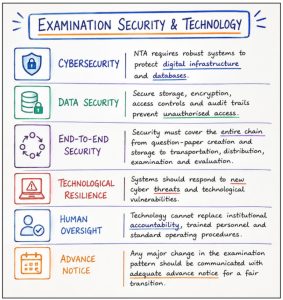
- Cyber Threats: Increasing dependence on digital systems creates vulnerabilities involving hacking, data breaches and unauthorised access.
- Candidate Uncertainty: Sudden changes in examination patterns can impose additional psychological and financial burdens on students.
- Accountability Gap: Effective reform requires clearly identifying responsibility at every stage of the examination lifecycle.
- Trust Deficit: Paper leaks undermine confidence in the fairness, transparency and credibility of public examinations.
- Lack of Statutory Status: As a society registered under the Societies Registration Act, 1860, NTA lacks a dedicated statutory framework, raising concerns over legal accountability, institutional autonomy and clearly defined powers.
Way Forward
- Permanent Reform Cell: Establish a dedicated institutional reform and examination-security mechanism within NTA to continuously review vulnerabilities.
- Institutional Memory: Maintain a central repository of past incidents, audits, corrective measures and best practices accessible to successive officers.
- Independent Audits: Conduct periodic cybersecurity, process and third-party audits before major examinations.
- End-to-End Security: Build a secure chain covering question-paper generation, encryption, storage, transportation, distribution and evaluation.
- Risk-Based Monitoring: Use artificial intelligence, data analytics, anomaly detection and real-time monitoring while ensuring appropriate safeguards.
- Standard Operating Procedures: Develop uniform, regularly updated SOPs for paper leaks, technical failures, impersonation and examination-centre breaches.
- Institutional Accountability: Clearly define roles, responsibilities and liability of NTA officials, contractors, examination centres and technology providers.
- Student-Centric Reform: Give candidates adequate advance notice, transparent grievance mechanisms and predictable examination calendars.
Click to Know UPSC Coaching Centres in India
Conclusion
The NEET-UG crisis underscores the need to institutionalise continuous reforms in NTA, backed by transparency, cybersecurity, accountability and institutional memory, to safeguard both exam integrity and public trust.
 20 Aug 2026