Subject: GS 3: Science & Technology
Context: The transformation of India’s space program over the last 12 years reflects the tri-fold spirit of Vishwas (Trust), Vikas (Development), and Jan Kalyan (Public Welfare).
- Powered by Aatmanirbhar Bharat, Make in India, and Viksit Bharat 2047, space technology has transitioned from an isolated scientific endeavor into a core strategic national asset.
UPSC Online Coaching
About India’s Evolving Space Architecture
- The traditional architecture has transitioned into a highly commercial, dynamic, and dual-purpose ecosystem.
- The modern model uses space-based assets to address terrestrial problems—optimizing agricultural mapping, expanding rural telecommunications via PM e-VIDYA, providing real-time disaster alerts, and securing regional strategic navigation autonomy.
India’s Initiatives & Actions
- Policy & Governance Overhauls:
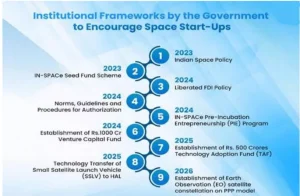
- Indian Space Policy 2023: Acted as the legislative inflection point by ending the state monopoly, allowing Non-Governmental Entities (NGEs) to execute end-to-end space activities across manufacturing, rocket design, and downstream satellite applications.
- Norms, Guidelines, and Procedures (NGP) 2024: Established standard protocols and clear compliance frameworks, optimizing institutional predictability for incoming global investors.
- IN-SPACe Gateway: Formed as an autonomous, single-window nodal regulator. It has successfully authorized 71 distinct technology transfers from ISRO to private domestic aerospace manufacturers.
- Commercial & Capital Initiatives:
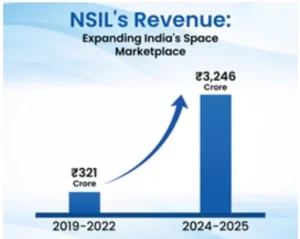
 NSIL Scaling: NewSpace India Limited (NSIL) has scaled up operations through Public-Private Partnerships (PPP), resulting in commercial revenue surging from ₹321.77 crore (FY 2021-22) to ₹3,246.09 crore (FY 2024-25).
- FDI Liberalization: The Foreign Direct Investment (FDI) limits have been structured through three distinct automatic route thresholds to protect high-tier technologies while capturing global capital:
- Up to 100% (Automatic): Components and sub-systems manufacturing.
- Up to 74% (Automatic): Spacecraft operations, satellite data products, and user segment operations.
 Up to 49% (Automatic): Core launch vehicle fabrication, system assembly, and building private spaceports.
- Sovereign Navigation & Data Infrastructure:
- NavIC System: Operating an independent, regional satellite positioning constellation (NVS series) covering the Indian mainland and extending up to 1,500 km beyond sovereign borders.
- Global Public Goods: Disseminated over 27 Terabytes (TB) of continuous solar observation datasets generated by the Aditya-L1 observatory into the global scientific public domain.
Future Targets
- Gaganyaan Phased Deliverables: The flagship human spaceflight mission is executing its critical path. The uncrewed Gaganyaan-1 (G1) orbital flight is scheduled for the second half of 2026 with the Vyommitra humanoid onboard, serving as a precursor to the crewed orbital flight.
- Lunar Sample Return (Chandrayaan-4): Scheduled for 2027, this multi-module mission aims to achieve a soft landing, extract physical regolith samples, and execute an autonomous lunar ascent to return them to Earth.
- Sovereign Space Station (Bharatiya Antariksh Station – BAS): Deployment of the foundational module, BAS-01, has been approved for orbit insertion by 2028, working toward a fully operational modular space station by 2035.
- Deep Space Missions (Shukrayaan): The Venus Orbiter Mission is targeted for launch in March 2028, testing capabilities such as aerobraking and advanced thermal management systems.
Bilateral Co-Explorations
- Chandrayaan-5 (LUPEX): A joint ISRO–JAXA mission (2027–28) deploying a specialized rover to drill for water ice deposits at the lunar south pole.
- TRISHNA (2026): A climate-science satellite developed with CNES (France) utilizing high-resolution thermal infrared imagery to monitor urban heat islands and crop water stress.
- Next Generation Launch Vehicle (NGLV): Development of a heavy-lift launch system with a payload capacity of 30 tonnes to LEO and a partially reusable configuration (14-tonne reusable capacity) to drastically reduce cost-to-orbit.
Strategic Importance of India’s Space Transformation
- Socio-Economic Welfare: Transforms governance through satellite-derived solutions in precision agriculture, early-warning disaster response, and regional connectivity.
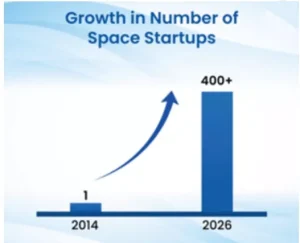
- Economic Velocity: Expansion from a single registered space startup in 2014 to over 400 active firms by early 2026, attracting more than $500 million in private investment and generating high-skill employment.
- Strategic Autonomy: Reliance on indigenous infrastructure such as NavIC protects critical military and civilian logistics from external geostrategic leverage.
- Space Diplomacy: Strengthens India’s regional leadership through initiatives such as the South Asia Satellite (GSAT-9), supporting digital education and telemedicine services.
UPSC Coaching Classes
Key Constraints and Emerging Challenges
- Low Global Market Share: Despite elite space capabilities, India’s space economy is valued at approximately $8 billion, accounting for only 2–3% of the global space market.
- Manufacturing Bottlenecks: Scaling advanced laboratory designs into mass production remains constrained by limited high-precision manufacturing capacity.
- Life-Support Risk Thresholds: Developing human-rated systems, reliable life-support technologies, and autonomous spacecraft docking mechanisms remains technologically demanding.
- Hostile Planetary Parameters: Designing electronics capable of surviving Venus’s high-pressure, high-temperature (~460°C), and corrosive environment is a major engineering challenge.
- Fiscal Capital Pressures: Simultaneously financing planetary missions, human spaceflight, heavy-lift rockets, and new spaceports imposes substantial fiscal demands.
Way Forward
- Achieve 2030 Market Targets: Expand private-sector participation and launch frequency to attain India’s target of an 8% share of the global space economy by 2030.
- Operationalize New Infrastructure: Expedite completion of the Kulasekarapattinam Spaceport (Tamil Nadu) for SSLV launches and develop the Third Launch Pad at Sriharikota.
- Mainstream NavIC Adoption: Strengthen partnerships with global chipset manufacturers such as Qualcomm to integrate NavIC into mass-market smartphones.
- Reduce Launch Costs: Advance Reusable Launch Vehicle (RLV) technologies and improve cryogenic propulsion systems to lower per-kilogram launch expenses.
Click to Know UPSC Offline Courses
Conclusion
By combining achievements such as Chandrayaan-3, space-sector liberalization, and a vibrant startup ecosystem, India is emerging as a major space power. Advancements in reusable launch systems, human spaceflight, and the Bharatiya Antariksh Station will strengthen its role in global space governance by Amrit Kaal 2047.
 24 Jun 2026