Subject: GS 3: Science & Technology
Context: Researchers from BITS Pilani , in collaboration with IBM Quantum, developed a quantum algorithm that simulated subatomic particles on 120 qubits, earning India’s first ‘Active Quantum Advantage’ recognition from the Quantum Advantage Tracker (QAT).
UPSC Online Preparation
About the Achievement
- Achievement: The team developed a quantum algorithm capable of simulating the real-time behaviour of subatomic particles governed by the strong nuclear force, demonstrating a verified case of quantum advantage.
- Performance: The computation was completed in 20 seconds on an IBM quantum processor using 120 qubits, whereas a leading classical computer required nearly two hours to perform the same task.
- Global Recognition: The result has been designated as ‘Active’ by the Quantum Advantage Tracker (QAT), making it the first validated demonstration of active quantum advantage by an Indian laboratory.
About Quantum Computing
- Quantum computing is an advanced computing paradigm that exploits the principles of quantum mechanics to solve computational problems that are impractical or impossible for even the most powerful classical supercomputers.
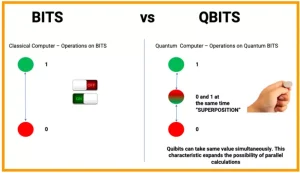
Working Principle: Unlike classical computers that process information using bits (0 or 1), quantum computers use qubits, which can exist in multiple states simultaneously through superposition, interact via entanglement, and perform computations using quantum interference.
- Suitable Applications: Quantum computers are particularly effective for solving problems involving complex quantum systems, optimisation, cryptography, molecular modelling, materials science, and high-energy physics.
- Limitation: They are not universally faster than classical computers and remain less efficient for routine tasks such as arithmetic operations, word processing and general data handling.
What is Quantum Advantage?
- Quantum advantage refers to the stage at which a quantum computer performs a specific, practically useful computational task faster, more efficiently or with greater accuracy than the best available classical supercomputer.
- Why It Matters: It demonstrates that quantum computers can deliver measurable computational benefits for real-world scientific problems rather than merely theoretical or artificial benchmark tasks.
- Significance of the Present Achievement: The BITS Pilani algorithm is among the few globally recognised examples of useful quantum advantage, as it addresses a genuine problem in particle physics rather than a specially designed benchmark.
Key Features of the Quantum Algorithm
- Models Strong Nuclear Interactions: The algorithm simulates the interactions of quarks and gluons, which are governed by the strong nuclear force responsible for binding atomic nuclei.
- Improves Scalability: A novel encoding strategy reduces computational redundancy, enabling the simulation to scale from previous demonstrations involving around 27 qubits to 120 qubits.
- Mitigates Quantum Noise: The researchers introduced an efficient noise-cancellation technique by comparing paired quantum measurements, thereby improving computational reliability without expensive hardware modifications.
- Future-Ready Design: The algorithm can readily utilise future high-qubit quantum processors, making it adaptable to next-generation quantum hardware.
About the Quantum Advantage Tracker (QAT)
- The Quantum Advantage Tracker (QAT) is an independent global platform that rigorously validates claims of quantum advantage.
- Developed By: It was launched in 2025 by IBM, the Flatiron Institute, BlueQubit, Algorithmiq, and academic collaborators.
- Validation Process: Submitted results are independently reproduced on both classical and quantum computers before being accepted.
- Active Status: A claim remains ‘Active’ until a classical algorithm is shown to solve the same problem with comparable efficiency.
- Rigorous Standards: Out of more than 220 submissions, only a small number have been recognised as active quantum advantage demonstrations.
Click to Explore UPSC Offline Coaching
Its Significance
- Demonstrates India’s Quantum Research Capability: It represents the first internationally validated demonstration of active quantum advantage by an Indian research institution, strengthening India’s position in advanced quantum research.
- Advanced High-Energy Physics: The algorithm enables efficient simulation of quark-gluon dynamics, supporting research in Quantum Chromodynamics (QCD) and particle physics.
- Example: Researchers at CERN have expressed interest in evaluating the approach for future particle simulations.
- Enables Future Scientific Applications: Similar approaches could accelerate research in drug discovery, materials engineering, chemical simulations, optimisation, and climate modelling as quantum hardware matures.