Subject: GS 3: Science
Context: Chinese researchers developed a Metal-Organic Framework (MOF) that removes tritium from nuclear wastewater with record efficiency, offering a breakthrough in nuclear waste management.
About Tritium Problem
- Tritium (³H) is a radioactive isotope of hydrogen containing one proton and two neutrons.
- It occurs naturally in trace amounts and is also produced in nuclear reactors.
- Difficult to Remove: Tritium combines with oxygen to form tritiated water (HTO), which is chemically almost identical to ordinary water (H₂O).
- This makes conventional separation methods highly energy-intensive and inefficient.
- Environmental Significance: Although tritium emits low-energy beta radiation, it can pose risks if ingested.
- Large quantities of tritiated water, such as those from the Fukushima nuclear plant, require safe treatment before disposal.
UPSC Coaching Classes
Key Highlights of the New Research
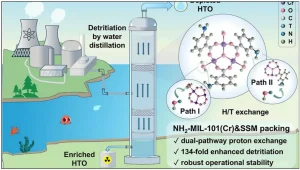
- Advanced Separation Technology: Researchers developed a metal-organic framework (MOF)-based active packing material, using NH₂-MIL-101(Cr) coated on stainless-steel mesh to improve tritium separation.
- Removal Mechanism: The MOF acts like a microscopic sponge, increasing surface area by 32 times.
- Its chromium-oxygen clusters selectively exchange radioactive tritium with ordinary hydrogen through isotope exchange, greatly enhancing separation efficiency.
- Performance : The technology achieved 42.5 theoretical plates per metre, making it about 134 times more efficient than the best existing material.
- It offers a promising solution for Fukushima-type radioactive wastewater and supports safer, sustainable nuclear energy management.
About Metal-Organic Framework (MOF)
- Metal-Organic Frameworks (MOFs) are highly porous crystalline materials formed by linking metal ions/clusters with organic molecules (linkers).
- The 2025 Nobel Prize in Chemistry was jointly awarded to Susumu Kitagawa, Richard Robson, and Omar M. Yaghi for their pioneering work in the development of metal-organic frameworks (MOFs).
- Key Features
- Ultra-High Porosity: Possess enormous internal surface area, often exceeding conventional porous materials.
- Highly Tunable Structure: Pore size and chemical properties can be precisely engineered for specific applications.
- Selective Adsorption: Can selectively capture gases, isotopes, pollutants, or other target molecules.
- Lightweight and Stable: High adsorption capacity with relatively low material weight.
- Wide Applications: Used in gas storage, carbon capture, catalysis, drug delivery, water purification, and nuclear waste treatment.
Click to Know UPSC OnlyIAS Coaching Centres
Conclusion
The breakthrough demonstrates how advanced materials can transform radioactive waste management, enhancing nuclear safety while supporting sustainable and environmentally responsible clean energy systems.
 14 Jul 2026