Subject: GS 3: Science & Technology
Context: Researchers at the University of Minnesota have developed a synthetic cell capable of growing, replicating its DNA, dividing, and undergoing natural selection, marking a significant advance in synthetic biology and understanding the origins of cellular life.
UPSC Online Preparation
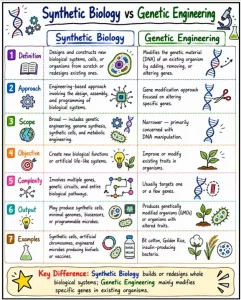
About Synthetic Cell
- A synthetic cell is an artificially engineered, cell-like system assembled from non-living biological components to mimic one or more essential functions of natural living cells.
- Composition: It is typically built using lipid membranes, DNA/RNA, proteins, enzymes, and other biomolecules instead of being derived from an existing living organism.
- Purpose: Synthetic cells help scientists understand the fundamental principles of life, investigate cellular processes, and develop applications in medicine, biotechnology, environmental science, and industrial biology.
- Types: Synthetic cells range from minimal cells (containing only essential components) to protocells that imitate primitive forms of life.
Regulation of Synthetic Cells:
- Convention on Biological Diversity (CBD): Promotes the conservation of biodiversity, sustainable use of biological resources, and risk assessment of modern biotechnology, including emerging synthetic biology applications.
- Cartagena Protocol on Biosafety (2003): A protocol under the CBD that regulates the safe transboundary movement, handling, and use of Living Modified Organisms (LMOs) to protect biodiversity and human health.
- World Health Organization (WHO) Biosafety Guidelines: Provide international guidance on biosafety, biosecurity, laboratory containment, and risk management for research involving genetically modified and synthetic biological systems.
- Synthetic cells currently lack a dedicated international legal framework. Their governance is guided through broader biosafety, biosecurity, and synthetic biology regulations under existing international instruments.
|
- Difference from Artificial Cells: Unlike conventional artificial cells, which mainly replicate isolated functions such as drug delivery, synthetic cells perform multiple integrated life-like processes, including metabolism, growth, replication, and division.
How Was the New Synthetic Cell Developed?
- Liposome-Based Cell Construction: Researchers began with a liposome—a microscopic bubble made of lipids (fats) that functions as an artificial cell membrane.
- Protein Synthesis Machinery: The liposome contained the PURE (Protein synthesis Using Recombinant Elements) system, enabling conversion of DNA into proteins without living cells.
- Synthetic Genome: The artificial cell carried a DNA genome of about 90,000 base pairs, containing genetic instructions for growth and reproduction.
- Feeding Mechanism: The genome encoded alpha-hemolysin, forming molecular hooks that captured feeder liposomes to absorb lipids and nutrients.
- Genome Replication: The cell used Phi29 DNA polymerase to accurately replicate its genome before division.
- Biological Cell Division: Researchers engineered a biological division mechanism by increasing protein concentration on the membrane, causing it to pinch and divide into daughter cells.
- Demonstration of Evolution: A genetic mutation enabled some cells to consume nutrients more efficiently, demonstrating Darwinian natural selection in a fully synthetic system.
Significance of the Breakthrough
- Closer to Artificial Life: Demonstrates key characteristics of living systems—growth, genome replication, division, and evolution—using entirely synthetic biological components.
- Advances Synthetic Biology: Strengthens synthetic biology by enabling programmable biological systems and improving understanding of molecular life processes.
- Understanding the Origin of Life: Provides a platform to study how primitive cells and complex living organisms may have evolved.
- Biomedical Applications: Potential applications include targeted drug delivery, precision cancer therapy, gene therapy, tissue regeneration, vaccine development, and personalised medicine.
- Industrial and Environmental Applications: Can be used for biopharmaceutical production, enzyme synthesis, biofuel production, and environmental remediation.
- Scientific Research Tool: Offers simplified models to study cellular metabolism, gene regulation, protein synthesis, and disease mechanisms.
Challenges and Ethical Concerns
- Incomplete Living System: Synthetic cells remain far simpler than natural cells, lacking complexity, adaptability, and self-sustaining metabolism.
- Technical Challenges: Building fully autonomous synthetic cells with long-term survival and stable inheritance remains difficult.
- Biosafety Risks: Potential accidental release, ecological impacts, and misuse require strong biosafety protocols.
- Ethical and Governance Issues: Raises concerns regarding artificial life, ownership, biosecurity, and regulatory oversight.
India and Synthetic Biology
- National BioE3 Policy (2024): Promotes synthetic biology, bio-manufacturing, and advanced biotechnology for economy, environment, and employment.
- Research Ecosystem: Institutions such as IISc, IITs, CSIR, DBT, and BIRAC are expanding research in genetic engineering, synthetic biology, and genome technologies.
- Biotechnology Vision: Synthetic biology is emerging as a key pillar of India’s healthcare innovation, bioeconomy, precision medicine, climate-resilient agriculture, and industrial biotechnology.
Way Forward
- Strengthen Fundamental Research: Increase investment in synthetic biology, systems biology, and artificial cell engineering.
- Develop Robust Regulatory Frameworks: Establish comprehensive biosafety, biosecurity, and ethical governance mechanisms.
- Promote International Collaboration: Enhance global cooperation on standards, responsible innovation, knowledge sharing, and risk management.
- Build Skilled Human Resources: Expand interdisciplinary training in biology, engineering, computer science, artificial intelligence, and bioinformatics.
- Translate Research into Applications: Promote academia-industry partnerships to develop solutions for healthcare, agriculture, environment, and industrial manufacturing.
Click to Know UPSC OnlyIAS Coaching Centres
Conclusion
The breakthrough highlights the transformative potential of synthetic biology for biotechnology, medicine, and origin-of-life research, while underscoring the need for robust biosafety, biosecurity, and ethical governance as artificial life technologies advance.
 6 Jul 2026