UPSC PYQs

Prelims, Mains & Optional PYQs

UPSC Notes

Comprehensive & Short Notes

Climate Change and Dairy Production in India: Heat Stress & Milk Yield

6 Jul 2026

Climate Change and Dairy Production in India: Heat Stress & Milk Yield

Subject: GS 2: Polity & Governance

Context: Recently, a study published in Scientific Reports finds that climate change is significantly reducing milk production in India’s trans-Gangetic plains, with buffaloes being the most vulnerable to heat stress, posing risks to food security and farmer livelihoods.
UPSC Online Coaching

Key Findings of the Study

Climate Change

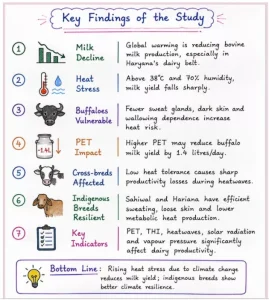
  • Significant Decline in Milk Production: Global warming has emerged as a major factor behind the decline in bovine milk production, with Haryana’s high-yield dairy belt witnessing particularly severe impacts.
  • Heat Stress Reduces Productivity: Temperatures above 38°C combined with humidity above 70% significantly reduce milk yield by causing physiological stress in dairy animals.
  • Buffaloes Most Vulnerable: Buffaloes are highly susceptible due to fewer sweat glands, dark skin, and dependence on wallowing. A rise in Potential Evapotranspiration (PET) can reduce milk yield by 1.4 litres/day.
    • PET is the maximum amount of water that can be evaporated from land and transpire from plants under prevailing weather conditions if water is not limiting. It is a key indicator of atmospheric moisture demand and heat stress
  • Cross-bred Cattle Also Affected: Cross-bred cattle experience sharp productivity losses during heatwaves because of lower heat tolerance.
  • Indigenous Breeds More Resilient: Sahiwal and Hariana possess efficient sweating, loose skin, and lower metabolic heat production, enhancing heat resilience.
  • Climate Indicators Matter: PET, Temperature-Humidity Index (THI), heatwaves, solar radiation, and vapour pressure significantly influence dairy productivity.

How Climate Change Affects Dairy Production

  • Physiological Heat Stress: High temperatures cause panting, reduced feed intake, higher cortisol levels, and lower activity, diverting energy from milk production.
  • Reduced Milk Secretion: Heat stress disrupts milk ejection, lowering milk yield and increasing livestock mortality under extreme conditions.
  • Declining Fodder Availability: Rising temperatures reduce the quantity, quality, and availability of fodder, alongside increasing water scarcity.
  • Greater Disease Burden: Climate change weakens animal immunity, increasing parasites, infectious diseases, and veterinary costs.
  • Economic Losses: Heat stress causes losses of 3.2 million tonnes of milk annually (about ₹2,661 crore), projected to reach 15 million tonnes by the 2050s.

Implications for India

  • Threat to Dairy Economy: Declining productivity threatens food security, nutrition, and the rural dairy economy.
  • Livelihood Risks: Nearly 80 million smallholder dairy farmers face declining incomes due to climate-induced productivity losses.
  • Nutritional Security Concerns: Lower milk availability threatens access to protein, calcium, and essential micronutrients.
  • Climate Vulnerability of Agriculture: The findings highlight rising climate vulnerability of both livestock and crop agriculture.

Adaptive Measures and Climate-Resilient Practices

  • Microclimate Management: Adoption of sprinklers, foggers, misting systems, shaded sheds, and wallowing ponds reduces heat stress.
  • Improved Feeding Practices: Balanced nutrition, better feed management, and adequate water improve resilience.
  • Early Warning Systems: Integrate PET and THI into regional early warning systems for timely interventions.
  • Thermo-Tolerant Breeding: Promote breeding using Bos indicus traits to improve heat tolerance.
  • Conservation of Indigenous Breeds: Strengthen in-situ conservation and farmer-led breed improvement of indigenous cattle.

UPSC Coaching Classes

Earlier Government Initiatives

  • Rashtriya Gokul Mission (RGM): Promotes conservation and genetic improvement of indigenous cattle breeds.
  • National Programme for Dairy Development (NPDD): Strengthens dairy infrastructure, milk procurement, and value chains.
  • National Livestock Mission (NLM): Supports fodder development, breed improvement, and climate-resilient livestock management.
  • National Innovations on Climate Resilient Agriculture (NICRA): Develops climate-resilient technologies for agriculture and livestock.
  • National Action Plan on Climate Change (NAPCC): National Mission for Sustainable Agriculture (NMSA) promotes climate adaptation and resource efficiency.

Way Forward

  • Promote Climate-Smart Dairy Farming: Expand heat mitigation infrastructure, climate-resilient housing, and climate advisory services.
  • Strengthen Indigenous Breeding Programmes: Scale up heat-tolerant indigenous breed improvement.
  • Improve Fodder Security: Invest in climate-resilient fodder crops, silage, and drought-resistant forage.
  • Expand Climate Advisory Services: Develop heat stress forecasting, digital advisories, and extension services.
  • Support Smallholder Farmers: Provide financial incentives, insurance, credit, and technology support.
  • Strengthen Research and Innovation: Increase investment in livestock genomics, precision dairy farming, climate-resilient breeding, and animal health research.

Click to Know UPSC Offline Courses

Conclusion

The findings highlight the need for climate-smart dairy farming, heat-resilient indigenous breeds, early warning systems, and adaptive livestock management to safeguard milk production, nutrition security, and smallholder incomes under a warming climate.

Check Out UPSC CSE Books

Visit PW Store

online store 1

Climate Change and Dairy Production in India: Heat Stress & Milk Yield

Need help preparing for UPSC or State PSCs?

Connect with our experts to get free counselling & start preparing

Free Counselling for UPSC Aspirants

Connect with our experts and take the right next step.

Expert Guidance
Personalized Strategy
100% Free

Book Your Free Session

NEED ASSISTANCE?

Request a Callback

Our counsellor will connect with you and help you choose the right course and centre.

  • Expert Guidance
  • Course & Fee Information
  • Quick Callback Support

Request a Callback

Books
UPSC PYQs
UPSC Notes
Current Affairs
Quick Revise Now !
AVAILABLE FOR DOWNLOAD SOON
UDAAN PRELIMS WALLAH
Comprehensive coverage with a concise format
Integration of PYQ within the booklet
Designed as per recent trends of Prelims questions
हिंदी में भी उपलब्ध
Quick Revise Now !
UDAAN PRELIMS WALLAH
Comprehensive coverage with a concise format
Integration of PYQ within the booklet
Designed as per recent trends of Prelims questions
हिंदी में भी उपलब्ध

<div class="new-fform">


    </div>

    Subscribe our Newsletter
    Sign up now for our exclusive newsletter and be the first to know about our latest Initiatives, Quality Content, and much more.
    *Promise! We won't spam you.
    Yes! I want to Subscribe.