Subject: GS 2: Polity & Governance
Context: Recently, a three-judge Bench headed by the Chief Justice of India issued notice to the Union Government and States on a petition seeking distinct legal recognition and constitutional protection for intersex persons.
UPSC Online Preparation
Key Highlights

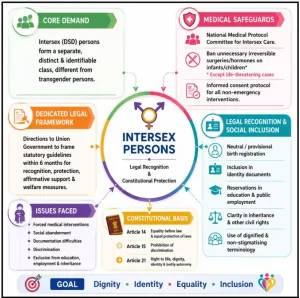
- Core Demand: The petition seeks a declaration that persons born with congenital variations in sex characteristics (Differences of Sex Development – DSD) constitute a separate and identifiable class, distinct from persons whose gender identity differs from their sex assigned at birth.
- Dedicated Legal Framework: It seeks directions to the Union Government to frame statutory guidelines within six months providing recognition, protection, affirmative support, and welfare measures for intersex persons.
- Medical Safeguards: The petition seeks:
- Constitution of a National Medical Protocol Committee for Intersex Care.
- Prohibition of medically unnecessary irreversible surgeries or hormonal interventions on intersex infants and children, except where required to address a life-threatening medical condition.
- Adoption of an informed consent protocol for all non-emergency interventions.
- Legal Recognition & Social Inclusion: The petition seeks:
- Neutral/provisional birth registration.
- Inclusion in identity documents.
- Reservations in education and public employment.
- Clarity in inheritance and other civil rights.
- Use of dignified and non-stigmatising terminology.
- Issues Faced by Intersex Persons: The petition highlights challenges such as forced medical interventions, social abandonment, documentation difficulties, discrimination, and exclusion from education, employment, and inheritance.
- Constitutional Basis: The petition argues that the absence of separate recognition violates:
- Article 14 – Equality before law and equal protection of laws.
- Article 15 – Prohibition of discrimination.
- Article 21 – Right to life, dignity, identity, and bodily autonomy.
About Intersex Persons
- Intersex persons are individuals born with congenital variations in sex characteristics, including chromosomes, gonads, hormones, or genitalia, that do not conform to typical male or female biological classifications.
- Differences of Sex Development (DSD): DSD refers to a group of congenital conditions involving atypical development of chromosomal, gonadal, or anatomical sex characteristics.
- Intersex vs Transgender: Intersex refers to a biological variation present from birth, whereas transgender relates to a person’s gender identity differing from the sex assigned at birth.
- Medical Ethics: International standards discourage non-essential, irreversible medical interventions on intersex infants until they are capable of providing informed consent, except in medical emergencies.
- Key Challenges: Intersex persons face stigma, forced surgeries, legal invisibility, identity documentation issues, limited access to healthcare, and social discrimination.
Legal & Constitutional Framework in India
- NALSA Judgment (2014): The Supreme Court recognised the right to self-identify gender and directed governments to provide legal recognition, affirmative action, and social welfare measures for transgender persons. The present petition argues that intersex persons require a distinct legal framework rather than being subsumed within transgender protections.
- Transgender Persons (Protection of Rights) Act, 2019: Prohibits discrimination against transgender persons and provides for welfare measures, but does not specifically address the unique medical and legal concerns of intersex persons.
- Intersex persons in India often fall under the broader “transgender” legal umbrella.
Click to Explore UPSC Offline Coaching
Judicial & State Interventions on Intersex Rights
- Madras High Court – Arunkumar v. Inspector General of Registration (2019): The Court effectively prohibited medically unnecessary sex-selective surgeries on intersex infants and children, recognising their right to bodily integrity.
- Tamil Nadu Government Order (2019): Pursuant to the Madras High Court’s directions, Tamil Nadu became the first State to ban sex reassignment surgeries on intersex infants and children, except in life-threatening medical situations.
- Delhi Commission for Protection of Child Rights (DCPCR), 2021: Recommended a ban on medically unnecessary sex-selective surgeries on intersex infants.
- Supreme Court (2026): Referred the PIL on intersex rights to a three-judge Bench, recognising that it raises substantial constitutional questions regarding the distinction between “sex” and “gender” and the need for a separate legal framework for intersex persons.