India’s Net FDI Decline: Causes, Trends, Challenges & Economic Impact

11 Jun 2026

India’s Net FDI Decline: Causes, Trends, Challenges & Economic Impact

India’s net Foreign Direct Investment (FDI) has declined sharply in recent years, leading to debate over whether it reflects weak investor confidence or changing patterns of global capital flows.
  • India’s net FDI declined from a peak of $44 billion in 2020–21 to less than $1 billion in 2024–25, before recovering to around $7.6 billion in 2025–26.
    • Net FDI is calculated as the difference between FDI inflows and FDI-related outflows after accounting for capital repatriation.
  • Gross FDI inflows remained high at around $94.6 billion in 2025–26, showing that large inflows and weak net flows can exist simultaneously.

Best Online Coaching for UPSC

About FDI

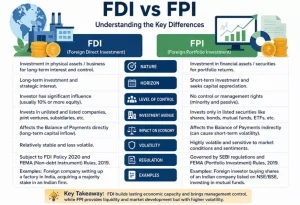
  • Foreign Direct Investment (FDI) refers to an investment by an individual or a company in one country into business interests located in another country.
  • Allowed 100% FDI in some sectors- IT and Software Development, E-commerce, Renewable Energy, Automobile Sector, Food Processing
  • Governance: 
    • FDI in India is currently governed by the FDI Policy 2020 and the FEMA (Non-Debt Instrument) Rules, 2019, issued under the framework of the Foreign Exchange Management Act (FEMA), 1999.
    • The Department for Promotion of Industry and Internal Trade (DPIIT) under the Ministry of Commerce and Industry is the primary authority responsible for framing and regulating FDI policy in India.
    • The Reserve Bank of India (RBI) plays a crucial role in implementing and monitoring FDI regulations by ensuring compliance with the FEMA framework.
  • FDI prohibited in certain sectors- Lottery and Gambling, Atomic Energy, Tobacco, Chit Funds
  • Two routes of FDI:
    • Automatic Route: No prior government approval is required. Investment is made directly in permitted sectors, subject to FDI policy regulations. Examples: Infrastructure, IT, and most manufacturing sectors.
    • Government Approval Route: Requires prior approval from the relevant government authorities or ministries. Examples: Defense, media, and multi-brand retail sectors.

India’s Net FDI Decline

Evolution of India’s FDI Policy

  • Initial Objective (Post-1991 Economic Reforms): After the 1991 economic liberalisation, India’s FDI policy was primarily aimed at attracting foreign investment for technology transfer, export promotion, and conservation of foreign exchange reserves.
  • Changing Policy Focus: Over time, the policy approach shifted from focusing mainly on the quality and developmental impact of foreign investment towards attracting larger volumes of FDI inflows.
    • In this process, concerns related to future external payment obligations, quality of investment, technology spillovers, and long-term economic benefits received comparatively less attention.

Different Types of FDI Investors

Real FDI (RFDI)

  • Real FDI (RFDI) refers to investment by traditional multinational enterprises that establish production facilities, service operations, brands, and long-term business activities in the host country.

Changing Composition of FDI Inflows

  • Recent analysis of effective FDI inflows shows:
    • Real FDI (RFDI): 41.9%
    • Financial investors: 40.5%
    • Diaspora and SPV-linked investments: 17.6%
  • This indicates that a significant share of FDI is driven by financial flows rather than fresh productive investment.

  • Such investors generally contribute to:Technology transfer through advanced production methods and know-how.
    • Employment generation by creating direct and indirect job opportunities.
    • Productivity improvement through better management practices and global value-chain integration.
  • Example: Foreign manufacturing companies establishing factories in India.

Financial Investors

  • Financial investors include private equity funds, venture capital firms, sovereign wealth funds, and asset management companies that invest mainly for financial returns.
  • Their primary objective is capital appreciation and planned exit rather than establishing long-term productive capacity.
  • Such investments can provide capital and improve corporate efficiency, but large-scale exits through share sales, buybacks, or strategic divestments may reduce net FDI despite continued gross inflows.

Diaspora Investments and Special Purpose Vehicles (SPVs)

  • Some FDI flows occur through diaspora investments, Special Purpose Vehicles (SPVs), and offshore financial centres.
  • These structures involve overseas entities linked to Indian capital and may sometimes include round-tripping, where domestic capital moves abroad and returns to India through foreign investment routes.
  • Such investments increase financial flows but may not always represent new foreign capital, technology transfer, or additional productive capacity.

UPSC Online Courses

Role of Foreign Direct Investment (FDI) in Driving India’s Economic Transformation

  • Promotes Capital Formation: FDI supplements domestic savings by providing long-term capital for infrastructure, manufacturing, and service sector expansion, supporting sustained economic growth.
  • Enables Technology Transfer: Foreign investors bring advanced technologies, innovation, managerial expertise, and global best practices, improving productivity and competitiveness of Indian industries.
  • Strengthens Manufacturing Sector: FDI supports industrial development, expansion of production capacity, and integration into global value chains, helping India achieve manufacturing-led growth.
  • Generates Employment Opportunities: Foreign investment creates direct and indirect employment through new enterprises, supply chains, and expansion of existing businesses.
  • Enhances Export Competitiveness: Multinational companies connect India with global markets, increasing exports and improving participation in international trade networks.
  • Improves Infrastructure Development: FDI contributes to sectors such as transport, energy, logistics, and digital infrastructure, reducing bottlenecks and improving economic efficiency.
  • Supports MSME Development: Foreign companies create linkages with domestic firms, enabling technology adoption, better quality standards, and integration into global supply chains.
  • Strengthens Balance of Payments: FDI provides non-debt creating foreign capital, helping finance external requirements and reducing dependence on external borrowing.
  • Enhances Global Integration: FDI increases India’s integration with the global economy by attracting multinational enterprises and strengthening international economic partnerships.

Government Policies/Initiatives Promoting FDI in India

  • Production Linked Incentive (PLI) Scheme (2020): Provides incentives to attract foreign investment in strategic manufacturing sectors and strengthen domestic production capacity.
  • National Single Window System (2021): Creates a single digital platform for faster approvals and improves ease of doing business for investors.
  • PM Gati Shakti National Master Plan (2021): Develops integrated infrastructure and logistics networks to reduce costs and attract investment.
  • FDI Policy Liberalisation Measures: Expands automatic route access and relaxes sectoral caps to encourage foreign investment across key sectors.
  • GIFT City–IFSC Development: Promotes India as an international financial hub to attract global financial institutions and cross-border investments.

Challenges with Current FDI Approach

  • Quantity Over Quality: Excessive emphasis on increasing FDI volume may overlook whether foreign investment is creating productive capacity, technology transfer, employment opportunities, and long-term economic value.
  • Limited Manufacturing Impact: The declining share of Real FDI (RFDI) in manufacturing raises concerns about whether foreign investment is sufficiently contributing to industrial development, manufacturing expansion, and integration into global value chains.
  • Increasing Capital Outflows: Large-scale investor exits, disinvestment, and capital repatriation can create external payment pressures and may reduce the long-term benefits of foreign capital inflows.
  • Complex Capital Structures: The increasing use of Special Purpose Vehicles (SPVs), offshore entities, and financial investment routes makes it difficult to differentiate between genuine foreign investment and financial capital movements.
  • Limited Technology Spillovers: A significant share of FDI, especially financial investments, may not result in substantial technology transfer, innovation, or improvement in domestic productive capabilities.
  • Rising Profit and Royalty Outflows: Increasing payments towards dividends, royalties, and intellectual property rights (IPR) charges may create pressure on the external sector and reduce the net economic gains from FDI.
  • Sectoral Imbalance in FDI Inflows: FDI inflows are often concentrated in selected sectors such as services, digital platforms, and finance, while manufacturing sectors requiring deeper industrial transformation may receive relatively lower investment.
  • Vulnerability to Global Capital Movements: Greater dependence on foreign financial investors can expose the economy to sudden capital exits, market volatility, and changes in global investment sentiment.

Way Forward

  • Focus on Quality FDI: India should prioritise quality-oriented FDI that contributes to technology transfer, manufacturing capability, innovation, and skilled employment generation rather than focusing only on increasing investment volumes.
  • Improve FDI Data Transparency: FDI reporting should clearly differentiate between fresh capital investment, financial investments, and ownership restructuring transactions to provide a more accurate assessment of foreign investment benefits.
  • Strengthen Domestic Manufacturing Ecosystem: Policies such as the Production Linked Incentive (PLI) scheme, infrastructure development, and skill enhancement programmes should be used to attract long-term investors and promote manufacturing growth.
  • Manage External Vulnerabilities: India should closely monitor capital outflows, royalty and intellectual property payments, and profit repatriation trends to maintain external sector stability and ensure sustainable benefits from FDI.
  • Promote Greenfield Investments: India should encourage greenfield FDI that creates new production facilities, expands industrial capacity, and generates employment instead of relying mainly on mergers, acquisitions, and financial transactions.
  • Encourage Export-Oriented FDI: Policies should focus on attracting investments that enhance export competitiveness, integrate India into global value chains, and improve the country’s manufacturing base.
  • Strengthen Domestic Investment Capacity: Improving the domestic business environment and supporting Indian enterprises will reduce excessive dependence on foreign capital and create a stronger investment ecosystem.
  • Ensure Balanced Regulatory Framework: India should maintain a framework that provides investor confidence while protecting national economic interests, ensuring that foreign investment supports sustainable development goals.

Conclusion

  • India’s FDI story cannot be judged only through gross inflow numbers or declining net flows. The real challenge is ensuring that foreign investment contributes to technology creation, manufacturing growth, employment generation and sustainable external balance. A shift from FDI quantity to FDI quality is essential for India’s long-term economic strategy.

Click to Know UPSC OnlyIAS Coaching Centres

Basis Inward FDI (FDI Inflow) Outward FDI (FDI Outflow)
Meaning Investment made by foreign companies or investors into the domestic economy. Investment made by domestic companies or investors in foreign countries.
Direction of Capital Flow Capital flows into India from foreign economies. Capital flows out of India to overseas markets.
Purpose To establish businesses, acquire companies, expand operations, or access Indian markets. To expand globally, acquire resources, access technology, enter new markets, or create global operations.
Impact on Economy Increases foreign capital availability and supports investment, employment, and growth. Can reduce domestic capital availability but may help Indian firms become global players.
Balance of Payments (BoP) Recorded as a financial account inflow. Recorded as a financial account outflow.
Examples A foreign automobile company setting up a manufacturing plant in India. An Indian company acquiring a foreign firm or setting up a subsidiary abroad.
Main Benefits Technology transfer, employment generation, productivity improvement, and integration with global value chains. Access to foreign markets, resources, technology, and global competitiveness.
Possible Concerns Profit repatriation, royalty payments, and dependence on foreign investors. Capital outflow, possible capital recycling, and pressure on foreign exchange resources.
Major Investors Multinational companies, sovereign wealth funds, private equity funds, foreign institutional investors. Indian multinational companies, business groups, and domestic investors.
Example in India Context Foreign companies investing in Indian manufacturing, services, and infrastructure sectors. Indian firms investing in Singapore, UAE, Europe, or other global markets.

Check Out UPSC CSE Books

Visit PW Store


online store 1

India’s Net FDI Decline: Causes, Trends, Challenges & Economic Impact

Explore UPSC Foundation Course

Need help preparing for UPSC or State PSCs?

Connect with our experts to get free counselling & start preparing

Aiming for UPSC?

Download Our App

      
Quick Revise Now !
AVAILABLE FOR DOWNLOAD SOON
UDAAN PRELIMS WALLAH
Comprehensive coverage with a concise format
Integration of PYQ within the booklet
Designed as per recent trends of Prelims questions
हिंदी में भी उपलब्ध
Quick Revise Now !
UDAAN PRELIMS WALLAH
Comprehensive coverage with a concise format
Integration of PYQ within the booklet
Designed as per recent trends of Prelims questions
हिंदी में भी उपलब्ध

<div class="new-fform">


    </div>

    Subscribe our Newsletter
    Sign up now for our exclusive newsletter and be the first to know about our latest Initiatives, Quality Content, and much more.
    *Promise! We won't spam you.
    Yes! I want to Subscribe.