The Ministry of Cooperation recently held the first meeting of its National Level Policy Implementation and Monitoring Committee in New Delhi.
- The panel met to design a country-wide roadmap to execute the newly launched National Cooperation Policy-2025.
UPSC Online Coaching
More on the News
- Whole-of-Government Execution: The committee brought together multiple central ministries (including Panchayati Raj, Rural Development, and Agriculture), state governments, and financial giants like NABARD to ensure coordinated grassroots implementation.
- Massive Growth Targets: The panel reviewed strategic plans to aggressively expand national cooperative membership to 50 crore by 2035 and triple the economic contribution of the cooperative sector in the national economy.
- Grassroots Tech Upgrades: Key focus was placed on the fast-tracked computerization of Primary Agricultural Credit Societies (PACS), launching ERP-based management systems, and securing data systems against cyber threats.
- Review of New Institutions: The committee evaluated the progress of newly formed specialized bodies, including the Tribhuvan Sahkari University for training and three new national-level cooperatives for exports, organics, and quality seeds.
About National Cooperation Policy-2025
- The policy is a comprehensive national framework designed to transform India’s cooperative societies into transparent, technology-enabled, professionally managed, and member-centric economic institutions.
- Guided by the Prime Minister’s vision of “Sahkar se Samriddhi” (Prosperity through Cooperation), it acts as a core vehicle to energize the rural economy and drive India toward Viksit Bharat @2047.
- Objective: To build an inclusive, tech-driven, and future-ready cooperative sector that supports India’s Viksit Bharat vision by 2047.
- Goals of National Cooperation Policy 2025:
-
- Expand Scale and Impact: Increase the number of cooperatives by 30% and triple their GDP contribution by integrating 50 crore active members by 2034.
- Achieve Universal Coverage: Establish at least one primary cooperative unit in every panchayat to ensure grassroots-level outreach.
The Six Strategic Pillars
The entire policy structure rests on six basic pillars
- Strengthening the Foundation: Revamping and reinforcing the existing base of the cooperative sector.
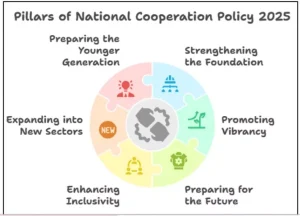 Vibrant and Competitive: Transforming cooperatives into modern, highly efficient, and competitive business enterprises.
- Preparing for the Future: Modernizing operations with advanced technology to handle tomorrow’s economic demands.
- Expanding Inclusiveness: Broadening the outreach to ensure deep participation from women, youth, and small/marginal farmers.
- New and Emerging Sectors: Promoting cooperative footprints in modern business fields like tech-driven services and green energy.
- Next-Gen Leadership: Connecting the younger generation with cooperative values and creating a startup culture within the sector.
Key Provisions of National Cooperation Policy 2025
- Model Cooperative Villages: Establishment of five model cooperative villages in every tehsil, beginning with a pilot in Gandhinagar (NABARD-led).
- Sectoral Expansion: Promotion of cooperatives in tourism, taxi services (Sahkar Taxi), insurance, and green energy; profits to benefit Primary Agricultural Credit Societies (PACS).
- Employment & Youth Linkages: Policy aims to generate jobs by establishing one cooperative in every village and increasing youth participation.
- Technology Integration: Focus on computerisation and tech-driven transparent management, especially in PACS, to improve accountability.
- Inclusivity Focus: Prioritizes villages, rural women, Dalits, and tribals; aims for equitable growth via member-centric development.
- Training & Education: Establishment of Tribhuvan Sahkari University to build skilled manpower for the cooperative ecosystem.
- Implementation Roadmap: 83 intervention points identified; work completed on 58, with legal updates planned every 10 years.
- Global Aspirations: National Cooperative Exports Limited established for international trade and global market access of Indian cooperative products
About Cooperative Societies
- Cooperative societies are voluntary associations of individuals who join together to meet their common economic, social, and cultural needs and aspirations.
- They operate on the principle of mutual help and self-help, prioritising the well-being of their members over profit maximisation.
- Status of Cooperative Societies In India:
-
- Currently there are more than 8 lakh cooperative societies registered in various fields like Housing, Dairy, Agriculture, Finance, etc.
- In 2021, the Ministry of Cooperation was created by the Government of India for realising the vision of ‘Sahkar se Samriddhi’.
- Jurisdiction: Cooperatives are a state subject under the Constitution.
- The subject ‘Cooperative Societies’ is mentioned in entry 32 of the State List under the Seventh Schedule of the Constitution.
UPSC Coaching Classes
Cooperative Banks
- Cooperative banks are financial institutions owned and managed by their members, who are also their customers.
- They operate on the principle of cooperation, with a focus on community welfare and member support, rather than maximizing profit like commercial banks.
|
Types of Cooperative Societies in India
- Consumer Cooperatives: These societies aim to provide quality goods and services to their members at affordable prices.
- Examples include Kendriya Bhandar and Apna Bazar.
- Producer Cooperatives: These societies support small producers by providing them with resources, technology, and market access.
- Examples include Amul Dairy Cooperative and Karnataka Handloom Weavers’ Cooperative Society.
- Marketing Cooperatives: These societies facilitate the collective marketing of agricultural and other products, ensuring better prices for their members.
- Credit Cooperatives: These societies offer financial services like loans and savings to their members, particularly those from rural and marginalised communities.
- Examples include Urban Cooperative Banks and Rural Cooperative Banks.
- Housing Cooperatives: These societies provide affordable housing solutions to their members by pooling resources and collectively developing housing projects.
- Multi-State Vs Single-State Cooperative Societies in India
- Multi-State Cooperatives operate across multiple states and are governed by the Multi-State Cooperative Societies Act, 2002, while Single-State Cooperatives operate within one state and follow the respective State Cooperative Societies Act.
- IFFCO, Amul, and NCDFI are Multi-State Cooperatives; State Cooperative Banks and PACS are State Cooperatives.
Constitutional Provisions for Cooperatives in India
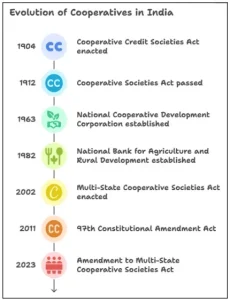
- 97th Constitutional Amendment: Added Part IXB (The Co-Operative Societies) to the Constitution.
- The Right to Form Cooperative Societies was included as the Right to Freedom under Article 19 (1).
- Article 43-B that deals with Promotion of Cooperative Societies was also inserted as one of the Directive Principles of State Policy.
- Multi-State Co-operative Societies (Amendment) Act, 2023: Amendment has been brought in the MSCS Act, 2002 to strengthen governance, enhance transparency, increase accountability, reform electoral process and incorporate provisions of 97th Constitutional Amendment in the Multi State Cooperative Societies.
Other Government Initiatives to Strengthen Cooperatives
- Ministry of Cooperation: The establishment of the Ministry of Cooperation in 2021 has provided a dedicated platform for addressing the needs and challenges of the cooperative sector.
- Financial Support: The government provides financial assistance to cooperatives through various schemes and programs.
- For Example under Computerization of Primary Agricultural Credit Societies (PACS) scheme government has allocated ₹2,516 crore to computerize nearly 63,000 PACS.
- Targeting different Sectors:
- Digital Services: PACS are being transformed into Common Service Centers (CSCs) to deliver a wide range of e-services to rural citizens.
- Healthcare: PM Bhartiya Jan Aushadhi Kendras are being operated by PACS to improve access to affordable medicines in rural areas.
- Energy: Under the PM-KUSUM Convergence scheme, PACS are promoting solar energy adoption among farmers for sustainable agriculture.
- Fisheries: Fish Farmer Producer Organizations (FFPOs) are being formed to empower fish farmers and enhance their market access.
Click to Know UPSC OnlyIAS Coaching Centres
Conclusion
The National Cooperation Policy-2025 modernizes India’s 8.48 lakh cooperatives into tech-driven hubs. By expanding membership to 50 crore, streamlining PACS, and targeting Viksit Bharat @2047, it empowers rural communities and drives inclusive, middleman-free economic growth.
 11 Jun 2026