The Central Government is launching a massive ₹1.25 lakh crore rural development transformation, rolling out the new ‘Viksit Bharat GRAMG’ framework that completely replaces the old MGNREGA system starting July 1, 2026.
UPSC Online Classes
Key Highlights
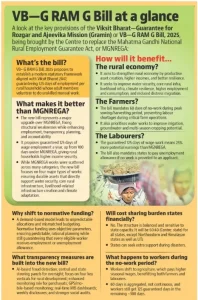
- Massive Financial Inflow: The Union Minister for Agriculture & Farmers Welfare and Rural Development released an interim package of ₹95,692 crore to States and Union Territories. Combined with existing funds, total capital surpasses ₹1.25 lakh crore.
- Direct-to-Village Funding: The entire capital pool will flow directly into nearly 2.80 lakh Gram Panchayats, ensuring individual village councils have several lakh rupees for localized asset creation.
Key Provisions of the Viksit Bharat – Guarantee for Rozgar and Ajeevika Mission (Gramin) Act, 2025
The VB-G RAM G Bill restructures the scheme around principles of strategic convergence and shared governance:
- Increased Guarantee: The statutory guarantee is raised from 100 days to 125 days of wage employment for every rural household.
- Funding Responsibility Shift: The financial burden moves from a predominantly Central-funded wage model to a Centrally Sponsored Scheme with shared financial liability:
- 60:40 Centre-State share for most states.
- 90:10 Centre-State share for northeastern and Himalayan states and UTs (Uttarakhand, Himachal Pradesh and Jammu and Kashmir).
- Allocation Model: The demand-driven ‘labour budget’ is replaced by a state-wise normative allocation determined by the Central Government.
- Mandatory Work Suspension: States are granted the authority to notify a period of up to 60 days in a financial year, coinciding with peak agricultural seasons (sowing/harvesting), during which scheme works shall not be undertaken to avoid labour shortages.
- Focus on Strategic Assets: Works must align with the Viksit Bharat National Rural Infrastructure Stack, focusing on four thematic domains:
- Water Security,
- Core Rural Infrastructure,
- Livelihood-related Infrastructure, and
- Mitigation of Extreme Weather Events.
- Digital Integration: Mandatory use of GIS-based tools, PM Gati Shakti layers, and AI audits is statutory.
- Retention of Unemployment Allowance: The Bill retains the provision for an unemployment allowance if work is not provided within 15 days of application.
About Mahatma Gandhi National Rural Employment Guarantee Act (MGNREGA): (UPSC CSE Prelims- 2011)
- MGNREGA is the world’s largest employment guarantee programme, aiming to enhance livelihood security by providing at least 100 days of wage employment each year to rural households whose adult members volunteer to do unskilled manual work.
- Launch: MGNREGA was enacted in 2005 and came into force on February 2, 2006.
- It is a rights-based framework that legally guarantees rural employment, making the government accountable for providing jobs on demand.
- Implementation: The scheme is implemented by the Ministry of Rural Development (MoRD) in partnership with state governments.
- Gram Panchayats play a crucial role in planning and executing projects under MGNREGA, ensuring that local needs guide the nature of work undertaken.
- Funding Structure
- MGNREGA is primarily funded by the Central Government, which bears 100% of the cost of unskilled labour and 75% of the material cost.
- State governments contribute the remaining 25% of the material cost and are responsible for unemployment allowances when work is not provided within 15 days of demand.
|
Click to Know UPSC Coaching Centres in India
Comparison between MGNREGA vs. VB-G RAM G Bill
| Feature |
MGNREGA (Rights-Based) |
VB-G RAM G Bill (Development-Oriented) |
| Core Philosophy |
- Justiciable Legal Entitlement
|
- Conditional Guaranteed Service
|
| Guarantee Days |
|
- 125 days/household/year (Statutory)
|
| Funding for Wages |
|
- 60:40 Centre-State (General states)
|
| Budgeting Model |
- Demand-driven (Open-ended commitment)
|
- Normative Allocation (Fixed annual ceiling by Centre)
|
| Work Interruption |
- None (Year-round right to work)
|
- Up to 60 days during peak agriculture
|
| Digital/Tech Integration |
- Basic Aadhaar/DBT for wage transfers
|
- Mandatory Biometric, GIS/AI for planning, execution, and audit
|
 11 Jun 2026