Recently, the Returning Officer (RO)—the official in charge of running the election—rejected the Rajya Sabha nomination of senior Congress leader Meenakshi Natarajan from Madhya Pradesh.
- The RO ruled that Natarajan submitted an incomplete background affidavit (Form 26) by hiding a pending court case (a private complaint) against her in Telangana.
UPSC Online Preparation
Understanding Rajya Sabha Nominations: (UPSC CSE Prelims 2001, 2004, & 2012)
- The Constitutional Composition (Article 80): The Rajya Sabha can have a maximum of 250 members.
- Out of these, 12 members are directly chosen by the President in fields like literature, science, art, and social service.
- The remaining 238 members represent the States and Union Territories.
- The Electoral College: Elected members of the State Legislative Assemblies (MLAs) vote to choose the Rajya Sabha members for their specific state.
- The System of Voting: The election uses a system called Proportional Representation by means of the Single Transferable Vote.
- The Open Ballot System: To stop political corruption, bribery, and lawmakers secretly voting against their own party, Rajya Sabha elections use an Open Ballot System.
- The Need for Backers (Section 33 of RPA, 1951): A person cannot just nominate themselves.
- To make sure only serious candidates apply, the application paper must be signed and supported by at least 10 MLAs of that state, or by 10% of the total MLAs in that state’s assembly, whichever number is smaller.
- Current Strength of Rajya Sabha: The Rajya Sabha (Council of States) is the Upper House of the Indian Parliament. Under Article 80 of the Constitution, its maximum strength is 250 members.
- It consists of 238 representatives from States and Union Territories and 12 nominated members appointed by the President of India from fields such as literature, science, art, and social service.
- The present strength of Rajya Sabha is 245 members, including 233 elected members and 12 nominated members.
- Fourth Schedule of the Constitution: The Fourth Schedule deals with the allocation of seats in Rajya Sabha among States and Union Territories.
- It is based on Article 80(2), which provides for representation of States and UTs in the Council of States.
- The allocation of seats is broadly linked to population, therefore larger states have greater representation compared to smaller states.
- Representation of States: Representatives of States in Rajya Sabha are elected by the elected members of State Legislative Assemblies.
- The election follows the system of Proportional Representation through Single Transferable Vote (STV).
- Rajya Sabha ensures representation of states in the federal structure of India, making it a permanent federal chamber.
- Representation of Union Territories: Only certain Union Territories have representation in Rajya Sabha.
- Currently, UTs represented in Rajya Sabha are:
- Delhi (National Capital Territory) – 3 seats
- Puducherry – 1 seat
- Jammu and Kashmir – 4 seats
- Other UTs without legislative assemblies do not have representation in Rajya Sabha.
|
Grounds for Disqualification (Legally Unfit to Hold Office)
These are the strict, long-term legal bars set by the Constitution (Article 102) and the Representation of the People Act, 1951. A person is completely banned from being a Member of Parliament if they meet any of the following:
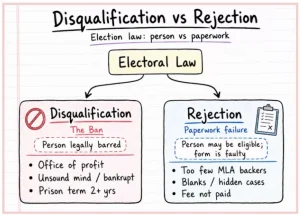
- Disqualification means the person is legally banned or fundamentally unfit to hold a seat in Parliament.
- Rejection means the person might be perfectly eligible to be an MP, but their current application forms are faulty, incomplete, or filled out incorrectly.
|
- Holding an Office of Profit: If they hold a paid job under the central or state governments that could make them biased or dependent on government favors (unless that specific job is exempted by a law made by Parliament).
- Mental State and Financial Standing: If a competent court officially declares them to be of unsound mind, or if they are an undischarged insolvent (meaning they are bankrupt and have unpaid debts they are legally unable to clear).
- Citizenship Issues: If they lose their Indian citizenship, give it up, or voluntarily pledge loyalty to a foreign country.
- Serious Criminal Convictions (Section 8 of RPA): If a court finds them guilty of a crime and sentences them to two or more years in prison.
- The Supreme Court has ruled that this disqualification hits instantly the moment the judge announces the sentence, removing them from office immediately.
- Corrupt Practices (Section 8A): If they are found guilty of election fraud, bribery, or treating voters unfairly during a previous election.
- Failing to Show Election Costs (Section 10A): If they fail to hand in a correct and timely account of all the money they spent during an election campaign.
- The Anti-Defection Law (10th Schedule): If they voluntarily leave the political party that got them elected, or if they vote against their party’s strict orders inside the Parliament house.
Grounds for Rejection of Nomination Papers (Procedural Invalidation)
- Hiding Material Facts (The Blank Column Rule): Every candidate must fill out a background declaration sheet known as Form 26.
- On this form, they must honestly list their personal wealth, family assets, loans, school qualifications, and any pending police or court cases.
- If a candidate leaves spaces completely blank, or intentionally hides a court case, it is legally treated as a major defect, and the RO is forced to throw out the application.
- Lack of Valid Backers: If the application form does not have the genuine signatures of the required number of MLAs (the 10 MLAs or 10% rule mentioned earlier).
- Failing to Pay the Deposit: If the candidate forgets to pay the mandatory security deposit fee. Currently, this fee is ₹10,000 for general candidates and ₹5,000 for candidates belonging to Scheduled Castes (SC) or Scheduled Tribes (ST).
- Missing the Official Oath: If the candidate fails to take the official loyalty oath to the Constitution before the authorized election official within the strict timeline allowed for filing applications.
Click to Explore UPSC Offline Coaching
Important Supreme Court Rulings on the Voter’s “Right to Know”
- Association for Democratic Reforms (ADR) Case (2002): The Supreme Court ruled that regular citizens have a fundamental right to know about the background of the people trying to lead them.
- This right is protected under Article 19(1)(a) (Freedom of Speech and Expression). The court made it mandatory for candidates to put their wealth, education, and criminal history out in the open.
- Resurgence India vs. Election Commission (2013): The Court stated that candidates cannot leave blank boxes on their Form 26 background sheets.
- Leaving boxes blank makes the entire form illegal. If a section does not apply to a candidate, they must explicitly write “Nil” or “Not Applicable” so voters know the information was not simply hidden.
- Satish Ukey Case (2019): The Supreme Court clearly stated that intentionally hiding any pending criminal case in an election form is an illegal and “corrupt practice.”
- If a candidate wins an election but is later found to have hidden a court case, their entire election victory can be canceled and declared empty by a court.
 11 Jun 2026