Recently, Myanmar President Min Aung Hlaing paid an Official Visit to India.
- Political Reconciliation: India reaffirmed its support for a Myanmar-led and Myanmar-owned peace process involving all stakeholders.
- India raised the issue of Nobel laureate Aung San Suu Kyi, who is in detention in Myanmar since the military coup in 2021.
Best Online Coaching for UPSC
Key Highlights of Myanmar President’s Visit to India
- Strategic Importance of Myanmar: Prime Minister Modi highlighted Myanmar’s central role in India’s Neighbourhood First, Act East, and MAHASAGAR frameworks.
- Educational Cooperation: India announced an increase in Mekong Ganga ICCR Scholarships for Myanmar students from 36 to 100 annually from 2026.
- Security Assurance: President Min Aung Hlaing reiterated that Myanmar’s territory would not be allowed to be used against India’s security interests.
About Rupee-Kyat Settlement Mechanism
- First operationalised in May 2024 to facilitate smooth currency flows, transaction volumes under this mechanism continue to experience steady growth.
- It reduces dependence on third-party currencies like the US Dollar by settling trade directly through Special Rupee Vostro Accounts (SRVA) handled by Punjab National Bank (PNB)
|
- Support for Sovereignty: India reaffirmed its commitment to Myanmar’s sovereignty and territorial integrity amid ongoing internal challenges.
- Border Management: Both sides emphasized preventing the misuse of their territories for activities that threaten each other’s security.
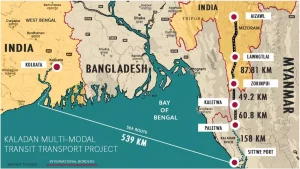
- Kaladan Project: The leaders reviewed progress on the Kaladan Multi-Modal Transit Transport Project and stressed the need for its early completion.
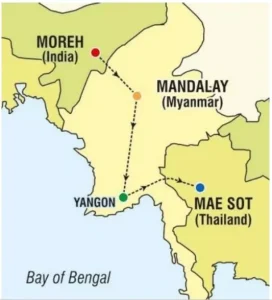 Trilateral Highway: Both countries reiterated their commitment to advancing the India–Myanmar–Thailand Trilateral Highway to promote regional connectivity and prosperity.
- Trade Facilitation: Both Countries welcomed the growing use of the Rupee–Kyat bilateral settlement mechanism, operational since May 2024.
- Investment Cooperation: Agro-processing, petroleum, energy, and mining were identified as priority sectors for investment and economic collaboration.
- Cyber Scam Victims: India and Myanmar agreed to continue cooperation for the rescue and repatriation of Indian citizens trapped in cyber scam compounds.
Significance of Myanmar for India
- Convergence of Key Policies: Myanmar occupies a unique position at the intersection of India’s Neighbourhood First Policy, Act East Policy, and MAHASAGAR Vision, making it a critical partner in India’s regional strategy.
- Gateway to Southeast Asia: Myanmar serves as India’s land bridge to ASEAN, facilitating connectivity, trade, and deeper engagement with the Indo-Pacific region.
- Regional Influence: Strong India–Myanmar relations are indispensable for advancing India’s strategic, economic, and geopolitical interests across South Asia, Southeast Asia, and the wider Indo-Pacific.
- Strategic Neighbour: Myanmar is India’s only Southeast Asian neighbour sharing both a land border and a maritime boundary, making it vital for regional security and connectivity.
- Northeast Security: Stability in Myanmar is crucial for managing insurgency, cross-border crime, and security challenges along the 1,643-km India–Myanmar border.
- Connectivity Hub: Myanmar is the linchpin of key projects such as the Kaladan Multi-Modal Transit Transport Project and the India–Myanmar–Thailand Trilateral Highway.
- Strategic Pillar of Regional Policy: Myanmar lies at the intersection of India’s Neighbourhood First Policy, Act East Policy, and MAHASAGAR Vision, making it indispensable to India’s regional strategy.
- Economic Partner: Myanmar offers opportunities for trade, investment, energy cooperation, mining, and access to critical minerals and rare earth resources.
- Bilateral trade between India and Myanmar reached USD 2.15 billion in the 2024–2025 financial year, making India Myanmar’s fourth-largest trading partner.
- Trade Balance: India generally maintains a trade deficit with Myanmar due to high imports of agricultural goods, though it is actively pursuing increased exports.
- Maritime Importance: Myanmar’s coastline along the Bay of Bengal enhances India’s maritime outreach and supports regional connectivity initiatives.
- Indo-Pacific Linkage: Strong relations with Myanmar strengthen India’s engagement with Southeast Asia and advance its broader Indo-Pacific objectives.
- Civilisational Connections: Shared Buddhist heritage and long-standing cultural ties provide a strong foundation for people-to-people relations.
- ASEAN Stability: Peace and stability in Myanmar are essential for the cohesion of ASEAN and the broader security architecture of Southeast Asia.
UPSC Coaching Classes
Challenges
- Border Security & Insurgency: Several Northeast insurgent groups have historically operated from bases inside Myanmar, posing a major security challenge for India.
- During the June 2026 visit, PM Modi specifically raised this issue, following which Myanmar assured that its territory would not be used against India’s security interests.
- Political Instability in Myanmar: The ongoing internal conflict between the Myanmar military and ethnic armed organizations has created uncertainty in bilateral engagement.
- Delay in Connectivity Projects: Strategic projects such as the Kaladan Multi-Modal Transit Transport Project and the India–Myanmar–Thailand Trilateral Highway continue to face delays.
- The delays are primarily due to active hostilities in Rakhine State and areas controlled by ethnic armed groups.
- Refugee Influx into Northeast India: Violence and instability in Myanmar have resulted in repeated refugee inflows into Mizoram and other border states.
- Mizoram has been hosting tens of thousands of Myanmar refugees since the 2021 coup, creating humanitarian and administrative challenges.
- The Rohingya crisis is a humanitarian and human rights tragedy that has strained the relations between India and Myanmar. They have fled to neighboring countries, especially Bangladesh and India, seeking refuge.
- Cross-Border Crime & Cyber Scams: Myanmar-based cyber scam compounds have emerged as a major transnational security concern.
- India has repatriated more than 2,400 Indian citizens trapped in such scam centres, while efforts continue to rescue others.
- Chinese Strategic Influence: Myanmar remains a key arena of India–China competition due to its strategic location and natural resources.
- Analysts note that India’s engagement with Myanmar is partly driven by concerns over China’s growing economic and geopolitical influence.
- Difficult Border Management: The 1,643-km India–Myanmar border passes through rugged mountains, dense forests, and remote tribal regions.
- These geographical conditions make effective surveillance, border fencing, and law enforcement difficult.
- Impact on Trade and Economic Cooperation: Security concerns and conflict-affected regions continue to hinder trade expansion and investment opportunities.
- Connectivity delays have limited the economic potential of India’s Act East Policy in Myanmar.
- Threat to India’s Act East Policy: Myanmar is the only ASEAN country sharing a land border with India and serves as India’s gateway to Southeast Asia.
- Instability in Myanmar directly affects the success of India’s connectivity, trade, and Indo-Pacific initiatives.
Way Forward
- Balancing Democracy and Strategic Interests: India must balance its support for democratic values with the need to engage Myanmar’s ruling authorities for security and connectivity objectives.
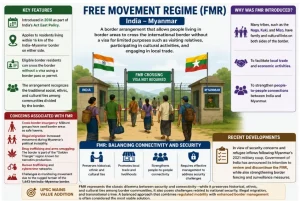
- Adopt a Balanced Border Management Strategy: India should pursue a calibrated approach towards the Free Movement Regime (FMR) by strengthening border infrastructure, regulating cross-border movement, and formalizing trade through designated entry points.
- Such measures can address security concerns while preserving the traditional social, cultural, and economic linkages of border communities.
- Counter External Influence Through Strategic Partnerships: To balance growing Chinese influence in Myanmar, India should enhance economic cooperation, connectivity initiatives, and development partnerships.
-
- Respecting Myanmar’s sovereignty while strengthening bilateral engagement can reinforce India’s role as a reliable regional partner.
- Promote Mutually Beneficial Economic Cooperation: India should work towards reducing the trade imbalance by encouraging greater market access for Myanmar’s exports, diversifying trade relations, and expanding investments into sectors such as energy, infrastructure, and manufacturing.
- Initiatives such as the proposed USD 6 billion petroleum refinery project near Yangon can significantly deepen economic interdependence.
- Expedite Connectivity and Infrastructure Projects: The timely completion of strategic projects such as the Kaladan Multi-Modal Transit Transport Project and Sittwe Port is essential for enhancing regional connectivity, boosting trade, and strengthening India’s Act East Policy.
- Improved infrastructure would generate economic benefits for both countries and integrate Northeast India with Southeast Asia.
- Expand Cultural and People-to-People Engagement: India should leverage its shared civilizational and cultural heritage with Myanmar through educational exchanges, cultural programs, and heritage conservation initiatives.
- Projects such as the restoration of the Ananda Temple at Bagan and conservation of damaged pagodas can strengthen societal bonds and foster goodwill.
- Encourage Track-II Diplomacy and Regional Peace Initiatives: India can facilitate dialogue platforms involving policymakers, experts, and civil society representatives from regional groupings such as the Quad and ASEAN Troika.
- Such initiatives can promote consensus-building, address humanitarian concerns, support national reconciliation, and contribute to lasting peace and stability in Myanmar.
Click to Explore UPSC Offline Coaching
Conclusion
- India’s Myanmar policy must combine strategic pragmatism, economic engagement, security cooperation, and democratic outreach.
- A balanced and multidimensional approach will not only protect India’s national interests but also contribute to peace, stability, and prosperity in the broader Indo-Pacific region.
 2 Jun 2026