Subject: GS 2: International Relations
Context: India has said that the Indus Waters Treaty (1960) will remain suspended until Pakistan permanently and credibly stops supporting cross-border terrorism.
- The statement came after Pakistan sought restoration of the treaty following the Pahalgam terror attack (2025) and Operation Sindoor.
UPSC Online Coaching
About the Indus Waters Treaty (IWT)
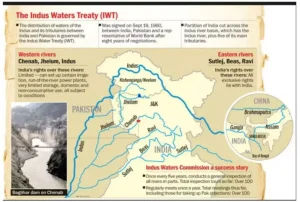
- Historic Water-Sharing Agreement: Signed in 1960 between India and Pakistan, with the World Bank as a signatory facilitating the negotiations, making it one of the world’s longest-standing transboundary river treaties.
River Allocation: The Eastern Rivers (Ravi, Beas, Sutlej) were allocated for India’s unrestricted use, while the Western Rivers (Indus, Jhelum and Chenab) were largely allocated to Pakistan, subject to specified Indian uses.
- India’s Permitted Rights: India can undertake run-of-the-river hydropower projects, irrigation, navigation and limited storage on Western Rivers within treaty-prescribed technical parameters.
- Institutional Mechanism: The treaty established the Permanent Indus Commission (PIC) for regular data sharing, inspections, technical cooperation and dispute prevention.
- Dispute Resolution Framework: Provides a graded mechanism involving the Permanent Indus Commission, Neutral Expert, and Court of Arbitration for resolving technical and legal disputes.
Why has India Kept the Treaty in Abeyance?
- Cross-Border Terrorism: India argues that the treaty was founded on the principles of goodwill and friendship, which Pakistan has consistently violated by supporting cross-border terrorism.
- The Cabinet Committee on Security (CCS) placed the treaty in abeyance following the Pahalgam attack, linking water cooperation to national security concerns.
- Changing Ground Realities: India has highlighted that climate change, population growth, changing developmental needs and technological advancements have substantially altered the assumptions on which the treaty was negotiated.
- Repeated Treaty Disputes: Persistent disagreements over projects such as Kishanganga and Ratle Hydroelectric Projects, alongside Pakistan’s simultaneous use of multiple dispute resolution forums, have strained treaty implementation.
- National Security Priority: India maintains that “water and blood cannot flow together,” signalling that bilateral cooperation cannot continue independently of Pakistan’s actions on terrorism.
Implications of the Treaty Remaining in Abeyance
- Bilateral Relations: Suspension further deepens diplomatic tensions and reduces one of the few remaining institutional channels of India-Pakistan cooperation.
- Pakistan’s Water Concerns: Pakistan has repeatedly described restoration of the treaty as essential for its long-term water and agricultural security.
- India’s Strategic Leverage: The decision enhances India’s negotiating leverage while allowing greater flexibility in optimising permissible water utilisation within its territory.
- International Attention: The development has attracted global attention because the treaty has long been viewed as a resilient example of international river governance.
- Future Water Diplomacy: The episode highlights the growing linkage between national security, water security, climate change, and transboundary resource management.
Click to Know UPSC OnlyIAS Coaching Centres
Conclusion
The Indus Waters Treaty has entered a new phase where water diplomacy is increasingly inseparable from national security, climate resilience and regional geopolitics. India’s decision to keep the treaty in abeyance reflects a shift towards integrating counter-terrorism, strategic interests and sustainable water governance into its neighbourhood policy.