UPSC PYQs

Prelims, Mains & Optional PYQs

UPSC Notes

Comprehensive & Short Notes

Right to a Fair Trial in India: Article 21, UAPA and Speedy Justice

4 Jul 2026

Right to a Fair Trial in India: Article 21, UAPA and Speedy Justice

Subject: GS 2: Polity & Governance

Context: The continued imprisonment of accused persons, including Umar Khalid and Sharjeel Imam, in the 2020 Delhi riots conspiracy case without the trial beginning has revived the debate on balancing national security, personal liberty, speedy justice and the right to a fair trial, especially under the Unlawful Activities (Prevention) Act, 1967 (UAPA)

UPSC Online Preparation

About Right to a Fair Trial

  • It is an integral part of Article 21, ensuring that no individual is deprived of liberty except through a just, fair and reasonable procedure established by law.
  • Essential Components: It includes the presumption of innocence, speedy trial, legal representation, impartial judiciary, fair investigation, access to evidence, reasoned judicial decisions, and the right to appeal.
  • Judicial Recognition: The Supreme Court has consistently held that a fair trial is the cornerstone of the rule of law, ensuring that justice is not only done but is also seen to be done.
  • International Standards: The right is recognised under Article 10 of the Universal Declaration of Human Rights (UDHR) and Article 14 of the ICCPR, which guarantee a fair and public hearing before an independent and impartial tribunal.
  • Democratic Significance: A fair trial protects individual liberty, prevents arbitrary exercise of State power, safeguards against wrongful conviction, and strengthens public confidence in the justice delivery system.

Constitutional & Legal Framework:

  • Article 21: Guarantees the Right to Life and Personal Liberty, which has been judicially interpreted to include the right to a fair and speedy trial.
  • Article 22(1): Ensures the right to consult and be defended by a legal practitioner of one’s choice immediately after arrest.
  • Article 14: Protects equality before law, requiring consistent, fair and non-arbitrary application of criminal justice principles.
  • Article 39A (DPSP): Directs the State to ensure equal justice and free legal aid so that access to justice is not denied due to economic or other disabilities.
  • UAPA, 1967: Imposes stringent bail conditions under Section 43D(5), making release difficult even before guilt is established.
  • International Commitments: India is a signatory to the International Covenant on Civil and Political Rights (ICCPR), which guarantees the right to be tried within a reasonable time or released pending trial.

Why Has the Issue Come into Focus?

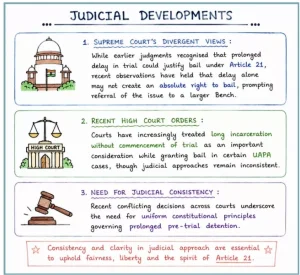
  • Prolonged Undertrial Detention: Some accused in the Delhi riots conspiracy case have spent nearly six years in custody without conclusion of trial, reviving concerns over “process becoming punishment.”
  • Right to a Fair TrialConflicting Judicial Approaches: Different Benches of the Supreme Court and High Courts have adopted varying standards on whether prolonged incarceration alone justifies bail under stringent laws.
  • Increasing Use of Special Laws: Growing reliance on UAPA and other national security legislations has intensified concerns regarding prolonged detention without conviction.
  • Judicial Backlog: Massive pendency of criminal cases continues to delay trials, weakening the constitutional guarantee of timely justice.
  • National Debate: The issue has sparked renewed discussion on balancing individual liberty, national security and effective criminal justice administration.

Why is a Speedy Trial Fundamental?

  • Protection of Personal Liberty: Pre-trial detention should remain an exception, as every accused enjoys the presumption of innocence until proven guilty.
  • Fair Trial Guarantee: Justice delayed weakens both prosecution and defence by affecting witnesses, evidence, memory and procedural fairness.
  • Rule of Law: Indefinite incarceration without conviction undermines public confidence in the criminal justice system.
  • Human Dignity: Years spent in prison without adjudication impose irreversible social, economic, psychological and professional costs, even where the accused is eventually acquitted.
  • Democratic Safeguard: Timely judicial scrutiny prevents criminal law from becoming an instrument for suppressing political dissent or civil liberties.

Key Challenges

  • Process Becoming Punishment: Under stringent laws such as the Unlawful Activities (Prevention) Act (UAPA), restrictive bail provisions and prolonged pre-trial detention often result in de facto punishment without conviction.
  • Delays in Criminal Justice: Slow investigations, huge case pendency, repeated adjournments and procedural complexities delay the commencement and completion of trials.
  • Institutional Capacity Constraints: Shortage of judges, prosecutors, court staff, forensic facilities and digital infrastructure hampers timely justice delivery.
  • Undertrial Crisis and Prison Overcrowding: A large undertrial population contributes to overcrowded prisons, increasing financial, administrative and humanitarian burdens.
  • Inconsistent Bail Jurisprudence: Divergent judicial interpretations create uncertainty in the protection of personal liberty and equal treatment before law.
  • Balancing National Security and Fundamental Rights: Ensuring national security while safeguarding personal liberty, due process, speedy justice and the right to a fair trial remains a key constitutional challenge.

Way Forward

  • Strengthen Speedy Trial Mechanisms: Introduce time-bound trial frameworks, robust case management systems and priority disposal of long-pending undertrial cases.
  • Reform Bail Jurisprudence: Develop clear constitutional guidelines ensuring that prolonged incarceration without trial ordinarily favours grant of bail while balancing genuine security concerns.
  • Enhance Judicial Capacity: Increase judicial appointments, expand court infrastructure and strengthen prosecution, forensic and investigative capabilities.
  • Periodic Judicial Review: Mandate regular judicial review of prolonged undertrial detention, particularly under special legislations such as UAPA.
  • Balance Liberty and National Security: Ensure that exceptional anti-terror laws operate consistently with the constitutional principles of fairness, proportionality, necessity and due process.
  • Leverage Technology: Expand e-Courts, virtual hearings, digital case management, AI-assisted administrative functions and electronic evidence management to reduce procedural delays while preserving judicial independence.

Click to Explore UPSC Offline Coaching

Conclusion

The legitimacy of the criminal justice system rests not merely on punishing the guilty but on ensuring that no individual is deprived of liberty for years without timely judicial determination. Strengthening speedy trials, consistent bail jurisprudence, judicial capacity, institutional efficiency and constitutional safeguards is essential to uphold the rule of law, fundamental.

Check Out UPSC CSE Books

Visit PW Store

online store 1

Right to a Fair Trial in India: Article 21, UAPA and Speedy Justice

Need help preparing for UPSC or State PSCs?

Connect with our experts to get free counselling & start preparing

Free Counselling for UPSC Aspirants

Connect with our experts and take the right next step.

Expert Guidance
Personalized Strategy
100% Free

Book Your Free Session

NEED ASSISTANCE?

Request a Callback

Our counsellor will connect with you and help you choose the right course and centre.

  • Expert Guidance
  • Course & Fee Information
  • Quick Callback Support

Request a Callback

Books
UPSC PYQs
UPSC Notes
Current Affairs
Quick Revise Now !
AVAILABLE FOR DOWNLOAD SOON
UDAAN PRELIMS WALLAH
Comprehensive coverage with a concise format
Integration of PYQ within the booklet
Designed as per recent trends of Prelims questions
हिंदी में भी उपलब्ध
Quick Revise Now !
UDAAN PRELIMS WALLAH
Comprehensive coverage with a concise format
Integration of PYQ within the booklet
Designed as per recent trends of Prelims questions
हिंदी में भी उपलब्ध

<div class="new-fform">


    </div>

    Subscribe our Newsletter
    Sign up now for our exclusive newsletter and be the first to know about our latest Initiatives, Quality Content, and much more.
    *Promise! We won't spam you.
    Yes! I want to Subscribe.