Subject: GS 2: Polity & Governance
Context: The alleged abuse of toddlers at Little Buds Day Care Centre inside the Capgemini campus, Bengaluru, has highlighted concerns regarding child safety, caregiver accountability, and enforcement of crèche regulations in India.
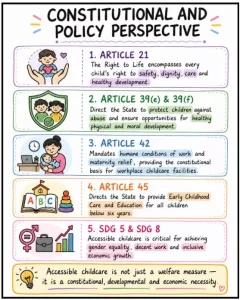
- The National Minimum Standards and Protocol (2024) seek to transform childcare from an informal family responsibility into a structured institutional support system, strengthening India’s social infrastructure while supporting higher female labour force participation.
UPSC Online Classes
About Crèches and the Regulatory Framework
- Definition: A Crèche is a childcare facility that provides a safe, secure, and nurturing environment for children (generally 6 months and above) while parents or guardians are at work, along with nutrition, healthcare, and Early Childhood Care and Education (ECCE).
2024 National Standards: The Ministry of Women and Child Development (MWCD), in consultation with the Ministry of Labour and Employment (MoLE), issued the National Minimum Standards and Protocol for Crèches (2024) prescribing minimum standards for all childcare centres.
- Objective: The guidelines aim to promote women-led development, increase Female Labour Force Participation (FLFP), institutionalise quality childcare services, and create employment opportunities in the childcare sector.
- Implementation: The standards are presently advisory (suggestive), with States and Union Territories expected to adopt or strengthen them through their own regulatory frameworks.
- Recent Example: The Little Buds Day Care incident in Bengaluru has renewed calls for making these standards legally enforceable across all States.
Infrastructure, Safety and Child Protection Norms
- Infrastructure Standards: Crèches should preferably be located on the ground floor, with adequate ventilation, lighting, secure windows, child-friendly furniture, resting areas, play zones, and barrier-free access for children with disabilities.
- Health & Hygiene: Centres must provide safe drinking water, hygienic kitchens, nutritious meals, child-friendly toilets with running water, regular sanitation, and age-appropriate learning materials.
- Safety Measures: Closed-Circuit Television (CCTV) surveillance is mandatory, with parental access encouraged wherever feasible. Emergency contact numbers, first-aid facilities, fire safety equipment, and child-safe premises are essential.
- Government Oversight: Local Police, Women and Child Development Department, and Labour Department should be informed about every registered crèche for monitoring and emergency response.
- Recent Concern: The Bengaluru abuse case has exposed gaps in real-time monitoring, CCTV oversight, and routine inspections despite the existence of prescribed safety norms.
Staffing, Governance and Institutional Oversight
- Staff Qualifications: Every crèche should have at least one Crèche Supervisor (minimum 12th pass) and one Crèche Helper (minimum 10th pass) for every 20–25 children, with preference given to trained childcare or nursing professionals.
- Background Verification: Mandatory Police Verification, Character Certificate, and Medical Fitness Certificate are required before appointing caregivers to ensure child safety.
- Women Caregivers: The guidelines recommend that only women caregivers should be engaged for childcare responsibilities.
- Crèche Administrative Committee (CAC): Every crèche should constitute a Crèche Administrative Committee comprising administrators, supervisors, and parent representatives to oversee management, safety, grievance redressal, and quality standards.
- Emerging Challenge: Outsourcing caregivers without rigorous verification has emerged as a significant concern in several private daycare centres.
Labour Law Provisions and Women’s Employment
- Statutory Requirement: The Code on Social Security, 2020 and the Occupational Safety, Health and Working Conditions (OSHWC) Code, 2020 require establishments employing 50 or more workers to provide crèche facilities either individually or through shared/common crèches.
- Working Mothers’ Rights: Women employees are entitled to four visits per day to the crèche, including nursing and rest intervals.
- Common Crèche Model: Smaller establishments may jointly establish common crèches through government agencies, private entities, or Non-Governmental Organisations (NGOs).
- Policy Objective: These provisions seek to reduce the childcare burden on women, improve workforce retention, and enhance Female Labour Force Participation (FLFP).
- Implementation Gap: Trade unions continue to report widespread non-compliance, particularly among private establishments and smaller employers.
Challenges that need to be Tackled
- Weak State-Level Enforcement: Since the 2024 guidelines are advisory, implementation varies significantly across States.
- Poor Regulatory Oversight: Surprise inspections, licensing audits, and compliance monitoring remain inadequate.
- Corporate Non-Compliance: Many eligible establishments fail to establish mandatory crèche facilities despite statutory obligations.
- Inadequate Staff Screening: Weak background verification and outsourced recruitment increase risks of child abuse.
- Limited Emergency Preparedness: Many crèches lack formal linkages with nearby hospitals, child protection units, and emergency services.
Way Forward
- Strengthen Legal Backing: States should convert the 2024 National Standards into legally enforceable regulations with clear penalties for non-compliance.
- Technology-Based Monitoring: Ensure tamper-proof CCTV systems with secure parental access and digital compliance reporting.
- Regular Surprise Inspections: Conduct joint inspections by the Police, Labour Department, and Women and Child Development Department.
- National Caregiver Registry: Develop a digital database of certified childcare professionals with mandatory training and blacklisting of offenders.
- Expand Quality Childcare: Accelerate the rollout of Anganwadi-cum-Crèches (AWCCs) under Mission Shakti (Palna Scheme) and encourage shared crèche models for Micro, Small and Medium Enterprises (MSMEs).
Click to Know UPSC Offline Courses
Conclusion
Safe and well-regulated crèches are not merely welfare facilities but foundational institutions for child development, women’s empowerment and inclusive economic growth. The Bengaluru incident demonstrates that issuing guidelines alone is insufficient; robust enforcement, professional standards, periodic monitoring and child-centric governance are essential to protect children’s rights and restore public confidence in institutional childcare.