Recently, the Delhi High Court ruled that the Right to be Forgotten is part of the Article 21 right to privacy and issued a judicial framework for de-indexing court records and masking personal details online in absence of a parliamentary law.
UPSC Online Preparation
About the Right to Be Forgotten (RTBF)
- Concept and Definition: RTBF enables individuals to seek the deletion, de-indexing, or restriction of access to their personal data from digital platforms when such information becomes outdated, irrelevant, disproportionate, or harmful to privacy and reputation.
- It reflects the core principle of informational self-determination, allowing individuals greater control over their digital footprint.
- Open Justice vs. Personal Dignity: “Open justice” means court processes must be open and transparent.
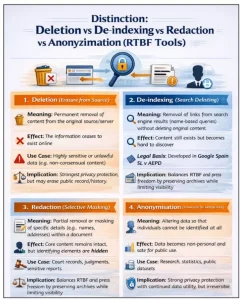 However, the judiciary clarified that this does not mandate that a private person’s name should function as a permanent commercial search keyword on internet search engines like Google.
- Global Impact of Indian Orders: The Delhi High Court stated that its de-indexing orders will operate globally, meaning internet search engine intermediaries must remove these search links from all their global domains, not just inside India.
Key Findings of the Judgement
- The Basis of Registration: The Court heard over 30 petitions filed by a diverse group, including individuals acquitted of criminal charges, parties to matrimonial disputes, and people whose cases were quashed or settled.
- They shared a common grievance that name-based searchability causes continuous harm to their reputation, dignity, and life prospects.
- Entirement of the Acquitted: The Court explicitly held that persons who have been acquitted, discharged, or whose proceedings have been quashed are fully entitled to have that final legal determination reflected in their digital identity.
- Commercial Search Engines Restricted: The judgment noted that search engines cannot indefinitely link individuals to past legal troubles through name-based searches once the case has ended in acquittal or involves purely private disputes.
- Open Justice Limits: The Court said that while open justice ensures transparency in courts, it cannot justify the endless and unrestricted online spread of a person’s past legal troubles.
Global Evolution of RTBF
- European Union Framework: The modern concept emerged from the 2014 Google Spain case at the Court of Justice of the EU, which forced search engines to remove links to personal data that is “inadequate or no longer relevant.”
- This is now codified under Article 17 of the General Data Protection Regulation (GDPR) as the formal “right to erasure”, subject to exceptions like public interest and freedom of expression.
- Developments in Other Jurisdictions:
- United States: The California Online Eraser Law (2015) protected minors, while the DELETE Act (2023) allowed adults to delete personal data held by commercial data brokers.
- Canada: The Federal Court of Appeal (2023) ruled that search engines fall under federal privacy law (PIPEDA). In 2025, the Privacy Commissioner upheld a limited right to de-indexing in specific harm-based cases.
- Countries like the United Kingdom, Argentina, and Japan have also evolved similar protections based on their native enforcement models.
Interpretation and Status of RTBF in India
- Constitutional Basis: RTBF flows from the Right to Privacy under Article 21, as recognized by the Supreme Court in the landmark K.S. Puttaswamy v. Union of India (2017) case.
- It is a derivative right, meaning it is not absolute and must be balanced against Freedom of Speech (Article 19(1)(a)), transparency, and legal/archival requirements.
- Statutory and Regulatory Position: The Digital Personal Data Protection (DPDP) Act, 2023 recognizes the right to erasure, allowing individuals to request the deletion of data when its purpose is served.
- However, statutory ambiguity persists regarding its direct application to public court records, media archives, and publicly available data.
- The IT Intermediary Guidelines (2021) complement this by mandating intermediaries to remove privacy-violating content within strict timelines.
Click to Know UPSC OnlyIAS Coaching Centres
Evolution of Judicial Approach in India
- Early Foundations: The R. Rajagopal (1994) case first recognized the “right to be let alone,” but maintained that public records like court judgments were open to publication.
- Post-Puttaswamy Trial Phase (Conflicting Views):
- Dharamraj Dave v. State of Gujarat (2017): The Gujarat HC denied the removal of an acquittal record, prioritizing judicial transparency.
- Orissa High Court (2020): Highlighted the need for a legal framework to protect women in cyber-crimes like revenge porn.
- Supreme Court (2022) & Delhi HC (2021): Began a pro-privacy shift, directing the removal of names from search engines in sensitive matrimonial disputes and livelihood protection cases.
- Kerala High Court (2023): Refused RTBF in ongoing cases, protecting the rule of open justice.
- Himachal Pradesh High Court (2024): Ordered the redaction of names in a rape case post-acquittal to eliminate lasting social stigma.
- The May 2026 Consolidation (The New Standard): The Delhi High Court settled these variations by creating a clear two-tier taxonomy for de-indexing:
- Who CAN Ask for De-indexing: People who have been fully acquitted or discharged, individuals whose cases have been quashed or settled, parties to private/matrimonial disputes, and names mentioned incidentally inside larger judgments.
- Who CANNOT Ask (Strict Exceptions): Relief will be denied to individuals convicted of crimes, individuals involved in serious offences against women or children, and individuals involved in a breach of public trust (such as corruption by public servants, politicians, or people holding fiduciary duties).
 2 Jun 2026