Synthetic biology now allows scientists to design artificial life forms using AI and genetic engineering, creating major opportunities in medicine and industry while also raising serious biosecurity, ethical, and environmental concerns.
UPSC Online Classes
Recent Key Findings
- The Complexity Paradox: Genetic tests have shown that how complex a living creature looks does not depend on its total number of genes.
- For example, a tiny, single-celled bacterium has about 4,300 genes, a human being has about 22,000 protein-coding genes, while a microscopic water flea (Daphnia) carries 31,000 genes—far more than humans.
- Cheaper and Faster Technology: The speed of DNA sequencing (reading genes) has grown very fast while the cost has dropped completely.
- What once took an international team over ten years and $3 billion during the first Human Genome Project can now be done in a few hours for a few hundred dollars in a small lab.
- Computer-Made Life: Scientists have proven that a complete bacterial genome can be built chemically using a digital computer file.
- This man-made DNA was successfully placed inside a living cell that had its own natural DNA removed, creating the world’s first digitally created life.
About Synthetic Biology
Synthetic biology is a field that applies engineering rules to biology to design and build new biological parts, tools, and systems. It is divided into two main methods:
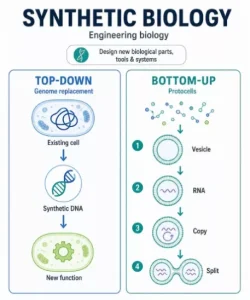
- Top-Down Synthetic Biology (Genome Replacement): This method takes an existing, living cell and completely replaces its natural DNA with human-designed, chemically made DNA chains to change how the cell behaves or what it produces.
- Bottom-Up Synthetic Biology (Protocells): This method does not use any pre-existing life. Instead, scientists look at non-living chemistry to build a simple cell completely from scratch.
- Labs create protocells using fatty-acid vesicles (tiny fat bubbles) that naturally form closed walls, trap RNA inside, copy that genetic material under the right conditions, and split into two.
Core Genetics vs. Biological Complexity
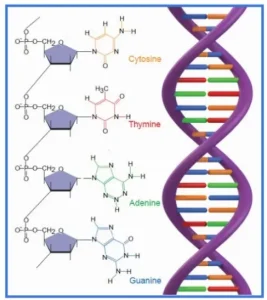
- DNA- The Basic Code of Life: Deoxyribonucleic acid (DNA) is the main building block of the genome. It writes the code of life using a simple four-letter chemical alphabet- Adenine (A), Thymine (T), Guanine (G), and Cytosine (C).
- The Role of Transcription Factors: True biological complexity is driven by gene control rather than the total number of genes.
- Regulatory regions of DNA act like light switches. They are special spots where control proteins called transcription factors attach to turn specific genes “on” or “off”.
- This interaction decides exactly how, when, where, and how much of a protein is made inside a cell.
Significance of Synthetic Biology
- Improving Healthcare: Advanced gene design allows scientists to build special cell factories. These factories can manufacture targeted medicines, new vaccines, and treatments for severe inherited conditions like Phenylketonuria.
- Cleaning the Environment and Clean Energy: Artificial cells can be designed to trap carbon, clean up toxic industrial chemical spills, and make clean biofuels directly from non-food plants.
- Mapping the Tree of Life: Gathering genome sequences acts like a highly detailed history book of our planet.
- It shows how different animals and plants are related, how evolutionary branches split, and how living things change through mutations over long periods, filling in the blanks where fossils are missing.
Concerns that need to be Tackled
- The Risk of Independent Copying: Unlike normal machines or nuclear power plants, engineered biological creatures can convert digital data into a self-replicating product (something that multiplies on its own).
- Once let out into nature, they can breed independently, making them nearly impossible to bring back or control.
- The Evolution Trap: Artificial life forms put out into nature will naturally mix with wild plants and animals. Over time, these creatures will undergo unmonitored mutations driven by natural selection.
- This can harm local wildlife or damage ecosystem balances in unpredictable ways.
- Biosecurity and Dual-Use Risks: Because making genes has become so cheap and easy, combined with the power of Artificial Intelligence (AI), there is a higher risk of accidental lab leaks or the intentional creation of highly dangerous, custom-made germs.
Click to Know UPSC Offline Courses
Way Forward
- Flexible Rules and Oversight: Governments must move away from old, slow safety laws. They need to set up fast, smart safety checks that can keep up with quick breakthroughs in gene design and AI.
- International Biosecurity Agreements: Since biological germs do not care about national borders, global agreements and treaties are urgently needed to monitor commercial DNA orders and stop the illegal creation of dangerous germs.
- Safe Isolation Practices: The first real-world uses of synthetic biology must be strictly locked inside closed industrial tanks.
- Any artificial life meant to be let outside must have built-in genetic kill-switches to stop them from breeding outside the laboratory.
 2 Jun 2026