Subject: GS 2: Polity & Governance
Context: The Department of Health Research (DHR) has released the Draft National Health Research Policy 2026 for stakeholder consultation.
- National Health Research Policy, 2011, provides the existing framework for health research in India.
- The Draft National Health Research Policy 2026 seeks to modernise this framework by addressing emerging health challenges and promoting indigenous innovation.
Best Online Coaching for UPSC
About the Draft National Health Research Policy 2026
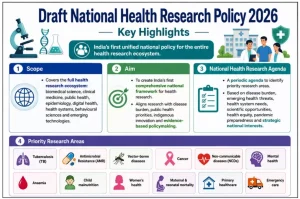
- It is the first unified national policy covering the entire health research ecosystem, including biomedical science, clinical medicine, public health, epidemiology, digital health, health systems, behavioural sciences and emerging technologies.
- Objectives
-
- Align scientific research with India’s actual disease burden and public health priorities
- Promote indigenous innovation
- Strengthen evidence-based policymaking
- Ensure measurable outcomes from research investment
Key Proposals
- National Health Research Agenda: Envisages a National Health Research Agenda to periodically identify priority research areas based on disease burden, emerging health threats, health system needs, scientific opportunities, health equity, pandemic preparedness and strategic national interests.
- Priority Research Areas: Identifies key areas such as tuberculosis, antimicrobial resistance (AMR), vector-borne diseases, cancer, non-communicable diseases (NCDs), mental health, anaemia, child malnutrition, women’s health, maternal and neonatal mortality, primary healthcare and emergency care.
- Governance Framework: Three-Tier Governance Structure
| Tier |
Role |
| National Health Research Stewardship Committee |
Overall strategic coordination |
| Department of Health Research (DHR) |
Nodal implementing agency |
| ICMR (Indian Council of Medical Research) |
Scientific and technical lead |
- Regulatory and Ethical Reforms: Proposes streamlined ethics approval mechanisms for multicentre studies, establishment of a National Research Integrity Office (NRIO), responsible use of Artificial Intelligence (AI) in health research, and stronger emphasis on research integrity, cybersecurity, data governance and community participation.
- Research Evaluation Framework: Shifts research assessment from publications, citations and patents to its real-world impact on public policy, clinical practice, health programmes, indigenous technologies, institutional capacity, equity and societal well-being, including wider adoption of the ICMR Impact of Research and Innovation Scale (ICMR-IRIS).
- Enhanced Research Investment: Proposes a phased increase in public expenditure on health research from 0.024% of Gross Domestic Product (GDP) to 0.072% by 2037 and 0.15% by 2047.
- Long-Term National Targets: Sets measurable targets for research investment, medical science PhDs, scientific publications, patents and approved indigenous health technologies.
Need for the Policy
- Fragmented Research Ecosystem: Health research remains dispersed across institutions with limited coordination and strategic direction.
- Misalignment with National Health Priorities: Research does not adequately reflect India’s disease burden, health-system gaps, equity concerns and emerging public health challenges.
- Low Public Investment: Public expenditure on health research remains significantly below global benchmarks, limiting research capacity and innovation.
- Regional Disparities: Research infrastructure, funding and scientific capacity remain concentrated in a few institutions and States, while many medical colleges have limited research output.
- Limited Translation into Practice: Scientific findings are often slow to influence healthcare delivery, policymaking and clinical practice.
- Administrative and Regulatory Bottlenecks: Lengthy approval processes and procedural delays continue to hinder timely research and innovation.
Click to Know UPSC Coaching Centres in India
About Health Research in India
- Encompasses biomedical sciences, clinical medicine, public health, epidemiology, digital health, health systems, behavioural sciences and emerging technologies.
- Major Institutions: Includes the Indian Council of Medical Research (ICMR), Department of Health Research (DHR), All India Institute of Medical Sciences (AIIMS) and other premier medical institutions, and the National Institute of Nutrition (NIN), Hyderabad.
- Indian Council of Medical Research (ICMR): Apex body for biomedical research and the country’s premier medical research organisation.
- Department of Health Research (DHR): Nodal department responsible for formulating policies, coordinating and promoting health research.
- All India Institute of Medical Sciences (AIIMS) and other premier medical institutions: Undertake advanced medical education, clinical research and translational healthcare research.
- National Institute of Nutrition (NIN), Hyderabad: Premier institute dedicated to nutrition research, food safety and public health nutrition.
 15 Jul 2026