Subject: GS 3: Environment
Context: Renewed tensions in West Asia have disrupted crude oil and LPG supply routes, reviving the debate on whether Compressed Biogas (CBG) can reduce India’s import dependence and strengthen energy security.
India’s Energy Vulnerability
- India imports ~85% of its crude oil requirement, much of it from West Asia.
- ~90% of India’s LPG imports transit through the Strait of Hormuz — a critical chokepoint.
- Any West Asian instability directly threatens energy supply security, despite diversification of crude suppliers.
|
IAS coaching
Why Does India Need Biogas?
- Energy Security – Domestic CBG cuts reliance on imported fossil fuels, diversifying India’s energy mix.
- Waste Management – Converts crop residue, cattle dung, municipal/sewage waste into fuel, curbing stubble burning and pollution.
- Climate Commitments – Renewable, carbon-neutral fuel supports Paris Agreement goals and India’s Net Zero by 2070 target.
About Biogas
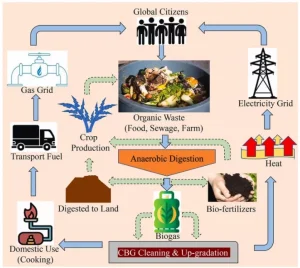
- Biogas is a gaseous fuel produced through the anaerobic decomposition of biodegradable organic matter such as cattle dung, crop residues, municipal solid waste and sewage.
- Composition: It primarily consists of methane (50–70%), carbon dioxide (30–50%), and small quantities of hydrogen sulphide, nitrogen and water vapour.
- Nature: Biogas is a renewable, carbon-neutral and clean-burning fuel that converts organic waste into usable energy.
- Applications: It is primarily used for cooking, electricity generation, heating and small-scale industrial applications.
About Compressed Biogas (CBG)
- It is purified biogas from which carbon dioxide, hydrogen sulphide, moisture and other impurities are removed, after which it is compressed to produce a high-quality gaseous fuel.
- Composition: CBG contains over 90–95% methane, making it chemically and functionally similar to Compressed Natural Gas (CNG).
- Applications: It is used as a transport fuel, for industrial applications, and can be supplied through City Gas Distribution (CGD) networks for domestic and commercial consumption.
- By-products: The production of CBG also generates Fermented Organic Manure (FOM) and Liquid Fermented Organic Manure (LFOM), which can be used as organic fertilisers.
Government Initiatives to Promote Biogas
- SATAT Initiative (2018): The Sustainable Alternative Towards Affordable Transportation (SATAT) initiative was launched by the Ministry of Petroleum and Natural Gas to establish 5,000 CBG plants and create a market for compressed biogas. However, only 132 plants had become operational as of June 2026.
- GOBARdhan Scheme (2018): The Galvanising Organic Bio-Agro Resources Dhan (GOBARdhan) scheme was launched under the Swachh Bharat Mission (Grameen) to convert biodegradable waste into biogas and organic fertilisers through the Waste-to-Wealth approach.
- Mandatory CBG Blending Obligation (FY 2025–26 onwards): The Government has mandated 1% blending of CBG in CNG and Piped Natural Gas (PNG) from FY26, which will be gradually increased to 5% by FY29.
Challenges in Scaling Up Biogas
- Slow Infrastructure Development: The number of operational CBG plants remains significantly below the targets due to delays in project implementation.
- High Capital Cost: Biogas and CBG plants require substantial upfront investment, affecting their commercial viability.
- Limited Private Participation: Inadequate financial returns, financing constraints and policy uncertainties have discouraged private investment.
- Limited Access to Institutional Finance: Developers often face difficulties in obtaining affordable credit for establishing projects.
- Shift Towards Energy Crops: Higher returns from biofuel feedstocks may encourage farmers to cultivate maize and other energy crops instead of food crops.
- Lessons from Germany: Germany’s rapid expansion of biogas encouraged excessive maize cultivation (“corn mania”), eventually forcing the government to restrict the use of maize as feedstock.
- The Economic Survey 2025–26 noted a sharp rise in maize cultivation, raising concerns over reduced crop diversity and food security.
- It highlighted that maize yield increased from 2.56 tonnes/ha (FY16) to 3.78 tonnes/ha (FY25), while the yields of soybean, sunflower, rapeseed, groundnut and millets have stagnated or declined.
- Threat to Crop Diversity: Expansion of maize cultivation may reduce the area under pulses, oilseeds, millets and other essential crops, affecting agricultural diversification.
- Food Security Concerns: Reduced cultivation of pulses and edible oil crops may increase India’s import dependence and expose domestic food prices to greater global volatility.
UPSC Online Classes
Global Comparison
| Country/Region |
Status |
| Europe, China, U.S. |
Together account for ~90% of global biogas production |
| Germany |
Leading European producer; introduced Renewable Energy Sources Act (2000) with income guarantees and bonuses for small-scale plants |
| Denmark |
Targets 100% biomethane in its gas system by 2030; uses livestock manure and agri-waste (not crops) as feedstock — a more sustainable model.
- Biomethane is purified biogas — biogas that’s been upgraded to remove CO₂, moisture, and trace impurities, leaving mostly methane (usually 95%+ purity).
|
Way Forward
- Prioritise Waste-Based Feedstock: Biogas production should primarily utilise crop residues, cattle dung, municipal solid waste and other biodegradable waste instead of food crops.
- Strengthen Financial Incentives: Greater capital subsidies, viability gap funding, tax incentives and easier access to institutional finance are needed to improve project viability.
- Develop Supporting Infrastructure: Investments in biomass aggregation, storage, transportation and gas pipeline connectivity are essential for scaling up production.
- Promote Private Sector Participation: Stable policy frameworks, assured offtake agreements and long-term pricing mechanisms can encourage private investment.
- Maintain Food-Energy Balance: Biofuel policies should ensure that the promotion of energy crops does not compromise food security, crop diversity and farmers’ long-term sustainability.
Click to Know UPSC Offline Courses
Conclusion
Biogas and Compressed Biogas (CBG) can become key drivers of India’s clean energy transition and energy security. Realising this potential requires strong infrastructure, policy support, private investment, and a waste-based feedstock strategy that safeguards food security and agricultural sustainability.
 15 Jul 2026