Subject: GS 2: International Relation
Context: The Stockholm International Peace Research Institute (SIPRI), in its 2026 Yearbook, has assessed that 12 of India’s estimated 190 nuclear warheads are operationally deployed, highlighting the maturation of India’s second-strike capability under its No First Use (NFU) doctrine.
UPSC Online Coaching
Key Findings of SIPRI 2026
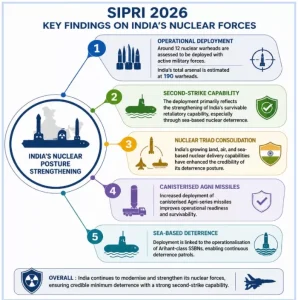
- Operational Deployment: Around 12 nuclear warheads are assessed to be deployed with active military forces, while India’s total arsenal is estimated at 190 warheads.
- Second-Strike Capability: The deployment primarily reflects the strengthening of India’s survivable retaliatory capability, especially through sea-based nuclear deterrence.
- Nuclear Triad Consolidation: India’s growing land, air, and sea-based nuclear delivery capabilities have enhanced the credibility of its deterrence posture.
- Canisterised Agni Missiles: Increased deployment of canisterised Agni-series missiles improves operational readiness and survivability.
- Sea-based Deterrence: Deployment is linked to the operationalisation of Arihant-class SSBNs, enabling continuous deterrence patrols.
About Operationally Deployed Nuclear Warheads
- Definition: Nuclear warheads that are mated with delivery systems (missiles, aircraft, or submarines) and maintained in operational readiness under authorised command and control.
- Not Equivalent to War Readiness: Operational deployment does not imply imminent use or a lowering of the nuclear threshold.
- Difference from Stockpile: A country may possess many nuclear warheads, but only a fraction may be operationally deployed at any given time.
India’s Nuclear Doctrine
- No First Use (NFU): India commits not to initiate a nuclear strike but reserves the right to massive retaliation following a nuclear attack.
- Credible Minimum Deterrence: Maintains only the minimum nuclear capability necessary to deter adversaries.
- Assured Retaliation: Focuses on preserving a survivable second-strike capability rather than maintaining large deployed arsenals.
- Civilian Political Control: Nuclear weapons remain under strict civilian oversight through the Nuclear Command Authority.
Its Significance
- Strengthens Second-Strike Capability: Enhances the credibility of India’s NFU doctrine by ensuring survivable retaliatory forces.
- Completes Nuclear Triad: Operational SSBNs provide the most secure leg of India’s nuclear deterrence architecture.
- Improves Strategic Stability: A credible retaliatory capability reduces incentives for adversaries to attempt a disarming first strike.
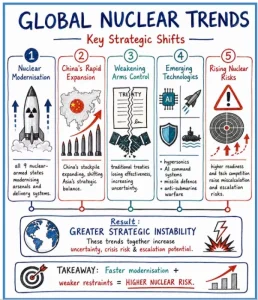 Addresses Emerging Threats: Supports deterrence against an evolving strategic environment, particularly China’s expanding nuclear capabilities.
India’s Earlier Such Initiatives
- Draft Nuclear Doctrine (1999): Introduced the principles of No First Use and credible minimum deterrence.
- Official Nuclear Doctrine (2003): Formalised NFU, assured retaliation, and civilian political control through the Nuclear Command Authority (NCA).
- Nuclear Triad Development: Progressive induction of Agni ballistic missiles, air-delivered nuclear capability, and Arihant-class SSBNs.
- Canisterisation of Missiles: Improved survivability, mobility, and rapid launch capability of the Agni missile series.
- INS Arihant Programme: Established India’s indigenous sea-based nuclear deterrent, completing the nuclear triad.
UPSC Coaching Classes
Arising Challenges
- Regional Arms Competition: Simultaneous nuclear modernisation by China and Pakistan could intensify strategic rivalry.
- Technological Disruption: Advances in AI, cyber warfare, and missile defence may undermine deterrence stability.
- Arms Control Vacuum: Weakening global disarmament mechanisms increase long-term nuclear risks.
- Crisis Management: Greater operational readiness demands robust command-and-control systems to avoid accidental escalation.
Way Forward
- Strengthening India’s Credible Deterrence:
- Enhance Second-Strike Capability: Continue strengthening the sea-based deterrent through additional SSBNs and longer-range SLBMs.
- Modernise Command and Control: Improve secure communication, early warning, and nuclear command systems.
- Maintain NFU Credibility: Reaffirm commitment to No First Use and credible minimum deterrence.
- Invest in Survivability: Expand mobility, hardening, and survivability of strategic assets.
- Promoting Global Nuclear Stability:
- Revitalise Arms Control: Support renewed multilateral efforts on nuclear risk reduction and arms control.
- Strengthen Strategic Dialogue: Expand confidence-building measures with neighbouring nuclear powers.
- Address Emerging Technologies: Develop international norms governing AI, hypersonic weapons, and autonomous military systems.
- Champion Responsible Nuclear Governance: Continue advocating universal, verifiable, and non-discriminatory nuclear disarmament.
Click to Know UPSC OnlyIAS Coaching Centres
Conclusion
India’s operational deployment of a limited number of nuclear warheads reflects the maturation of its assured retaliation capability, not a departure from its No First Use doctrine. As global nuclear competition intensifies, maintaining a credible deterrent alongside responsible nuclear restraint remains central to India’s strategic security and international standing.
 30 Jun 2026