Nearly six years after its launch, Chandrayaan-2 has provided new evidence suggesting the possible presence of subsurface ice in the Moon’s south polar regions.
UPSC Online Classes
The Science Behind the Discovery
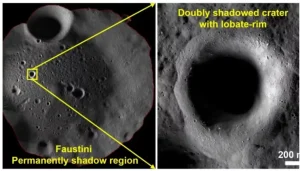
The study focused on a unique geomorphological and thermal niche on the Moon.
- Doubly Shadowed Craters: These are small craters located within larger Permanently Shadowed Regions (PSRs) near the lunar poles.
- Because they receive neither direct sunlight nor significant scattered radiation, they remain among the coldest known locations on the Moon.
- Thermal Shielding: These regions remain extremely cold due to continuous shielding from sunlight and thermal radiation.
- Such conditions make them favourable sites for long-term preservation of water-ice.
- Volatile Trap: These ultra-cold regions act as cold traps, where water and other volatile compounds can remain preserved over geological timescales.
Analytical Methodology
Scientists used advanced radar polarimetric analysis to distinguish possible ice-rich subsurface material from rough, rocky terrain, since both can produce similar radar echoes.
- Degree of Polarization (DOP): DOP measures how much of the returned radar signal retains its original polarization after interacting with the lunar surface or subsurface.
- Radar Detection Criterion: The study proposed a refined diagnostic criterion for volumetric scattering, which may indicate subsurface ice-bearing material:
- Circular Polarization Ratio (CPR) > 1.0 and Degree of Polarization (DOP) < 0.13
- Morphological Support: A roughly 1.1 km-wide crater within Faustini crater showed enhanced radar polarization and a distinct lobate-rim morphology.
- This suggests that an impact may have excavated or interacted with an ice-rich subsurface layer.
Why is this Discovery Significant?
- In-Situ Resource Utilization (ISRU): Mapping possible subsurface ice deposits is critical for future lunar exploration.
- Lunar ice could potentially be used to extract drinking water, generate oxygen, and produce hydrogen-oxygen rocket propellant.
- Fuel for Deep-Space Missions: If accessible lunar water can be converted into propellant, the Moon could become a strategic refuelling hub for future missions to Mars and beyond.
- Chandrayaan-2’s Continuing Scientific Value: Although the Vikram lander did not achieve a soft landing in 2019, the Chandrayaan-2 Orbiter continues to provide valuable scientific data.
- Its DFSAR payload offers high-resolution, fully polarimetric L-band and S-band radar observations for lunar polar studies.
Click to Explore UPSC Offline Coaching
PWOnlyIAS Extra Edge:
- Moon Surface & Temperature Features:
- Permanently Shadowed Regions (PSRs): Dark regions near the lunar poles that receive little or no direct sunlight because crater rims block solar illumination.
- These regions can preserve water-ice and other volatiles.
- Doubly Shadowed Craters: Smaller craters located within larger PSRs.
- They are shielded from both direct sunlight and much of the scattered light or thermal radiation from nearby terrain, making them extremely cold.
- Volatile Trap / Cold Trap: An ultra-cold region where volatile substances such as water vapour can freeze and remain preserved for long geological periods.
- Lobate-Rim Morphology: A flow-like or tongue-shaped crater rim. In this case, it may indicate that an impact excavated or interacted with ice-rich subsurface material.
- Radar Tech & Signal Terms:
- Dual Frequency Synthetic Aperture Radar (DFSAR): A radar instrument on Chandrayaan-2 that uses microwave signals to study the lunar surface and shallow subsurface, even in dark polar regions.
- Radar Polarimetry: A method that studies how the polarization of radar waves changes after reflection.
- It helps infer surface roughness, buried material, and possible ice-rich deposits.
- Degree of Polarization (DOP): A measure of how organized the returned radar signal remains after reflection. Lower DOP may indicate more complex internal scattering.
- Circular Polarization Ratio (CPR): A radar parameter used to compare returned circularly polarized signals.
- High CPR alone can indicate either rough terrain or ice, so the study combined CPR with DOP to improve interpretation.
- Space Travel Concepts:
- In-Situ Resource Utilization (ISRU): The use of local resources in space, such as extracting water from lunar ice, instead of carrying all supplies from Earth.
- Liquid Hydrogen-Oxygen Propellant: A high-energy rocket fuel mixture that can theoretically be produced by splitting water into hydrogen and oxygen using electrolysis.
|
 1 Jun 2026