Recently, the Supreme Court issued directions in a long-running matter related to human trafficking and commercial sexual exploitation. The ruling seeks to strengthen the protection, rehabilitation and reintegration framework for survivors, especially women and children.
- The case originated from a petition filed by the NGO Prajwala in 2004, highlighting gaps in India’s legal and institutional response to trafficking and commercial sexual exploitation.
- The Supreme Court treated trafficking as a serious violation of human dignity and called for a stronger, survivor-centric protection framework.
- The Court’s directions focus on improving victim protection across the pre-rescue, rescue, post-rescue and rehabilitation stages.
- They also underline the need for coordinated action by law enforcement agencies, welfare departments, shelter homes and civil society organisations.
UPSC Online Preparation
Key Guidelines Issued by the Supreme Court
The court’s new binding guidelines focus on changing how victims are treated before, during, and after they are saved:
- Uniform Victim Protection Protocol: The government must develop a standardised national framework for the protection, care and rehabilitation of survivors of sexual exploitation.
- This will help reduce variation in rescue, shelter, counselling and reintegration practices across states.
- Survivor-Sensitive Rescue Operations: Rescue operations must be conducted in a manner that protects the dignity and safety of survivors.
- Victims of trafficking should not be treated as offenders, but as persons in need of care, protection and rehabilitation.
- Strengthened Rehabilitation Framework: The guidelines emphasise long-term support for survivors, including safe housing, counselling, legal aid, skill development, livelihood support and social reintegration.
- Institutional Accountability: The ruling pushes authorities to address weaknesses in policing, shelter homes, legal aid, witness protection and survivor support systems.
- Strengthening Legal and Enforcement Mechanisms: The Court highlighted the need to address institutional and legal gaps that weaken action against organised trafficking networks.
About the Case and the Changing Nature of Trafficking
- The Prajwala Petition: The petition was filed by the NGO Prajwala in 2004 to draw attention to the trafficking of women and children for commercial sexual exploitation.
- It highlighted the absence of adequate legal safeguards, rehabilitation systems and survivor protection mechanisms.
- High-Profit Organised Crime: Human trafficking is a highly profitable organised crime.
- Trafficking networks exploit poverty, weak enforcement capacity, lack of awareness and institutional gaps.
- Declining Age Profile of Victims: The petition highlighted concerns over the targeting of younger girls and children, making child protection and early intervention crucial.
- Changing Methods of Trafficking: Earlier, traffickers often relied on economic inducements to lure vulnerable families.
- Today, they also use false promises of employment, glamour, education, marriage and escape from family distress.
- Cyber-Enabled Trafficking: Traffickers increasingly use social media, fake job portals, messaging platforms and online advertisements to identify, groom and exploit victims.
- This makes cyber-policing and digital evidence collection essential.
Significance of the Ruling
- Protection of Human Dignity: The ruling reinforces that trafficking is not merely a law-and-order issue but a direct violation of dignity, bodily autonomy and constitutional rights.
- Victim-Centric Justice: It shifts the focus from punitive action alone to survivor protection, rehabilitation and reintegration.
- Uniform National Standards: A standard protocol can ensure that survivors receive similar levels of protection and care irrespective of the state in which they are rescued.
- Institutional Accountability: The ruling pushes governments and enforcement agencies to improve policing, shelter management, legal aid, counselling and survivor support.
- Recognition of Civil Society Role: The case also reflects the importance of sustained advocacy by civil society organisations in advancing the rights of vulnerable groups.
Challenges in Implementation
Despite the historic judgment, implementing these guidelines will face real-world hurdles:
- Law Enforcement Mindset: Police and local officials often require specialised training to treat rescued persons as survivors rather than offenders.
- Shelter and Rehabilitation Deficits: Many shelter homes face issues such as overcrowding, inadequate counselling, weak monitoring and limited reintegration support.
- Inter-State and Cross-Border Trafficking: Trafficking networks operate across state and national borders, making coordination among police, border agencies and welfare departments difficult.
- Cyber-Enabled Trafficking: Online grooming, fake job offers and digital recruitment networks create new enforcement challenges.
- Low Conviction and Witness Protection Issues: Survivors may face intimidation, stigma and procedural delays, which can weaken prosecution outcomes.
Related India’s Initiatives Against Trafficking
This ruling strengthens India’s existing legal and social tools against exploitation:
- Immoral Traffic (Prevention) Act, 1956: It is India’s principal legislation dealing with trafficking for commercial sexual exploitation, including offences related to brothels, procuring, detaining and exploiting persons for prostitution.
- Anti-Human Trafficking Units (AHTUs): These are specialised police units established to prevent trafficking, rescue victims and investigate trafficking networks.
- Ujjawala Scheme: It is a comprehensive scheme for the prevention of trafficking and for the rescue, rehabilitation, reintegration and repatriation of victims of commercial sexual exploitation.
- Mission Shakti: It is an umbrella scheme for women’s safety, security and empowerment, including institutional support through One Stop Centres, Women Helplines and related protection mechanisms.
- National Crime Records Bureau (NCRB) and Digital Tracking Systems: Platforms such as Crime and Criminal Tracking Network and Systems, missing children databases and NCRB crime data help in tracking trafficking, missing persons and related offences.
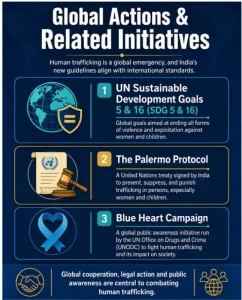
Global Actions & Related Initiatives
Human trafficking is a global concern, and India’s anti-trafficking framework aligns with several international norms and initiatives.
- UN Sustainable Development Goals 5 and 16: These goals aim to eliminate violence, exploitation and trafficking, especially against women and children, while promoting justice and strong institutions.
- The Palermo Protocol: It is a United Nations treaty to prevent, suppress and punish trafficking in persons, especially women and children. India is a signatory to this protocol.
- Blue Heart Campaign: It is a global public awareness initiative of the United Nations Office on Drugs and Crime to fight human trafficking and raise awareness about its impact on society.
Way Forward
- Sensitise Police Forces: Mandatory training on trauma-informed rescue, survivor dignity and victim-sensitive investigation should be institutionalised.
- Strengthen NGO Partnerships: Experienced organisations such as Prajwala can support shelter management, counselling, legal aid and community-based rehabilitation.
- Address Cyber-Trafficking: Law enforcement agencies must strengthen cyber surveillance, digital evidence collection and action against trafficking through social media, fake job portals and online advertisements.
- Ensure Economic Reintegration: Survivors should receive immediate financial support, skill training, livelihood opportunities and long-term social protection.
- Improve Inter-State Coordination: AHTUs, NCRB systems, border agencies and state police forces should work through real-time information sharing and standard operating procedures.
Click to Explore UPSC Offline Coaching
Conclusion
The Supreme Court’s guidelines create a stronger victim-centric framework against human trafficking by ensuring the safety, dignity, and rehabilitation of survivors. The ruling strengthens rescue protocols and supports safer reintegration of victims into society.
 1 Jun 2026