Using NASA’s James Webb Space Telescope (JWST), scientists have mapped a daily weather cycle on an exoplanet nearly 700 light-years away, marking the first time a repeating daily cloud cycle has been seen on an alien world.
UPSC Coaching Classes
Recent Key Findings
- Atmospheric Asymmetry: JWST observed the planet’s terminator region, where the morning limb appears cloud-rich, while the evening limb appears comparatively clearer.
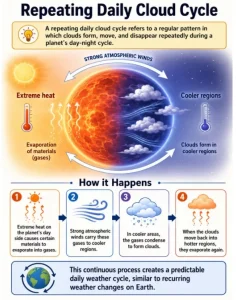 Clouds of Vaporized Rock: Unlike Earth where clouds are made of water vapor, the clouds on this planet are made of magnesium silicate (vaporized rock), iron, and magnesium sulphide.
- Daily Weather Cycle: On the cooler nightside of the planet, rock-forming minerals cool down and turn into clouds. Powerful atmospheric winds push these clouds to the dayside.
- On the dayside, extreme heat of over 1,000°C causes these mineral clouds to evaporate or move into deeper atmospheric layers, leaving the evening limb relatively clear.
- Overcoming Cloud Obstruction: Pervasive clouds usually block a telescope’s view like a frosted pane of glass, distorting data.
- By observing the relatively clear evening limb, JWST detected stronger water vapour signals, suggesting that the planet’s atmosphere may be chemically closer to a Jupiter-like composition than earlier understood.
About WASP-94A b (The Exoplanet)
- Classification: It is a “Hot Jupiter”—a massive gas giant located in the constellation Microscopium.
- Physical Traits: It is almost twice as big as Jupiter in volume, but has only half its mass.
- Orbit: It orbits extremely close to its star, taking just four Earth days to complete one full year.
- Tidal Locking: Due to tidal locking, the same side of WASP-94A b always faces its star, creating a permanent scorching dayside and a relatively cooler nightside.
About Exoplanets
- Definition: An exoplanet is simply any planet that orbits a star outside our Solar System. More than 6,000 have been found so far.
- Diverse Environments: Exoplanets have extreme weather. Some have rain made of molten metal, vaporized rock, or liquid glass driven by supersonic winds, while others have diamonds raining down.
- Key Detection Methods:
- Transit Method: Tracking the slight dimming of a star’s light when an exoplanet passes directly in front of it.
- Transmission Spectroscopy: As starlight filters through the edges of a planet’s atmosphere during a transit, gases selectively absorb specific wavelengths of light. By reading these missing wavelengths, scientists can identify the exact chemicals in the air.
- Significance: Studying exoplanet atmospheres helps scientists understand how planetary systems form, grow, and differ from our own Solar System.
Click to Know UPSC OnlyIAS Coaching Centres
 1 Jun 2026