Researchers from Aryabhatta Research Institute of Observational Sciences found that massive stars can trigger the birth of new stars in nearby molecular clouds.
- The findings were published in The Astrophysical Journal.
UPSC Online Classes
Key Findings of the Study
- Study Region: The study examined Bright Rimmed Cloud 44 (BRC 44), located nearly 900 parsecs away in the Cepheus OB2 star-forming region.
- A parsec is a unit of astronomical distance equal to about 3.26 light-years or nearly 31 trillion kilometres, commonly used to measure distances between stars and galaxies.
- Radiation-Induced Star Formation: Ultraviolet radiation from nearby massive stars ionises and compresses surrounding gas clouds, creating favourable conditions for new star formation.
- Shockwave Mechanism: The compressed gas generates shock waves that travel deeper into molecular clouds, increasing density and initiating stellar birth processes.
- Discovery of Young Stellar Objects: Researchers identified 22 new young stellar objects within BRC 44, including several brown dwarfs incapable of sustaining hydrogen fusion.
- Multi-Wavelength Observation: The study used data from the 3.6-metre Devasthal Optical Telescope, Devasthal Fast Optical Telescope (Devasthal, Uttarakhand, India) , Spitzer Space Telescope (Located in Outer Space; operated by NASA, United States), and radio observatories in China.
What are Molecular Clouds?
- Molecular clouds are dense and cold regions in space composed primarily of molecular hydrogen along with dust particles and other gases. They are among the largest structures present in galaxies.
- Composition: Molecular clouds mainly contain:
- Molecular hydrogen (H₂)
- Helium,
- Cosmic dust
- Traces of other molecules such as carbon monoxide.
- Temperature and Density: These clouds are extremely cold, with temperatures generally ranging between 10–30 Kelvin.
- Their high density allows gas particles to clump together under gravitational forces.
|
What are Massive Stars?
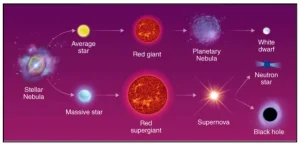
- Massive stars are stars having masses greater than eight times the mass of the Sun and possessing extremely high luminosity and temperature.
- Rapid Stellar Evolution: Massive stars consume nuclear fuel rapidly and complete their life cycle within millions of years, unlike Sun-like stars that survive for billions of years.
- High Energy Emission: These stars emit intense ultraviolet radiation and strong stellar winds that significantly influence surrounding interstellar environments.
- Supernova End Stage: Massive stars eventually explode as Type II supernovae, leaving behind neutron stars or black holes as stellar remnants.
- Formation Source: Like ordinary stars, massive stars originate within molecular clouds composed of gas and cosmic dust present in nebulae.
Click to Know UPSC Coaching Centres in India
Significance
- Understanding Stellar Evolution: The findings improve scientific understanding of how stars evolve and interact with surrounding molecular clouds during different stages of cosmic evolution.
- Triggered Star Formation Theory: The study strengthens evidence for radiation-driven or triggered star formation, where older massive stars initiate the birth of new stellar generations.
- Insights into Brown Dwarfs: The identification of brown dwarfs provides important clues regarding the transition between planets and fully developed stars.
- Advancing Astronomical Research: The research demonstrates India’s growing capabilities in observational astronomy through the use of indigenous telescopes and international scientific collaboration.
- Understanding Galactic Formation: Studying star-forming regions helps scientists better understand the evolution of galaxies and the distribution of matter in the universe.
 9 May 2026