Reserve Bank of India revised capital adequacy norms to simplify CET1 calculations and align counterparty credit risk rules with global Basel standards.
Key Changes in Capital Adequacy Ratio (CAR)
- Simplified CET1 Inclusion: The RBI removed the earlier condition linking inclusion of quarterly profits in CET1 capital with deviations in NPA provisioning patterns.
- Revised Counterparty Risk Norms: Banks must now include trading-partner exposures of all consolidated entities while calculating capital adequacy at the group level.
- Updated Add-on Percentages: The RBI revised “add-on” factors used for estimating future exposure arising from off-balance-sheet transactions such as derivatives.
- Risk Weight for Cleared Trades: Trades cleared through regulated central counterparties will attract a lower 2% risk weight, reducing additional capital burden on banks.
UPSC Coaching Classes
What is Capital Adequacy Ratio (CAR)?
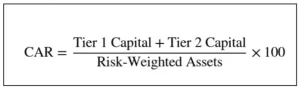
- Capital Adequacy Ratio (CAR), also known as Capital-to-Risk Weighted Assets Ratio (CRAR), measures a bank’s capital as a percentage of its risk-weighted assets.
- Tier 1 Capital: Tier 1 capital represents core capital, including equity and retained earnings, capable of absorbing losses without stopping banking operations.
- Tier 2 Capital: Tier 2 capital includes supplementary reserves and subordinated debt available to absorb losses during liquidation or financial stress.
- Risk-Weighted Assets: Risk-weighted assets are bank assets adjusted according to their risk profile, with riskier loans requiring higher capital backing.
- Consequences of Non-Compliance: Banks failing to maintain the prescribed Capital Adequacy Ratio (CAR) may face regulatory actions such as:
- Restrictions on providing loans and credit to customers
- Limitations on payment of dividends to shareholders
- Curbs on business expansion and new investment activities
Significance of CAR
- Depositor Protection: A higher CAR provides banks with a financial cushion to absorb unexpected losses and protect depositor funds during crises.
- Financial Stability: CAR reduces the possibility of bank failures spreading across the financial system, thereby strengthening macroeconomic stability.
- Prudent Lending: Banks are discouraged from excessive risky lending because higher-risk assets increase risk-weighted assets and capital requirements.
- Investor Confidence: Strong CAR levels improve investor confidence, lower funding costs, and reduce the probability of panic-driven bank runs.
Limitations of Capital Adequacy Ratio (CAR)
- CAR does not account for liquidity risk or the possibility of sudden runs on the bank.
- The ratio can be influenced by accounting practices, potentially understating risk exposure.
- CAR measures capital adequacy but does not directly indicate profitability or operational efficiency.
Basel III Norms
- Global Regulatory Framework: Basel III is an international banking regulatory framework developed after the 2008 global financial crisis to strengthen banking resilience.
- Minimum Capital Requirement: Basel III prescribes a minimum total CAR of 8% of risk-weighted assets for banks globally.
- CET1 Requirement: Banks must maintain a minimum Common Equity Tier 1 (CET1) ratio of 4.5% under Basel III norms.
- Capital Conservation Buffer: An additional Capital Conservation Buffer of 2.5% CET1 increases the effective minimum requirement to 10.5% for Indian banks.
- RBI’s Stricter Norms: The RBI mandates scheduled commercial banks in India to maintain a minimum CAR of 9%, higher than global Basel standards.
|
Impact of Changes in CAR Framework
- Limited Impact on CET1: Most domestic banks are unlikely to face major reductions in CET1 ratios because derivative trades are largely cleared through regulated counterparties.
- Moderate Rise in RWAs: Inclusion of exposures from consolidated entities may slightly increase risk-weighted assets for some banks.
- Improved Risk Management: The revised framework strengthens transparency and standardisation in measuring counterparty credit risk from trading activities.
Click to Explore UPSC Offline Coaching
Conclusion
The revised CAR framework strengthens banking resilience, simplifies capital calculations, and aligns India’s banking regulations more closely with international Basel standards.
 9 May 2026