India’s agricultural exports grew by 2.3% in 2025-26 despite higher tariffs imposed by the United States under the Trump administration.
UPSC Coaching Classes
Key Trends in Agricultural Exports
- Resilient Export Growth
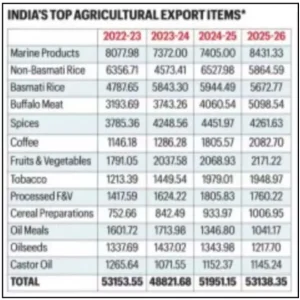
- India’s farm exports increased from $52 billion (2024-25) to $53.1 billion (2025-26).
- Agricultural exports performed better than India’s overall merchandise export growth of 0.9%.
- Near Historic High
- Farm exports in 2025-26 remained close to the all-time high of $53.2 billion recorded in 2022-23.
- The trend reflects growing competitiveness of Indian agricultural products globally.
- Marine Products Success
- Marine product exports rose by 13.9% to over $8.4 billion despite reduced shipments to the U.S.
- Higher exports to China and Southeast Asian markets offset losses in the American market.
- Strong Performing Commodities
- Buffalo meat, coffee and fresh fruits and vegetables achieved record export levels in 2025-26.
- Demand growth in Asia, Europe and West Asia supported export expansion.
Negative Impact of Trump Tariffs
- Higher Tariff Barriers: The United States imposed steep tariffs on several Indian exports, with rates reaching up to 50% before later reductions.
- Sectors affected included pharmaceuticals, garments, jewellery, leather and agricultural products.
- Decline in Exports to the U.S.: Indian exports of marine products, spices, basmati rice and processed fruits and vegetables to the U.S. witnessed declines.
- Marine exports to the U.S. fell from $2.7 billion to $2.3 billion during 2025-26.
Factors Supporting Export Growth
- Market Diversification: Broader geographical spread of exports reduced vulnerability to protectionist measures.
- Indian exporters diversified shipments towards countries such as China, Vietnam, Japan, Belgium, Thailand, Canada and the United Kingdom.
- Reduced dependence on a single export destination improved resilience against tariff shocks.
- Competitive Pricing: Indian agricultural products remained price competitive in global markets due to lower production costs and large-scale output.
- Value Addition and Processing: Growth in processed and value-added agricultural products enhanced export earnings and market access.
- Government Support Measures: Export promotion schemes, logistics improvements and trade facilitation measures supported agricultural exporters.
Challenges Remaining
- Dependence on External Markets: Agricultural exports remain vulnerable to geopolitical tensions, tariff wars and global demand fluctuations.
- Quality and SPS Standards: Indian exports continue to face challenges related to sanitary and phytosanitary (SPS) standards in developed markets.
- Climate and Supply Risks: Climate variability, input costs and supply chain disruptions can affect export competitiveness.
Click to Know UPSC OnlyIAS Coaching Centres
Conclusion
India’s agricultural export resilience demonstrates the importance of market diversification, competitive production and strategic trade adaptation amid rising global protectionism.
 11 May 2026