Recently, an analysis highlighted the rising debt burden of major Indian states such as Tamil Nadu, West Bengal, Kerala, and Assam.
- The report shows that debt-to-GDP ratios and interest payments are increasing sharply, making state finances increasingly unsustainable.
About Rising State Debt
- The rising debt burden of Indian states refers to the continuous increase in government borrowings and outstanding liabilities over time.
- These liabilities include loans taken from the central government, financial institutions, and market borrowings through state bonds.
Best Online Coaching for UPSC
Rising Debt Burden of Indian States: A Snap Shot
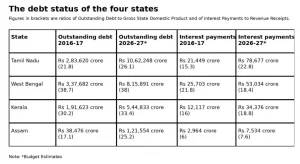
- Tamil Nadu: Tamil Nadu’s outstanding debt — the total money the state government owes to lenders at a given point — has nearly quadrupled from Rs 2.8 lakh crore to Rs 10.6 lakh crore between 2016-17 and 2026-27 (April-March).
- The stock of debt has also risen from 21.8% of the state’s gross domestic product (GDP) to 26.1% over this period.
- Ten years ago, interest payments consumed 15.3% of the Tamil Nadu government’s total revenues (or income from both tax and non-tax sources). This financial year, that ratio is expected at 22.8%.
- West Bengal: Persistent High Debt Levels: West Bengal already had a high debt-to-GDP ratio (around 30–38%), which has remained persistently elevated over the last decade.
- A large portion of state revenue is now spent on interest payments (~20%), limiting funds for development and welfare schemes.
- Kerala: Rising Debt Stress Despite Development Model: Kerala’s debt-to-GDP ratio has increased further over the past decade, reflecting growing fiscal stress.
- Around 20% of state revenue is now used for interest servicing, reducing fiscal space for public investment and social spending.
- Assam: Rising Debt but Controlled Interest Burden: Assam’s debt-to-GDP ratio increased from 17.1% to 25.2%, showing rapid accumulation of liabilities.
- However, interest burden remains relatively low (below 10%) due to special category state benefits and higher central grants.
Impact on Governance and Economy
- Reduced Spending on Infrastructure: According to RBI State Finances Report (2025–26), high debt servicing has constrained capital expenditure growth in several states.
- States like Tamil Nadu and Kerala allocate a large share of expenditure to revenue spending rather than capital creation, limiting infrastructure expansion.
- Pressure on Health and Education Budgets: RBI data shows that in many states, development expenditure (social + economic services) remains below fiscal needs due to rising committed expenditure.
- For example, Kerala’s committed expenditure (salaries, pensions, interest) accounts for over 65% of revenue spending, squeezing funds for health and education.
- Decline in Fiscal Autonomy: States with high debt such as West Bengal (~39% of GSDP) and Kerala (~35–37%) face reduced fiscal flexibility due to heavy borrowing dependence.
- This limits their ability to design independent development policies without relying on central support or market borrowing.
- Rising Debt Servicing Burden: Interest payments in states like Tamil Nadu have increased sharply, reaching ₹78,677 crore (2026–27 estimate).
- This rising burden reduces fiscal space for productive spending and increases dependence on fresh borrowings.
- Long-Term Fiscal Instability: RBI reports highlight that most states exceed the FRBM recommended debt limit of 20% of GSDP, indicating structural fiscal stress.
- This weakens long-term stability and increases vulnerability to interest rate shocks.
- Inefficiency in Development Outcomes: Despite high expenditure, states often show lower capital outlay efficiency, with much spending diverted to salaries, pensions, and subsidies.
- This leads to delays and inefficiencies in infrastructure and welfare delivery.
- Inter-Generational Debt Burden: High outstanding liabilities (e.g., Tamil Nadu projected over ₹10 lakh crore debt by 2027) shift repayment pressure to future taxpayers.
- This creates a long-term burden, reducing fiscal space for future development and economic choices.
Why is the Fiscal Stress rising in Indian States?
- Rising Loan Dependency: States are increasingly relying on market borrowings and loans to finance their expenditures.
- This growing dependence reflects weak internal revenue mobilisation and fiscal stress.
- Persistent Fiscal Deficits: Many states continue to run fiscal deficits year after year, spending more than their revenues.
- This leads to continuous accumulation of debt and financial imbalance.
- Increasing Interest Burden: A significant portion of state revenue is now used for servicing debt and paying interest.
- This reduces funds available for productive and developmental expenditures.
- Reduced Fiscal Space for Development: High debt servicing obligations limit spending on infrastructure, health, and education.
- States face shrinking flexibility in allocating resources for growth-oriented sectors.
- Revenue-Expenditure Mismatch: There is a widening gap between revenue generation and expenditure commitments.
- States are unable to match rising welfare and administrative costs with adequate income.
- Rising Cost of Borrowing: Hardening interest rates in the economy have increased the cost of new loans for states.
- This makes debt repayment more expensive and worsens fiscal pressure.
- Structural Revenue Weakness: Heavy dependence on central transfers and limited tax base expansion weaken fiscal autonomy.
- States struggle to generate sustainable own-source revenues.
- Long-term Fiscal Sustainability Risk: Continuous borrowing without adequate revenue reforms threatens long-term financial stability.
- It may lead to a debt trap-like situation if corrective measures are not taken.
UPSC Online Coaching
Relevance in Post-Election Governance and Fiscal Policy Debate
- Electoral Promises vs Fiscal Reality: Post-election governments often face the challenge of balancing pre-election welfare promises (freebies, subsidies, loan waivers) with actual revenue constraints.
- This creates tension between political commitments and fiscal responsibility, forcing difficult budgetary adjustments soon after coming to power.
- Immediate Pressure on State Budgets: Newly elected governments inherit high debt stocks and rising interest burdens, limiting their ability to announce new schemes.
- A significant share of revenue is already locked in salary, pension, and debt servicing, leaving limited fiscal space for fresh initiatives.
- Policy Shift Towards Fiscal Consolidation: Election outcomes often trigger debates on revising subsidies, rationalising welfare schemes, and improving revenue mobilisation.
- Governments are pushed towards fiscal correction measures, including expenditure cuts and better targeting of benefits.
- Debate on Freebies vs Development Spending: The post-election phase intensifies discussions on whether populist welfare schemes undermine long-term development.
- Policy focus shifts toward balancing short-term electoral welfare with long-term infrastructure and capital investment needs.
- Centre–State Fiscal Relations: Rising state debt brings renewed attention to fiscal federalism and Centre–State financial dependence.
- Debates emerge on loan restructuring, borrowing limits, and conditional fiscal support from the Union government.
- Pressure for Fiscal Reforms: Governments are compelled to adopt FRBM compliance, asset monetisation, and subsidy rationalisation.
- Fiscal policy becomes a key governance issue in ensuring macroeconomic stability at the state level.
- Impact on Investor Confidence: High debt levels influence credit ratings of states and investor perception.
- Post-election fiscal clarity becomes important for maintaining investment inflows and economic stability.
- Shift in Governance Priorities: The focus of governance often shifts from electoral mobilisation to administrative efficiency and financial discipline.
- This marks a transition from populist politics to fiscal consolidation-driven governance.
Role of the Centre in Addressing Rising Fiscal Stress in Indian States
- Fiscal Transfers and Revenue Support: The Centre provides financial assistance to states through tax devolution and grants-in-aid as recommended by the Finance Commission.
- Adequate and timely transfers help states manage expenditure obligations and reduce excessive dependence on market borrowings.
- Regulation of State Borrowings: Under Article 293 of the Constitution, the Centre regulates state borrowing limits, especially for states indebted to the Union Government.
- This mechanism helps maintain overall macroeconomic stability and prevents unsustainable debt accumulation.
- Finance Commission Recommendations: The Finance Commission plays a key role in suggesting debt management measures, fiscal consolidation paths, and equitable resource distribution.
- It also encourages fiscal discipline through performance-based incentives and sector-specific grants.
- Support through Centrally Sponsored Schemes: The Centre shares financial responsibility with states in sectors such as health, education, agriculture, and rural development through Centrally Sponsored Schemes (CSS).
- Such expenditure sharing reduces fiscal pressure on resource-constrained states.
- Enforcement of Fiscal Discipline: The Centre promotes adherence to Fiscal Responsibility and Budget Management (FRBM) norms to ensure prudent fiscal management by states.
- It encourages states to maintain fiscal deficit and debt levels within sustainable limits.
- Special Financial Assistance during Crises: The Centre provides additional support during economic disruptions through GST compensation, disaster relief funds, and special assistance packages.
- Such interventions help states maintain essential expenditure during fiscal stress.
- Promotion of Cooperative Federalism: Institutions such as the GST Council and NITI Aayog facilitate coordination between the Centre and states on fiscal and developmental policies.
- Cooperative decision-making improves resource allocation and policy implementation.
- Incentivising Capital Expenditure: The Centre offers interest-free loans and reform-linked incentives to encourage states to increase capital expenditure on infrastructure and productive sectors.
- Higher capital investment strengthens long-term economic growth and improves states’ revenue-generating capacity.
Way Forward
- Debt Restructuring and Conditional Relief: The Union government, for instance, can restructure, waive or reduce the interest, or even write off a part of its loan to a state.
- The relief could be conditional upon the state undertaking reforms such as
- electricity tariff rationalisation; imposing charges on water, sanitation and other public services to recover operation and maintenance costs.
- Asset Monetisation: States can generate revenue by monetising underutilised public assets and infrastructure.
- This includes leasing, selling, or commercialising government land and non-core assets.
- Strategic Divestment of State Holdings: Divestment of stakes in profitable public sector undertakings (PSUs) can help reduce debt burden.
- It provides one-time capital inflow for retiring liabilities and lowering interest payments.
- Strengthening Tax Administration: Improving GST compliance and widening the tax base can enhance own-source revenues.
- Efficient administration reduces tax leakage and strengthens fiscal capacity.
- Expansion of Non-Tax Revenues: States should increase earnings through user charges, fees, fines, and service pricing.
- Better cost recovery mechanisms reduce dependence on borrowing.
- Rationalisation of Subsidies and Welfare Schemes: Welfare schemes must be better targeted to ensure benefits reach eligible populations.
- This helps reduce wasteful expenditure and improves fiscal discipline.
- Outcome-Based Budgeting and Fiscal Discipline: Shift towards performance-based budgeting linked to measurable outcomes.
- Ensures efficient allocation of resources and prioritisation of high-impact sectors.
Click to Explore UPSC Offline Coaching
Conclusion
- The Centre plays a dual role as a financial supporter and fiscal regulator in addressing the growing debt burden of states.
- Strengthening cooperative federalism, ensuring balanced fiscal transfers, and promoting fiscal discipline are essential for sustainable state finances
 9 May 2026